wayground logo

Free Printable Worksheets

Font size

S
M
L
XL
Worksheets

Living things in their environment

Total questions: 25

Worksheet time: 23mins

Name
Class
Date
1.

An area where living things interact with one another and with nonliving things

a)

ecosystem

b)

population

c)

community

d)

habitat

2.

A group of organisms of the same species living together in an ecosystem

a)

ecosystem

b)

population

c)

community

d)

habitat

3.

All the populations living in an ecosystem

a)

ecosystem

b)

population

c)

community

d)

habitat

4.

The part of an ecosystem in which an organism lives

a)

ecosystem

b)

population

c)

community

d)

habitat

5.

The variety of species in an ecosystem

a)

niche

b)

producer

c)

diversity

d)

consumer

6.

An organism that eats other organisms

a)

producer

b)

consumer

c)

bigger

d)

dinosaur

7.

A diagram that shows how energy is lost at each level in a food chain

a)

food web

b)

food chain

c)

energy pyramid

d)

ecosystem

8.
Nonliving elements in an ecosystem are called _______________. 
a)
biotic factor
b)
abiotic factor
c)
limiting factor
d)
carrying capacity 
9.

A deer population has significantly increased, the best hypothesis is

a)

the deer's main predator has been eliminated

b)

competition increased

c)

decreased water levels of local ponds

d)

organisms that rely on similar food sources migrated to the area

10.

An organism that can produce its own food through photosynthesis

a)

consumer

b)

heterotroph

c)

autotroph

d)

herbivore

11.
Use the diagram to answer the question.
The Mayfly is a food source for which 3 organisms?
a)
Frog, Dragon Fly and snake
b)
Frog, trout and dragon fly
c)
Frog, salamander and trout
d)
Frog and phytoplankton
12.
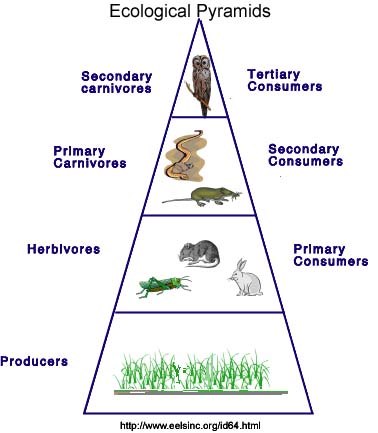
In this Food Web Pyramid what is the proper name for the organisms above the producer level at the bottom.
a)
herbivores
b)
consumers
c)
carnivores 
d)
omnivores
13.
The direction of the flow of energy in a food web is represented by ___.
a)
Light bulbs
b)
Dotted Lines
c)
Arrows
d)
Bubbles
14.
Which organism in this food web is a carnivore?
a)
Mouse
b)
Grasshopper
c)
Green Plant
d)
Snake
15.
How much energy is available to be passed on to the next trophic level in an ecosystem?
a)
100%
b)
10%
c)
50%
d)
75%
16.
The largest group of organisms found in a food web would be:
a)
Primary Consumers
b)
Producers
c)
Decomposers
d)
Tertiary Consumers
17.
What do you call a period of rapid growth?
a)
exponential growth
b)
logistic growth
c)
emigration
d)
predator-prey cycle
18.
Which type of growth is best illustrated by this rabbit population?
a)
exponential
b)
logistic
c)
S-shaped
d)
predator-prey
19.
Why has the population been able to grow so quickly in such a short period of time?
a)
Doctors have developed easier and safer ways to have babies
b)
People needed more help to work their farms so they had more children
c)
Because people stayed in one place and only moved when crowded out
d)
Because of medical care, clean water and better access to nutritious food
20.
The number of deaths compared to the total number of people in a population
a)
death rate
b)
doubling time
c)
population decline
d)
birth rate
21.
Which of the following is NOT a challenge to a growing population?
a)
Overcrowding
b)
Housing shortages
c)
Overuse of resources
d)
Increased food supplies
22.

As resources become less available the growth of a population

a)

slows or stops

b)

decreases or increases

c)

up or down

d)

in or out

23.

Exponential Growth occurs when-

a)

populations have plenty of food/space

b)

home to keystone species

c)

have few evasive species in a habitat

d)

have little to no competition or predators

24.

Three factors can affect population size

a)

births, deaths, individuals leaves or enters population

b)

deaths, birth, buildings

c)

photosynthesis, weather, deaths

d)

houses, weather, heath

25.
What are the effects of deforestation ?
a)
loss of habitat
b)
increased green house gasses 
c)
soil erosion and flooding
d)
all of the above