wayground logo

Free Printable Worksheets

NEW

Font size

S
M
L
XL
Worksheets

Specific Latent Heat and Gas law

Total questions: 50

Worksheet time: 2hrs 40mins

Name
Class
Date
1.
Boyle's Law shows the relationship between between which two factors of a gas?
a)
volume and pressure 
b)
temperature and pressure 
c)
pressure and temperature 
d)
Volume and mass
2.
Charles's law shows the relationship between which two factors of a gas ?
a)
volume and temperature 
b)
volume and pressure 
c)
pressure and volume
d)
volume and mass
3.
Directly proportional means that as one value increases ....................
a)
the other stays the same 
b)
the other increases as well
c)
the other decereases
d)
the other goes to zero
4.
Inversely proportional means as one value increases the other............. 
a)
increases 
b)
decreases 
c)
stays the same 
d)
goes to zero
5.
Boyle's law shows the volume and pressure of a gas are always ........
a)
inversely proportional 
b)
directly proportional 
6.
Charles's law shows that the temperature and volume of a gas are always........
a)
inversely proportional 
b)
directly proportional 
7.
Temperature describes  the ______________ of particles.
a)
volume
b)
mass
c)
motion
d)
conductivity
8.
When a basketball is left outside in the cold it goes flat because the volume of air inside the ball has been reduced. What  gas law does this represent?
a)
Boyle's Law
b)
Charles's Law
9.
If you push down the plunger of a bicycle pump the chamber's volume is decreased. When that happens pressure in the chamber increases and the air then rushes out of the pump and into your flat tire. What gas law does this represent?
a)
Charles's law
b)
Boyle's law
c)
Newtons laws
d)
Coulombs laws
10.
a)
this is a graph representing Boyle's law
b)
this is a graph representing Charles's law
11.
In order to convert to Kelvin, you add ______ to the Celsius measurement.
a)
372
b)
273
c)
237
d)
732
12.
What is 50 C in Kelvin?
a)
223
b)
323
c)
100
d)
50
13.
100 degrees Celsius is equal to _______ Kelvin. 
a)
0 K
b)
273 K
c)
173 K
d)
373 K
14.
If a balloon is cooled what will happen to the volume?
a)
Volume will increase
b)
Volume will decrease
c)
Volume will not change
15.
In Charles' Law the pressure remains constant.
a)
True
b)
False
16.
What is the formula for Boyle's Law?
a)
P1V1=P2V2
b)
P1V1/P2V2
c)
P1V2=P2V1
d)
P1/V1=P2/V2
17.
When Pressure increases then the Volume must...
a)
Increase
b)
decrease
18.
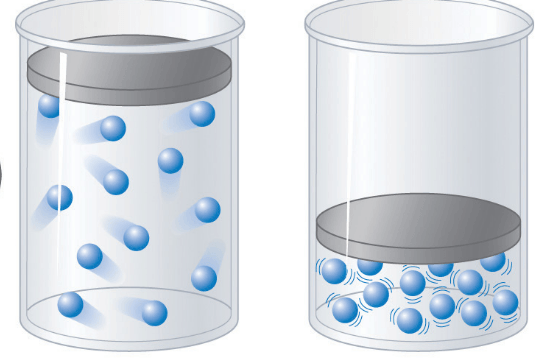
Which container will have a lower pressure?
a)
left
b)
right
c)
they both have the same pressure
d)
I don't know
19.
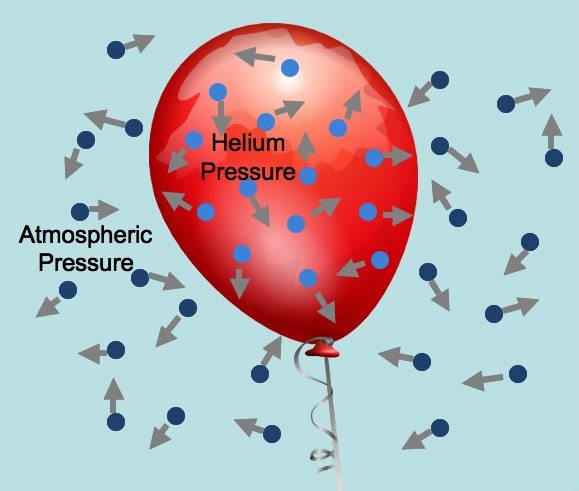
What causes pressure?
a)
The walls of the container
b)
The vacuum in the container
c)
The collisions of the particles
d)
Atmospheric pressure acting on the outside walls
20.
Boyle's law : When _______ is held constant, the pressure and volume of a gas are ________  proportional
a)
temperature,  equally
b)
mass, inversely
c)
temperature, inversely
d)
mass, equally
21.
What is the formula Charles' Law?
a)
V = T
b)
VT = VT
c)
T1 / V1 = T2 / V2
d)
V1 / T1 = V2 / T2
22.
Gas laws involve what three variables?
a)
Solid Liquid Gas 
b)
Speed Velocity Acceleration 
c)
Elements Compounds Mixtures 
d)
Pressure Temperature Volume 
23.
If you increase the pressure, what will happen to the temperature, if volume is constant?
a)
Increase
b)
Decrease
c)
Stay the same
d)
It will Blow Up
24.
If 6L of gas at 293K is compressed to 4L, what is the new temperature? 
a)
195K
b)
439.5K
c)
0.082K
d)
12.2K
25.
Using Combined Gas Law, if the pressure of a gas starts out at 200kPa and increases to 600kPa, what would the initial temperature be if it ended up at 300K?
a)
50K
b)
200K
c)
400K
d)
100K
26.
At higher temperatures...
a)
particles in an object have less energy
b)
particles in an object move faster
c)
a gas contracts
27.
Which of the following do the units need to be converted to be used in gas law equations
a)
Temperature
b)
Volume
c)
Pressure
d)
moles
28.
A gas has a volume of 3L at 200 kPa. What will its volume be if the pressure is changed to 500 kPa?
a)
1.0L
b)
1.2L
c)
2.0L
d)
7.5L
29.
A gas has a volume of 4.0 L at 5.0 atm. What will be the volume at 2.0 atm?
a)
10L
b)
15L
c)
20L
d)
24L
30.
A gas has a volume of 4 liters at 500K. What will its volume be (in liters) at 300K?
a)
1.4L
b)
1.8L
c)
2.0L
d)
2.4L
31.
A gas has a volume of 5.0L at 350K. If the volume changes to 4.0L, what is the new temperature?
a)
220K
b)
280K
c)
310K
d)
360K
32.
A gas has a pressure of 2 atm at 400K. If the temperature changes to 200K, what is the new pressure be?
a)
0.5atm
b)
1.0atm
c)
2.5atm
d)
3.0atm
33.
If you increase the pressure the temperture will
a)
Not be affected
b)
Increase
c)
Decrease
d)
You can't change the pressure
34.
A gas has a volume of 5 liters at 3 atm. To expand the volume to 6L, what the new pressure ( in atm ) have to be?
a)
0.5atm
b)
1.5atm
c)
2.5atm
d)
3.0atm
35.
Which of the following would increase the (gas) pressure of a system?
a)
Increase the Temperature
b)
Pump in more gas
c)
Decrease the volume
d)
All of these
36.

There are four main processes in changing of phase, and they are

a)

Melting

b)

Boiling

c)

Condensation

d)

All the above

37.

Latent heat is

a)

the heat absorbed or released at a boiling process during a change of phase

b)

the heat absorbed or released at a constant temperature during a change of phase

c)

the heat absorbed or released at a constant temperature during a change of phase of 1 kg object

d)

the heat absorbed or released by an object to increase or decrease its temperature by 1 degree Celcius

38.

The heat absorbed by melting a solid is known as

a)

latent heat of fusion

b)

latent heat of solid

c)

latent heat of liquid

d)

latent heat of vaporisation

39.

the symbol for specific latent heat is

a)

c

b)

ll

c)

Q

d)

m

40.

What is the formula to calculate specific latent heat of vaporisation?

a)

l=Qml=\frac{Q}{m}

b)

c = Q/(mΔƟ)

c)

Q = mcΔƟ

d)

Q=mlQ=ml

41.

The graph shows the cooling curve of a substance. At which stages the specific latent heat released?

a)

AB and CD

b)

BC and DE

c)

AB and EF

d)

BC and CD

42.

How much energy is required to freeze 150 g of water?
 [lv=2260000 J kg1; lf=334000 J kg1]\left[l_v=2260000\ J\ kg^{-1};\ l_f=334000\ J\ kg^{-1}\right]  

a)

50 100 cal

b)

339 000 J

c)

339 000 cal

d)

50 100 J

43.

How much energy is required to change 5 kg of ice at 0  °\degree C into water at the same temperature? (latent heat of fusion is 3.36 X 10610^6 J/kg )

a)

16.1 X 10^6 J

b)

16.8 X 10^6 J

c)

15.1 X 10^6 cal

d)

16.8 X 10^6 cal

44.

How much energy is required to melt down a 2000 g of mercury?(latent heat of fusion is 1.14 x  10410^4 J/kg)

a)

2.55   10^4 J

b)

2.28  10^4 J

c)

2,280  10^4 J

d)

3.28   10^4 J

45.

How much energy is required to change 2600 g of water at 100 °\degree C into steam temperature? (latent heat of vaporization is 2.26 x 10610^6 

a)

Q = 5.9 X 10610^6  J

b)

M = 5.9 X 10^6  J

c)

C = 5.9 X 10^6  J

d)

 Δ\Delta T = 5.9 X 10^6  J

46.

specific latent heat of vaporisation is

a)

the amount of heat required to change 1 kg of the substance from the solid to liquid phase without change in temperature

b)

the amount of heat required to change 1 kg of the substance from the liquid to gaseous phase without change in temperature

c)

the amount of heat required to change the temperature 1 kg of the substance by 1 degree Celcius

47.

Name the process at QR

a)

melting

b)

boiling

c)

condensation

d)

freezing

48.

Which molecules arrangement shows the stronger molecular bonds?

a)
b)
c)
49.

S.I unit for specific latent heat is

a)

J kg-1

b)

J kg-1 oC-1

50.

Latent heat absorbed during melting and boiling does not increase the average kinetic energy of the molecules

a)

True

b)

False