
 Worksheets
P4 Review SA 1
Total questions: 45
Worksheet time: 2hrs 33mins

If Sally is speeding through the parking lot at 18 m/hr, and she travels 9 m, how long did it take her?
2 m/hr
0.5 hr
2 m
0.5 m

If Emma is running for 8 minutes at 2 miles/min, how far did she run?
4 miles
16 min
16 miles
0.5 min

If Harry drives 4 miles in 2 minutes, what was his speed?
0.5 miles/min
2 miles/min
2 min/m
0.5 min/m
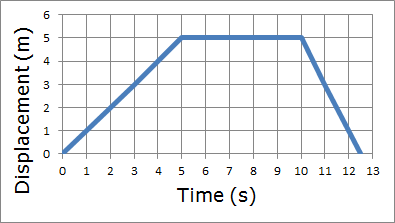

The position of a car near a traffic light changes with time. The distance of the car measured from the traffic light is shown graphically. How do you know that A to B had a faster constant speed than C to D?
It was frist
The AB line was steeper
The CD line was curved
A to B and C to D had the same speed.
What is the speed of the car in the first 50 seconds?
(a)
The position of a car near a traffic light changes with time. The distance of the car measured from the traffic light is shown graphic beside. What happened to the car from 10 seconds until 30 seconds?
(a)
Explain what could have caused it in 10 seconds until 30 seconds.
(a)

A student conducted an investigation with four objects rolling down a ramp. Which object rolled the fastest?
Object A
Object B
Object C
Object D

The graph above shows the motion of a student riding a bike. When did the speed of the bike increase the most?
between seconds 1 and 2
between seconds 3 and 4
between seconds 6 and 7
between seconds 9 and 10
What is necessary to determine the speed of an object?
the mass and volume of the object
the shape of the object and the distance it moved
the mass of the object and the time it took to move
the distance moved by the object and the time it took to move
Which most affects a baseball’s motion when it is hit by a batter?
the mass of the batter and how high the ball was thrown
the mass of the batter and how fast the ball was thrown
the angle of the baseball and how hard the batter hits it
the mass of the baseball and how hard the batter hits it
Mr. Sufi runs a 400 m race with a speed of 4 m/s. What time will it take him to finish the race?
100 seconds
396 seconds
404 seconds
1600 seconds
Mr. Totok runs at 10 m/min for 5 min, what distance will he run?
2 meters
5 meters
15 meters
50 meters
A boat travels at 22 km/hr for 10 hrs, the distance it will travel is (a) km
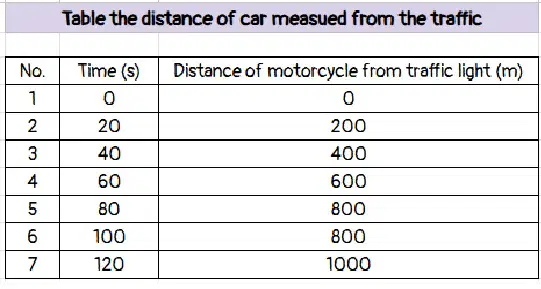
The position of a motorcycle near a traffic light changes with time. The distance of motorcycle measured from the traffic light shown in the table below.

Draw the table based on table above
Condensation
The process by which moisture in the air changes to liquid or solid form.
The change of water from one state to another as it moves between Earth’s surface and the atmosphere.
The process of changing a liquid into a gas.
Water that falls to Earth’s surface as rain, snow, sleet or hail.
Evaporation
The change of water from one state to another as it moves between Earth’s surface and the atmosphere.
The process by which moisture in the air changes to liquid or solid form.
The process of changing a liquid into a gas.
Water that falls to Earth’s surface as rain, snow, sleet or hail.
Freeze
The temperature at which a substance changes from a liquid to a gas.
To change from a liquid to a solid when temperature drops.
The temperature at which a substance changes from a liquid to a solid.
The point (temperature) at which a solid changes to a liquid.


What change of state is taking place in this photograph?
Condensation
Freezing
Vaporization
Melting

The diagram shows the changes in state of water (H2O). What is the process Z called?
Condensation
Freezing
Vaporization
Melting
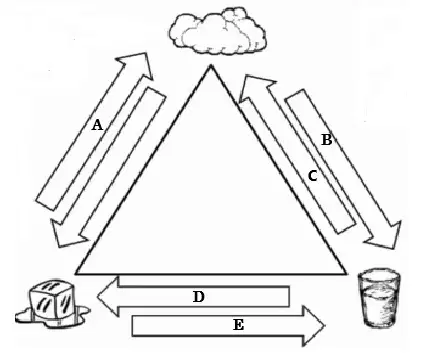
Identify what is the process A, B, C, D, and E.
(a)
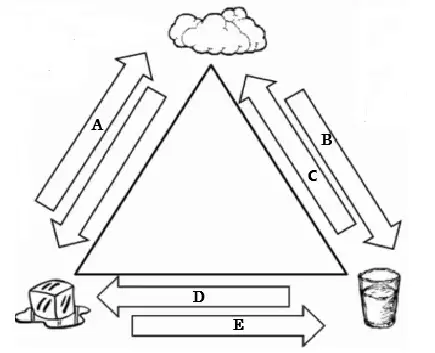
Does water gain heat or lose heat during processes C and D?
(a)
Give 3 ways in which you can use solids, liquids, and gases at home and in school safely.
(a)
A resource is considered renewable if it -
can be created only over millions of years
is made of Earths’ materials like rocks and minerals
can be replaced in a relatively short amount of time
is useful to humans in making energy and materials
Which of the following is a non-renewable resource?
Paper
Coal
Milk
Water
Fossil fuels form when organic matter is buried and then exposed to heat and pressure for millions of years. Fossil fuels are classified as nonrenewable resources because they –
take a long time to form
are used to produce heat
form from organic matter
can be found underground
Using a plastic soda bottle after it is melted down to make jacket stuffing, is an example of ___.
reduce
reuse
recycle
What can you conclude from the fact that lots of research is being done into wind and solar energy?
In the future, these technologies may be far more sophisticated and efficient
We don't really know how solar and wind energy can be used to produce electricity
These technologies are too complicated to be widely used
These technologies will someday be more expensive
Which of the following is the most sensible way to conserve natural resources?
Stop using electricity entirely.
Bike or walk to school instead of taking a gasolinepowered car.
Don't use any products made from trees.
Never ride in a car

How does recycling conserve natural resources?
It allows us to re-use products instead of manufacturing new ones
It prevents garbage from being burned.
It saves on the amount of fuel used by garbage trucks.
.It saves on the amount of plastic used to manufacture garbage bags.

Why is wind energy considered a renewable resource?
It can be found in a variety of places
It costs little to harness
The wind can blow incredibly fast
It's unlikely that we'll run out of wind.

Oil, coal, and natural gas are considered __________ ___________ because it takes millions of years for them to form.
nonrenewable resources
renewable resources
energy resources
very expensive
Which of the following is NOT a natural resource?
Electricity
Crops
Uranium
We dig metal out of the Earth to make steel for buildingsand automobiles. Metal is a nonrenewable resource.
True
False

