
 Worksheets
Atomic Physics-Unit 1
Total questions: 51
Worksheet time: 17mins
what is atom?
A Smallest Particles
Biggest Particle
Proton
Object
1. What is meant by matter?
Anything that occupies space.
Anything that occupies space and has weight.
What are the three basic physical states in which matter can exist?
Solid, liquid, and gas.
solid, rock, liquid.
liquid, solid, air
What is meant by pressure?
Mass over a given area.
Force that acts on a unit of area.
It is concerned with the structure and properties of the atom.
Nuclear Physics
Plasma Physics
Atomic Physics
Astro Physics
Physics is the branch of ?
Commerce
Science
Arts
Sports
What is the name of the particles of light?
protons
photons
atomic particles
infrared
Subatomic particles with a negative charge
Electrons
Neutrons
Protons
Quarks
The measurement of e/m was possible because of an instrument made by?
JJ Thomson
. J Perrin
Edison
Bohr
The e/m value of electrons comes out to be
×10−11
×1019
×10−19
By Magnetic field Cathode rays are deflected in
Straight Path
Circular Path
Curved Path
Round Path
The e/m of electron as compared to positive rays is
equal
greater
smaller
medium
The cathode ray experiment was done for the first time by
J.J. Thomson
John Dalton
Goldstein
Rutherford
The charge on an electron is
1.6 x 10⁻⁶ coulombs
1.6 x 10⁻²⁰ coulombs
1.6 x 10⁻¹⁹ coulombs
1.6 x 10⁻¹⁶ coulomb
Mass spectrometers are used to determine which of the following?
Composition in sample
Concentration of elements in sample
Relative mass of atoms
Properties of sample
The Charge of Cathode Ray is
Positive
Negative
Neutral
None of the Above
The charge of Positive rays is
Negative
Positive
Neutral
None of the above
the diameter of discharge tube is
4 cm
0.1 m
50 cm
6 cm
The length of the discharge tube is
50 cm
10 cm
60 m
4 cm
a simple and convenient device used to study the conduction of electricity through gases is known as
spectrometer
Strong glass tube
Gas discharge tube
None of the above
At normal temperature and pressure,
the gases are
Good insulators of electricity.
Good Conductor of electricity
semiconductor
none of the above
We can make a gas conduction
By Applying very High Voltage
By applying very low voltage
by reducing voltage
None of the above
Positive rays also known as
Canal Ray
cathode ray
x-ray
gamma ray
Positive rays are sometimes known as the canal rays. These were discovered in---------by Goldstein.
1886
1896
1869
1879
When potential difference is applied across the electrodes, electrons are emitted from
Anode
Cathode
between cathode and anode
None of the above
The stream of positive ions are called
Positive rays or canal rays
Cathode rays
negative rays
none of the above
the specific charge on electron is
me1.7×1011 Ckg−1
1.7×10⁻¹¹ Ckg−1
1.6×10¹¹ Ckg−1
1.6×10⁻¹¹ Ckg−1
The positive rays can Produce
Mechanical Effect
Chemical Effect
Mechanical as well as chemical effect
None of the above
In Thomson parabola method, the cathode is cooled by the
Water jacket
Strong Magnet
Gas
None of the above
A liquid trap T helps to keep the pressure in
Highly evacuated camera quite low
Highly evacuated camera very high
Discharge tube
None of the above
when no electric and magnetic field is applied, the positive ions strikes the screen O is called
Deflected spot
Undeflected spot
Scattering
None of the above
The first accurate determination of the masses of individual atoms was made in
1919
1887
1886
None of the above
The first accurate determination of the masses of individual atoms was made by
Aston
Thomson
Goldstein
None of the above
Aston used a different arrangement of electric and magnetic fields. Is it true or false?
True
False
May be
None of the above
Which one of the following statement is true?
To produce clearer photographs by Aston Mass spectrograph
To produce clearer photographs by Thomson method
None of the above
Aston mass spectrograph is more accurate than Thomson's parabola apparatus. Is it true or false?
true
false
may be
none of the above
when the pressure of gas in discharge tube is reduced to the order of 10mm of Hg, a luminous column formed from
Cathode to Anode
Anode to cathode
between cathode and Anode
None of the above
the positive column is disappears, when the pressure reaches to around
0.01 mm of Hg
0.5 mm of Hg
0.1 m of Hg
None of the above

Electric charges are created ______.
by gravitational forces.
separately.
between 2 oppositely charged objects.
by neutrons.
How can a neutral object become charged?
by being dipped in water
by being stuck to the desk with tape
by allowing gravity to work on it
by having electrons added or removed

Which statement best describes the electric fields in the image?
The charges are neutral.
Both charges are negative, so the field lines are alike.
The field lines move toward a positive charge and away from a negative charge.
The field lines move away from a positive charge and toward a negative charge.
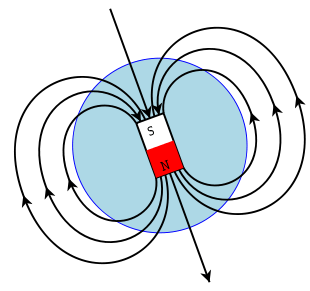
The area of magnetic force around a magnet is known as its _____________.
magnetic field
magnetic declination
magnetic fan lines
magnetic tan lines
What did jj thomson discover
proton
nucleus
electron
neutron
What was the year jj thomson discovered the atom
1897
1800
1913
1911

