wayground logo

Free Printable Worksheets

NEW

Font size

S
M
L
XL
Worksheets

5.6 analysing sound Waves F4

Total questions: 68

Worksheet time: 17hrs 0mins

Name
Class
Date
1.

What might happen to an object sitting on top of a speaker if loud music is played through the speaker?

a)

Absolutely nothing would happen to the object.

b)

The object could move due to the vibrations of the sound.

c)

The object could appear a different color because the sound is absorbed.

d)

The object could stop the sound from being transmitted out of the speaker because sound cannot travel through a solid.

2.

How does sound travel?

a)

in waves

b)

only through the air

c)

through magnets

d)

as thermal energy

3.

Sound waves can travel through all three states of matter. Which of the following best explains why sound travels most quickly through a solid?

a)

Solids always produce an echo, which makes the sound seem louder to the human ear.

b)

Only solids allow the vibrations to travel from one atom (particle) to another.

c)

In solids, the atoms (particles) are closest together, which allows the vibrations to travel rapidly from one to another through the object.

d)

Sound does not travel quickly through a solid. It travels most rapidly through a gas.

4.

Why can't sound travel through outer space?

a)

There is almost no matter in outer space, so the vibrations have no way to travel through the atmosphere. There is nothing to carry the sound waves through space.

b)

Sound actually travels very quickly through outer space because there is no matter to slow down the sound waves.

c)

There are too many planets and stars in outer space that absorb all of the sound waves, so they cannot travel to the human ear.

d)

Because outer space is a "vacuum," the vibrations are irregular and travel in too many directions for us to detect the sound.

5.

Which of these waves would produce a high pitch sound?

a)

Low frequency wave

b)

High frequency wave

6.

If you pluck a guitar string, it vibrates and creates a sound. In order to stop the sound, you could...

a)

blow on the string.

b)

pluck a different string.

c)

place your hand on the string to stop the vibration.

d)

pluck the same string again.

7.

What determines the pitch of a sound?

a)

The amount of energy used to create the vibration

b)

The wavelength of the sound wave.

c)

The volume of the sound.

d)

The frequency of the vibrations.

8.

If you pull a guitar string tighter, what will happen to the sound it creates?

a)

The pitch will become higher because the string will vibrate more quickly.

b)

The pitch will become lower because the string will vibrate more slowly.

c)

The sound will get louder because more energy will be in the string.

d)

The sound will get quieter because less energy will be in the string.

9.

A sound wave with low amplitude produces which type of sound?

a)

High

b)

Low

c)

Loud

d)

Soft

10.
travels through solids fastest because the molecules are closer together
a)
speed of sound
b)
wavelength
c)
frequency
d)
amplitude
11.
How high or low a sound is; depends on the frequency (greater frequency= higher pitch)
a)
pitch
b)
frequency
c)
sound
d)
medium
12.
A wave in which the vibration is in the same direction as that in which the wave is traveling; sound waves
a)
longitudinal wave
b)
ocean wave
c)
transverse wave
d)
mechanical wave
13.
The part of a longitudinal wave where the particles of the medium are close together.
a)
rarefaction
b)
compression
c)
crest
d)
trough
14.
A part in a longitudinal wave where the particles are spread apart
a)
compression
b)
rarefaction
c)
crest
d)
trough
15.
A reflected sound wave
a)
frequency
b)
pitch
c)
echo
d)
rarefaction
16.

The diagram shows a cartoon of a sound wave produced while a student is speaking.


What happens to the sound wave when the student speaks louder?

a)

The amplitude increases

b)

the wavelength will double

c)

the speed will increase

d)

the amplitude will decrease

17.

This diagram shows two different ways to represent longitudinal waves.


Which letter corresponds to rarefaction in the waves?

a)

Z

b)

X

c)

W

d)

Y

18.

What type of waves might experience rarefaction?

a)

rope rays

b)

x-rays

c)

Sound Waves

d)

infrared rays

19.

Two sound waves of different frequencies interfere and produce a resulting waveform shown with four points (W, X, Y, and Z) marked on the new wave.


At which point will the sound be the loudest ?

a)

W

b)

X

c)

Y

d)

Z

20.

The students in the diagram are communicating with the cans and string.


Which is the most likely explanation of how the students can hear and communicate using the objects?

a)

A Mechanical Wave transfers sound through the string

b)

sound bounces off the can and echoes

c)

sound travels through the string as an electromagnetic wave

d)

Transverse wave transfers sound through rope

21.

The diagram shows a research vessel using sonar to map the ocean floor.


Upon which basic behavior of sound waves does this technology depend?

a)

absorption

b)

compression

c)

reflection

d)

refraction

22.

Through which medium is it impossible to transmit sound waves?

a)

space

b)

rock

c)

air

d)

water

23.

A boy has a cork on his fishing line in a lake. His brother throws a rock in the lake near where he is fishing, and the waves created from the rock splashing cause the boy's cork to bob up and down for over a minute. What is the medium for the waves in this scenario?

a)

the cork

b)

the water

c)

the rock

d)

the fishing line

24.
Which feature of sound is determined by amplitude?
a)
Pitch
b)
Smoothness
c)
Loudness
25.
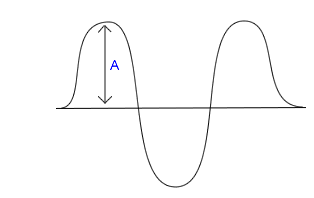
If the distance represented by the letter A (the amplitude) were increased, how would it change the sound?
a)
The sound would be higher. 
b)
The sound would be lower. 
c)
The sound would be softer. 
d)
The sound would be louder. 
26.
When a sound is louder what measurement gets bigger?
a)
Frequency 
b)
Amplitude 
c)
Wavelength 
d)
Crest
27.
What is something natural that Sound cannot travel through?
a)
Water
b)
Air
c)
Liquids
d)
outer Space
28.
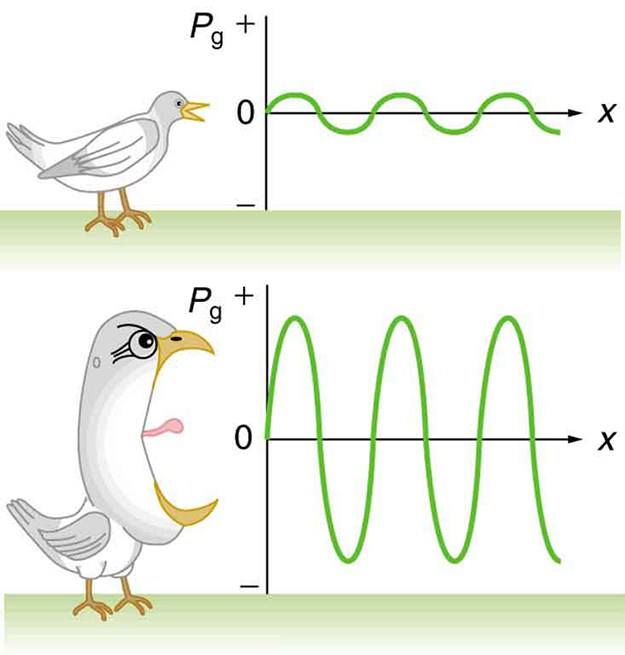
What is changed in the second picture?
a)
Someone is talking louder in picture 2
b)
Someone is talking softer in picture 2
c)
Someone is talking lower pitch in picture 2
d)
Someone is talking higher pitch in picture 2
29.
What is changed in the second picture?
a)
Someone is talking louder in picture 2
b)
Someone is talking softer in picture 2
c)
Someone is talking lower pitch in picture 2
d)
Someone is talking higher pitch in picture 2
30.
What is changed in the second picture?
a)
Someone is talking louder in picture 2
b)
Someone is talking softer in picture 2
c)
Someone is talking lower pitch in picture 2
d)
Someone is talking higher pitch in picture 2
31.

Sound waves travel as ________ waves.

a)

Transverse

b)

Longitudinal

c)

Surface

32.

Sound is made when a source of energy forces the matter to

a)

Vibrate

b)

Move

c)

Stay still

33.

A back-and-forth motion causing particles to move close together generates a ________.

a)

Rarefaction

b)

Surface wave

c)

Compression

34.

A rarefaction is generated when particles move

a)

Together

b)

Under

c)

Apart

35.

Which temperature causes sound to travel more slowly?

a)

Hot

b)

Cold

36.

The _______ of a wave increases with increased energy.

a)

Wave length

b)

Amplitude

37.

Loudness of waves is measured in

a)

Hertz

b)

Decibels

c)

Watts

38.

Frequency of waves is measured in

a)

Hertz

b)

Decibels

c)

Watts

39.

High frequency sounds have _______ pitch

a)

HIgh

b)

Low

40.
Sound is produced when something ______________
a)
Vibrates
b)
Moves through empty space
41.
High Amplitude =__________________
a)
Louder sounds
b)
Quieter Sounds
42.
Low Amplitude = ______________
a)
Quieter Sounds
b)
Louder sounds
43.
Low frequency = _______ Pitch
a)
Low
b)
High
44.
High frequency = _______ Pitch
a)
High
b)
Low
45.
In General Sound waves travel the slowest in __________
a)
solid
b)
liquid
c)
Gas
d)
Plasma
46.
In General Sound waves travel the fastest in __________
a)
solid
b)
liquid
c)
Gas
d)
plasma
47.
Which Wave produced the loudest sound?
a)
high Amplitude
b)
low Amplitude
48.
A sound is loud or soft depending on its ____________
a)
Amplitude
b)
Frequency
49.
A sounds high or low pitch depends on the waves ______________
a)
frequency
b)
amplitude
50.
You and your father inspect an empty house with the hopes of buying it. You walk through the rooms talking to one another, and you notice that your voices and footsteps are echoing in the big, empty house. What causes the echo?
a)
sound waves reflecting off smooth, flat surfaces throughout the house
b)
sound waves moving around the large rooms
c)
sound waves moving slowly through air
d)
sound waves refracting around corners in the empty rooms
51.
Cletus wants to make ear protectors for people who work around loud jet engines at Hartsfield Airport in Atlanta. Which of the following materials should he experiment with for the best results?
a)
a material that produces sound
b)
a material that absorbs sound
c)
a material that transmits sound
d)
a material that amplifies sound
52.
As the fire truck approached Mary, the pitch of the siren got higher. Once the fire truck passed and moved away, the siren's pitch got lower. This change in pitch is because of a change in the sound wave's
a)
concussion. 
b)
amplitude. 
c)
reflection.
d)
frequency. 
53.
After the train passed, the pitch of the train whistle became lower. This change in sound would be represented by what change in the diagram above? 
a)
The distance represented by C would increase. 
b)
The distance represented by C would decrease. 
c)
The distance represented by D would increase. 
d)
The distance represented by D would decrease. 
54.
Which of the following would you hear as a low pitched sound? 
a)
sound wave with a frequency of 50 Hz
b)
sound wave with frequency of 10,000 Hz
c)
sound wave with an intensity of 10 dB
d)
sound wave with an intensity of 100 dB
55.

Sound is produced by -----

a)

Heat energy

b)

Low temperatures

c)

Vibrations

d)

Friction

56.

True or False: Sound needs a medium.

a)

True

b)

False

57.

True or False: Sound waves are faster than light.

a)

False

b)

True

58.

Areas of increased pressure on a sound wave are known as a ----

a)

Rarefaction

b)

Compression

c)

Frequency

d)

Amplitude

59.

Spread out areas or areas of decreased pressure on a sound wave are known as a ---

a)

Rarefaction

b)

Amplitude

c)

Compression

d)

Hertz

60.

The measure of the amount of energy in a wave is ----

a)

Wavelength

b)

Hertz

c)

Frequency

d)

Amplitude

61.

Sound waves that are beyond the range of human ear are known as ----

a)

Infrasonic waves

b)

Ultrasonic waves

62.

Sonar and echolocation use ----- to detect objects under water.

a)

Refraction

b)

Reflection

63.
If you want to change the pitch of a sound, you have to change the ___
a)
frequency
b)
amplitude
c)
speed
d)
volume
64.
This is what you get when sound waves are reflected, or bounce back, off of a hard surface.
a)
Amplitude
b)
Pitch
c)
Volume
d)
Echo
65.
What is a pitch?
a)
highness or lowness of a sound
b)
the intensity of a vibration
c)
the amplitude of the sound wave
d)
volume of sound
66.

Bats use ________ to locate mosquitoes in the air.

a)

solar

b)

ecology

c)

echolocation

d)

refraction

67.
Why is the school library covered with carpet?
a)
So everyone can make a lot of noise
b)
to help absorb sounds to keep it quiet
c)
because it looks good
d)
to help absorb sounds so it can stay noisy
68.
What is B?
a)
crest
b)
trough
c)
compression
d)
rarefaction