
 Worksheets
Archimede's Principle, Density, and Temperature Conversion
Total questions: 31
Worksheet time: 2hrs 39mins
Name
Class
Date
1.
The upward force exerted by a liquid on an object immersed in or floating on the liquid
a)
pressure
b)
buoyant force
c)
normal force
d)
gravity
2.
The buoyant force on floating objects equals the weight of the floating object
a)
true
b)
false
3.
If an object weighing 50.0 N displaces a volume of water with a weight of 10.0 N, what is the buoyant force on the object?
a)
10 N
b)
60 N
c)
40 N
d)
20 N
4.
When the weight of an object is greater than the buoyant force, the object will ...
a)
Sink
b)
Float
c)
Expand
d)
Shrink
5.

Looking at the image... can oak float in water?
a)
Yes
b)
No
6.

What is the volume of Object X?
a)
10.0 cm3
b)
15.0 cm3
c)
20.0 cm3
d)
25.0 cm3
7.

Archimedes' Principle states that...
a)
The buoyant force acting on an object equals the volume of the fluid displaced by the object.
b)
The buoyant force acting on an object equals the weight (force of gravity) of the fluid displaced by the object.
c)
The buoyant force acting on an object will always be equal.
8.
What direction is the buoyant force in?
a)
Downward
b)
Left
c)
Right
d)
Upward
9.
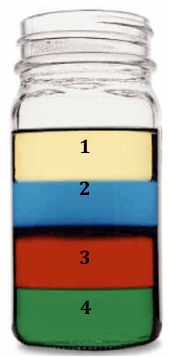
Put the liquids in order from most dense to least dense?
a)
4, 3, 2, 1
b)
1, 2, 3, 4
c)
3, 4, 2, 1,
d)
4, 3, 1, 2
10.
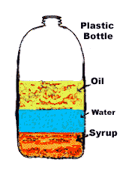
Which liquid is the least dense?
a)
oil
b)
water
c)
syrup
d)
plastic bottle
11.
What is the formula for density?
a)
density = mass x volume
b)
density = mass / volume
c)
density = mass + volume
d)
density = mass - volume
12.
Frank has an eraser. It has a mass of 4g, and a volume of 2cm3. What is its density?
a)
8 g/cm3
b)
2 g/cm3
c)
1/2 g/cm3
d)
24 g/cm3
13.
Jack has a rock. The rock has a mass of 14g and a volume of 2cm3. What is the density of the rock?
a)
7 mL
b)
7 g/cm3
c)
28 g/cm3
d)
1/7 g/cm3
14.

What is the volume of Object X?
a)
10.0 cm3
b)
15.0 cm3
c)
20.0 cm3
d)
25.0 cm3
15.
Frank has a paper clip. It has a mass of 9g and a volume of 3cm3. What is its density?
a)
3 g/cm3
b)
1/3 g/cm3
c)
27 g/cm3
d)
39 g/cm3
16.
Why do some substances float on water?
a)
they are warmer than water
b)
they are cooler than water
c)
they are more dense than water
d)
they are less dense than water
17.
Helium balloons rise on earth because
a)
helium is less dense than air
b)
helium is more dense than air
c)
helium is cooler than air
d)
helium is warmer than air
18.
What is the measuring unit for mass?
a)
centimeter
b)
millimeter
c)
grams
d)
pounds
19.
Which units of measurement are used for volume?
a)
grams
b)
centimeters
c)
grams/milliliter
d)
milliliter
20.
What units are used to measure Density?
a)
cm3/g
b)
g
c)
g/cm3
d)
cm3
21.
A crayon has a mass of 10g and volume of 5 mL. What is the density?
a)
30 g/mL
b)
15 g/mL
c)
1 g/mL
d)
2 g/mL
22.
What is the formula for Mass?
a)
Mass/Volume
b)
Density x Volume
c)
Mass/Density
23.
What is the formula for Volume?
a)
Mass/Volume
b)
Density x Volume
c)
Mass/Density
24.

Why do the liquids form different layers?
a)
They have different densities.
b)
They have different masses.
c)
They have different volumes.
d)
They are different temperatures.
25.
What units can be used to express density?
a)
g/mL
b)
grams
c)
millimeters
d)
milliliters
26.
What is the density of water?
a)
1g/cm3
b)
50 kg/cm3
c)
2g/cm3
d)
100g/ml
27.
Convert 35⁰F to Celsius (5/9 x (0F - 32))
a)
1.6⁰
b)
1.7⁰C
c)
2.0⁰
d)
16.6⁰C
28.
Convert 72⁰F to Celsius (5/9 x (0F - 32))
a)
2.2⁰C
b)
222⁰C
c)
22.2⁰C
d)
161.6⁰C
29.
Convert 99.6°F to Celsius (5/9 x (0F - 32))
a)
37.6°C
b)
37.5°C
c)
73.1°C
d)
375°C
30.
Convert 30°C to Fahrenheit (1.8 x 0C) + 32
a)
860°F
b)
86°F
c)
63.8°F
d)
56°F
31.
Convert 70°F to Kelvin, °C = 5/9 (°F-32), K = °C + 273
(hint: convert to Celsius, then Kelvin)
a)
325
b)
280
c)
7
d)
52
100 %

