wayground logo

Free Printable Worksheets

Font size

S
M
L
XL
Worksheets

Anatomy & Physiology BOY Quiz

Total questions: 70

Worksheet time: 46mins

Name
Class
Date
1.
The Esophagus is an organ that connects?
a)
The mouth to the stomach
b)
mouth to the small intestine
c)
stomach to the large intestine
2.
Digestion is when food is absorbed into the blood stream by? 
a)
villi
b)
stomach
c)
esophagus
d)
liver
3.
The large intestine is responsible for?
a)
absorption of water
b)
absorption of food
c)
making chyme
4.
Peristalsis is when?
a)
muscle contractions move the food along
b)
digestion begins
c)
stomach digests food
d)
muscle does nothing
5.
The Liver is responsible for?
a)
Store bile
b)
Produce bile
c)
creates enzymes
6.
The Gallbladder is an organ that?
a)
Stores bile
b)
Produce bile
c)
Creates enzymes
7.
A group of similar cells form____________.
a)
Organs
b)
Organ system
c)
Tissue
d)
Organism
8.
Which type of tissue is located in the trachea & fallopian tubes?
a)
Columnar epithelium 
b)
Ciliated epithelium 
c)
Stratified squamous epithelium 
d)
Cuboidal epithelium 
9.
 Loose connective tissue (areolar) is mainly located
a)
In the brain
b)
In the spinal chord 
c)
In the dermis of the skin
d)
In bones
10.
Which type of muscle is striated?
a)
Skeletal 
b)
Muscles in your throat 
c)
Nervous tissue 
d)
Smooth
11.
 The function of epithelial tissues is...
a)
Protection from cancer
b)
Movement of the body
c)
Lining of organs 
d)
Send information from one part of the body to another
12.
Dense connective tissue is mainly located in
a)
Bones      
b)
In the brain
c)
Ligaments/tendons
d)
None of the above
13.
Anatomy is the study of? 
a)
The "function" of body parts 
b)
The "structure" between body parts
14.
Physiology is the study of
a)
The "function" of the body parts
b)
The "structure" of the body and organs
15.

The human body is made up of 60-80% of this molecule?

a)

carbon dioxide

b)

glucose

c)

water

d)

oxygen

16.

What are the four macromolecules in the human body? (choose four answers)

a)

lipids

b)

nucleic acids

c)

proteins

d)

amino acids

e)

carbohydrates

17.

What is the correct order for the levels of organization in the body

a)

atom, molecule, macromolecule, cell, organelle, tissue, organ, organ system, organism

b)

atom, macromolecule, molecule, organelle, cell, tissue, organ, organ system, organism

c)

atom, molecule, macromolecule, organelle, cell, tissue, organ, organ system, organism

d)

atom, molecule, macromolecule, tissue, organelle, cell, organ, organ system, organism

18.

_________________ is a condition of a stable internal environment

a)

body composition

b)

gross anatomy

c)

homeostasis

d)

radiographic anatomy

e)

physiology

19.

The picture above is called ...

a)

Kidney

b)

Heart

c)

Liver

d)

Brain

20.

What part of human anatomy is it?

a)

brain

b)

leg

c)

mucles

d)

liver

21.

Ventral cavity that houses the lungs.

a)

Thoracic

b)

Abdominal

c)

Pelvic

d)

Cranial

22.

Lateral means what?

a)

To the right

b)

To the left

c)

To the side

d)

At the top

23.

Which plan divides the body into anterior and posterior?

a)

Coronal Plane

b)

Transverse Plane

c)

Sagital Plane

24.

Which plane divides the body into superior and inferior?

a)

Sagital

b)

Coronal

c)

Transverse

25.

Which plane divides the body into unequal left and right?

a)

Parasagital

b)

Midsagital

26.

Which cardinal plane is highlighted in green?

a)

Transverse

b)

Sagital

c)

Midsagital

d)

Coronal

27.

Which cardinal plane is highlighted in red?

a)

Parasagital

b)

Midsagital

c)

Coronal

d)

Transverse

28.

Which cardinal plane is represented in blue?

a)

Coronal

b)

Transverse

c)

Sagital

29.

What type of view is this?

a)

Midsagital

b)

Transverse

c)

Coronal

30.

Name this muscle

a)

Tricep

b)

Bicep

c)

Deltoid

d)

Trapezius

31.

Name this muscles

a)

Hamstrings

b)

Thighs

c)

Quads

d)

Glutes

32.

Name this muscle

a)

pectoralis major

b)

quadratus femoris

c)

trapezius

d)

triceps

33.

Name this muscle

a)

Adominals

b)

Obliques

c)

Glutes

d)

Quads

34.

Name this bone

a)

Tibia

b)

Femur

c)

Fibula

d)

Radius

35.

Name this bone

a)

Scapula

b)

Sternum

c)

Clavicle

d)

Mandible

36.

What is this action?

a)

Flexion

b)

Rotation

c)

Abduction

d)

Extension

37.

What is this action?

a)

Extension

b)

Flexion

c)

Circumduction

d)

plantar flexion

38.

What is the name of this joint?

a)

Hinge

b)

ball and socket

c)

condyloid

d)

Pivot

39.

What is the name of this joint at the elbow?

a)

Pivot

b)

Ball and socket

c)

Hinge

d)

Partially movable

40.

How many bones human skeletal system consists

a)

204

b)

209

c)

207

d)

206

41.

Average red blood cells produced each second by bone marrow________

a)

2.3 million

b)

2.8 million

c)

2.6 million

d)

2.5 million

42.

Coccyx is located which part of skeletal system?

a)

Head

b)

Neck

c)

Tailbone

d)

Fist

43.
The brain's "sensory switchboard":  directs sensory messages to proper area of the brain
a)
thalamus
b)
hypothalamus
c)
hippocampus
d)
reticular formation
44.
Carries messages between the body and the brain:
a)
cerebellum
b)
corpus callosum
c)
spinal cord
d)
special thalamus
45.
Known as the "Little brain" and is in charge of balance and coordinating movements:
a)
Thalamus
b)
Reticular Formation
c)
Hypothalamus
d)
Cerebellum
46.
Which letter on the illustration represents the frontal lobe
a)
A
b)
B
c)
C
d)
D
47.
The occipital lobe controls __________.
a)
Vision
b)
Problem Solving
c)
Memory 
d)
Arithmetic & Spelling
48.
The parietal lobe controls __________.
a)
Vision
b)
Problem Solving
c)
Memory
d)
Arithmetic & Spelling
49.
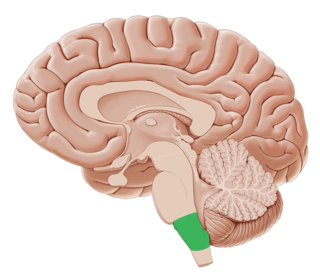
What is this?
a)
Pons
b)
Medulla Oblongata
c)
Cerebellum
d)
Hypothalamus
50.

What primary gas product is removed from your system during Exhalation?

a)

Air

b)

Oxygen

c)

Carbon Dioxide

d)

Carbon Monoxide

51.

Where the exchange of gases actually occur?

a)

Bronchi

b)

Trachea

c)

Oxygen

d)

Alveoli

52.

The tube that conveys air to and from the lungs; the windpipe

a)

Esophagus

b)

Bronchi

c)

Trachea

d)

Alveoli

53.

The thin skeletal muscle that sits at the base of the chest and separates the abdomen from the chest. It contracts and flattens when you inhale.

a)

Intercostal

b)

Diaphragm

c)

Epiglottis

d)

Larynx

54.

The "gate" that prevents food or fluid from entering the trachea.

a)

Pharynx

b)

Larynx

c)

Esophagus

d)

Epiglottis

55.
The process of stopping bleeding: vasoconstriction, platelet plug formation, blood clot formation
a)
hemostasis
b)
hemocytoblast
c)
hemopoeisis
56.
A type of clot that breaks lose and travels through the bloodstream. (dangerous!)
a)
thrombus
b)
platelet plug
c)
embolus
57.
BLOOD VESSELS that carry OXYGENATED blood AWAY from heart to rest of the body
a)
veins
b)
arteries
58.
TYPE of blood flow that cycles to the body tissues; allows for oxygen to be distributed to all the cells of the body.
a)
systemic circulation
b)
pulmonary circulation
59.
BLOOD VESSELS that allow for gas (O₂/ CO₂) and nutrient exchange.
a)
arteries
b)
arterioles
c)
veins
d)
capillaries
60.
TYPE of blood flow that cycles from the right ventricle to the lungs and back to the left atrium
a)
systemic circulation
b)
pulmonary circulation
61.
Blood vessels that carry blood back to the heart from lungs *but* they carry *OXYGENATED* blood.
a)
PULMONARY arteries
b)
aorta
c)
PULMONARY veins
d)
vena cava
62.
Blood vessels that carry blood away from the heart *but* they carry *DEOXYGENATED* blood.
a)
aorta
b)
PULMONARY veins
c)
vena cava
d)
PULMONARY arteries
63.
Largest artery in the body that carries blood from left ventricle to the rest of the body
a)
aorta
b)
vena cava
c)
PULMONARY veins
d)
PULMONARY arteries
64.
Receiving chambers of the heart; found in upper half of heart
a)
ventricles
b)
atria
65.
Lower chambers of the heart that are larger and more muscular in order to pump blood out of the heart
a)
septum
b)
atria
c)
ventricles
66.
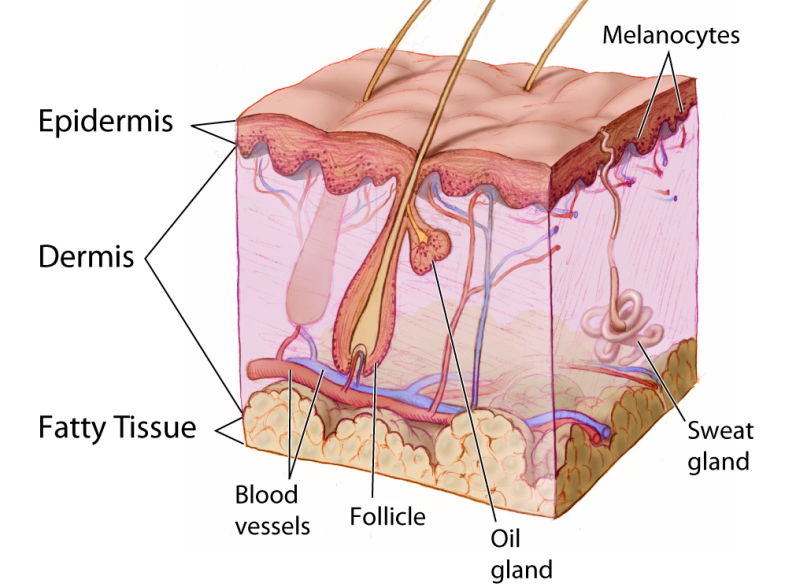
What is the outermost layer of the skin?
a)
Epidermis
b)
Dermis
c)
Subcutaneous
d)
fatty layer
67.
What are the three main layers of the skin?
a)
The epidermis, the dermis, and the subcutaneous
b)
The epidermis, the dermis, and the sebaceous
c)
The dermis, the sebaceous, and the sudoriferous
d)
The sudoriferous, the dermis, and the epidermis
68.
What gives your skin color
a)
Epidermis
b)
follicles
c)
dermis
d)
melanin
69.
Which is NOT a function of the skin?
a)
Insulation
b)
Movement
c)
Excretion
d)
Thermoregulation
70.
Which of the following is NOT part of the integumentary system?
a)
Skin
b)
Cartilage 
c)
Nails
d)
Hair