
 Worksheets
Review of Basic Chemistry for Biology
Total questions: 24
Worksheet time: 17mins
Name
Class
Date
1.
What charge do electrons have?
a)
positive
b)
negative
c)
neutral
2.
The atomic number of an elements is the total number of which particles in the nucleus?
a)
neutrons
b)
protons
c)
electrons
d)
protons and electrons
3.
Subatomic particle that determines the identity of the atom
a)
proton
b)
nucleus
c)
electron
d)
neutron
4.
The __________________ is the sum of the protons and the neutrons in an atom.
a)
Atomic Number
b)
Mass Number
c)
Protons
d)
Neutrons
5.
A covalent bond forms when
a)
Valence electrons are shared
b)
a sea of mobile electrons surround the cations
c)
valence electrons are shared between atoms
d)
none of the above
6.
Particles in an atom that are neutral and have no charge are
a)
negatrons
b)
electrons
c)
neutrons
d)
protons
7.
If the number of protons equal the number of _____, the atom will have no charge
a)
protons
b)
neutrons
c)
electrons
d)
nucleus
8.
What is the mass number?
a)
the number of protons
b)
the number of protons and neutrons
c)
the number of neutrons
d)
the number of protons and electrons
9.
Ions are:
a)
atoms with a positive or negative charge
b)
atoms with no charge
c)
atoms with ONLY a positive charge
d)
atoms with ONLY a negative charge
10.
What are the building blocks of MATTER?
a)
Atoms
b)
Cells
c)
Protons
d)
Neutrons
11.
A(n) ____________________ is a pure substance made of a single type of atom and cannot be broken down.
a)
Element
b)
Compound
c)
Molecule
d)
Mixture
12.
What holds atoms, molecules, and compounds together?
a)
Chemical Bonds
b)
Electromagnetism
c)
Magnetism
d)
Electricity
13.
A molecule is formed when two or more ____________ chemically join together.
a)
Atoms
b)
Compounds
c)
Mixtures
d)
Solutions
14.
Two atoms of the same element that have different numbers of neutrons are called
a)
ions
b)
isotopes
c)
isomers
d)
radioactive
15.

Ionic, covalent, van der Waals forces
a)
are types of atoms
b)
are compounds
c)
hold molecules and atoms together
d)
are of no consequence in life forms
16.

Most of the mass of the atom is contained in the nucleus, which subatomic particle is not in the nucleus and is responsible for chemical properties of atoms?
a)
proton
b)
electron
c)
neutron
d)
quark
17.

The unequal sharing of electrons in water makes water a polar molecule leading to the formation of
a)
nano bonds
b)
hydrostatic interactions
c)
molecular initiatives
d)
hydrogen bonds
18.
Which of the following statements is NOT true?
a)
Life depends on chemistry?
b)
Living things are composed of chemical compounds
c)
In order to understand biology, one must first understand the chemistry of life
d)
Chemistry and Biology are not intertwined.
19.
Ionic bonds share electrons
a)
true
b)
false
20.
Covalent Bonds share electrons
a)
True
b)
False
21.
Polar molecules are
a)
cold molecules
b)
ones where the charge is shared equally
c)
ones where the charge is not shared equally
d)
have the same degree of attraction
22.
Non-polar covalent bonds share electrons equally.
a)
True
b)
False
23.
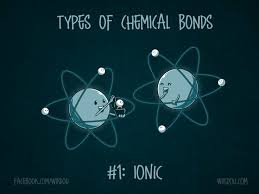
An ionic bond forms when
a)
Valence electrons are shared
b)
a sea of mobile electrons surround the cations
c)
valence electrons are transferred between atoms
d)
none of the above
24.
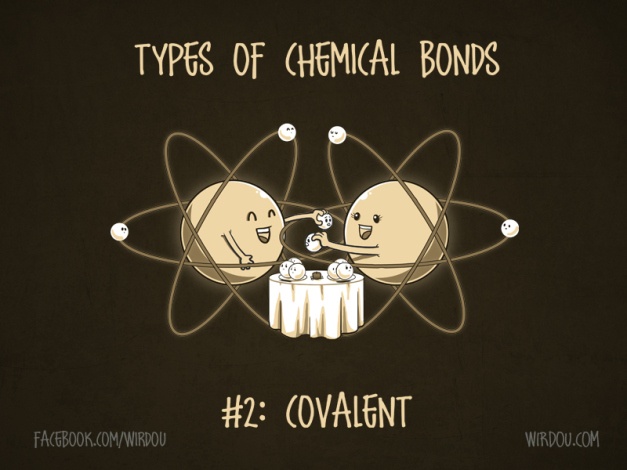
In chemical compounds, covalent bonds form when
a)
the electronegativity difference between two atoms is very large.
b)
electrons are completely transferred between two atoms.
c)
pairs of electrons are shared between two atoms.
d)
ions are held together by opposite charges.
100 %

