
 Worksheets
Motion and Speed - Ch 2
Total questions: 49
Worksheet time: 49mins
The tendency of an object to resist change in its motion
Net Force
Inertia
Balanced forces
Force
The sum of all forces acting on an object
Net Force
Inertia
Balanced forces
Force
A push or a pull exerted on an object
Net Force
Inertia
Balanced forces
Force
The net force acting on an object is zero
Net Force
Inertia
Balanced forces
Force
The rate of change in position at a given point in time.
Instantaneous speed
Velocity
Acceleration
Average speed
The speed of an object and the direction of its motion
Instantaneous speed
Velocity
Acceleration
Average speed
Rate of change of the velocity of an object
Instantaneous speed
Velocity
Acceleration
Average speed
The total distance that an object travels divided by the time of travel.
Instantaneous speed
Velocity
Acceleration
Average speed
Unequal forces pushing in opposite directions
Balanced forces
Force
Displacement
Unbalanced forces
The distance and direction an object moves from its starting point.
Balanced forces
Force
Displacement
Unbalanced forces
A graph with distance on the vertical axis and time on the horizontal axis
Slope
Distance
Distance-time graph
Displacement
The steepness of a line on a graph
Slope
Distance
Distance-time graph
Displacement
A measure of how far an object has moved
Slope
Distance
Distance-time graph
Displacement
The amount of matter in an object
Net force
Mass
Inertia
Force
An object that is neither speeding up nor slowing down travels at a/an. . .
Instantaneous speed
Constant Speed
Average Speed
Velocity
Which of the following is NOT used in calculating acceleration?
average speed
Time interval
final velocity
initial (beginning) velocity
Which one of the following would be a proper unit of acceleration?
cm/s
s/km2
km/h
m/s2
In which of the following conditions does the car NOT accelerate?
The car turns a corner
A car moves at 80 km/hr on a flat straight highway
A car speeds up from 35 km/hr to 80 km/hr
A car slows down from 80 km/hr to 35 km/hr
Which one of the following would have the greatest inertia
A car parked on the side of the road
A computer setting on a desk
A woman running on a track
A baseball during a pop fly

The horses on this carousel are accelerating because
the speed of the horse is constantly changing
the speed of the horses is constantly decreasing
the direction of the horses' motion is constantly changing
the travel time is different for every ride
Which answer best describes why a passenger who is not wearing a seat belt will likely hit the windshield in a head on collision?
gravity is taking over
forces acting on the windshield
inertia of the unbelted person
acceleration of the car


The graph represent the change in velocity of four cars over a period of time. Which line represents the car with the least amount of acceleration?
A
B
C
D

What does graph A show?
Positive Acceleration
Negative Acceleration
Zero Acceleration
High Acceleration
What does graph B show?
Positive Acceleration
Negative Acceleration
Zero Acceleration
High Acceleration
What does graph C show?
Positive Acceleration
Negative Acceleration
Zero Acceleration
High Acceleration


Which runner had a head start?
A
B
C
The law of inertia (Newton's first law) applies _____.
to moving objects only
only to objects that are not moving
to both moving and nonmoving objects
An object at rest stays at rest and an object in motion stays in motion with the same speed and in the same direction unless acted upon by a(n) ____________________.
unbalanced force
inertia
mass
balanced force
More mass = More inertia
True
False
Complete the excerpt of Newton's First Law of Motion
"An object in motion will ________ until it is acted on by an unbalanced force."
...stay in motion...
...stop its motion...
...increase its motion...
...decrease its motion...
Complete the excerpt of Newton's First Law of Motion
"...and an object at rest will ________ until acted on by an unbalanced force."
...stay at rest...
...start an increasing motion...
...start a decreasing motion...
Which has the MOST inertia?


A car travels 300 km in 6 hours. What is the average speed of the car (in km/hr)?
0.02 km/hr
1,800 km/hr
50 km/hr
50 km

A storm is moving toward your house at a speed of 20 km/hr. It is now 60 km away from your house. In what time will the storm reach your house?
0.3 hours
1200 hours
3 km
3 hours

A hot air balloon traveled 2.5 hours at a speed of 450 km/hr. What distance did it travel?
87 m/s
1300 m/s
180 km
1,125 km

If you are test-driving a Bugatti Veyron and you go from 0 km/s to 124 km/s in 3.7 seconds, what was your acceleration?
33.5 m/s2
0.03 m/s2
-33.5 m/s2
-0.03 m/s2

A marble rolling at 10 m/s slows to 2 m/s in 16 seconds. What is the acceleration of the marble?
0.5 m/s2
2 m/s2
-0.5 m/s2
-2 m/s2

A student travels 2 km in 30 minutes. The student then travels another 2 km in only 10 minutes. After that, the student rests.
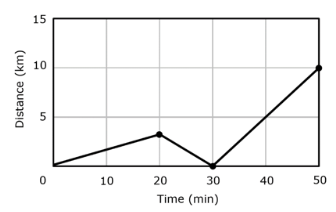
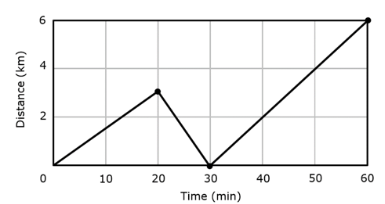
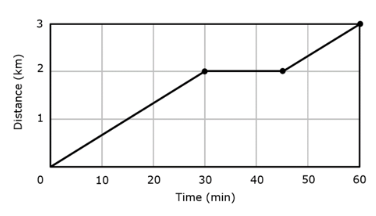
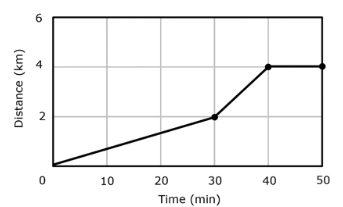
A boy rides his bike 3 km in 20 minutes. The boy then returns home in only 10 minutes to get his homework. He then travels 6 km in only 30 minutes.
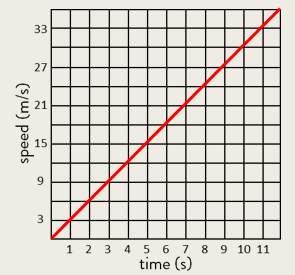
Accelerating gradually
Stopping
Slowing down constantly
Speeding up constantly

What is this graph showing?
Constantly slowing down
Constantly speeding up
Acceleration
Returning to starting point

