

Wayground logo

Free Printable Worksheets

Font size

S
M
L
XL
Worksheets

Practice Makes Perfect!

Total questions: 64

Worksheet time: 2hrs 25mins

Name
Class
Date
1.
A(n) ____________ is a special type of scientific investigation that is performed under controlled conditions.
a)
experiment
b)
lab
c)
inquiry
d)
hypothesis
2.
The more times that an experiment is repeated and the same results obtained, the more likely the results are _________. 
a)
better
b)
observed
c)
valid
d)
used
3.
This variable in an experiment is the one being deliberately changed by the scientist. 
a)
dependent variable
b)
independent variable
c)
data
d)
control group
4.
What step does every scientific experiment begin with?
a)
hypothesis
b)
question/problem
c)
procedures
d)
conclusion
5.
An experiment is performed on plants to see how different liquids affect plant growth. Each plant in the experiment is given a different liquid; water, apple juice, or milk. Each plant has the same amount of soil, sunlight, and listens to the same music. In this investigation, the independent variable is ...
a)
The type of plant
b)
The amount of sunlight
c)
The type of music
d)
The type of liquid
6.
The summary at the end of an experiment that explains the results. 
a)
conclusion
b)
procedures
c)
materials
d)
responding variable
7.
A student wants to test the effects of type of exercise on heart rate.  What is the dependent variable?
a)
heart rate
b)
type of exercise
c)
amount of exercise
d)
time of day exercise occurs
8.
An experiment is performed on plants to see how different liquids affect plant growth. Each plant in the experiment is given a different liquid; water, apple juice, or milk. Each plant has the same amount of soil, sunlight, and listens to the same music. In this investigation, what are the controlled variables?
a)
Type of plant, amount of music, and sunlight
b)
Water, apple juice, milk
c)
Plant growth
9.
Should experiments be repeated over and over to see if the results are the same each time?
a)
yes
b)
no
10.
When experimenting with the growth of a plant, a scientist uses three (of the same type of) plants, two different fertilizers, equal light, and equal water. What type of variable is the fertilizer?
a)
Dependent
b)
Independent
c)
Control
d)
Compound
11.
Research Question: Does the type of gasoline put in a car effect how fast the car can drive. What is the independent variable?
a)
Type of gasoline
b)
which car the gas is put into
c)
how fast the car can drive
d)
how much gas is put into the car
12.
Tiffany was investing how fast it took Hayden to react to different sounds. Identify the independent variable.
a)
How fast Hayden reacted
b)
different sounds
c)
types of music
d)
Hayden
13.
The independent variable is the ONE thing you _____.
a)
change
b)
keep the same
c)
experiment with
d)
investigate
14.
What are the three states of matter?
a)
solid, volume, mass
b)
density, volume, mass
c)
solid, liquid, gas
d)
density, gas, volume
15.
What part of the water cycle does this picture show?
a)
condensation
b)
precipitation
c)
evaporation
16.
What is it called when water is formed from a liquid to a water vapor?
a)
EVAPORATION
b)
PRECIPITATION
c)
TRANSPIRATION
17.
Is precipitation any form of water that falls back to earth?
a)
Yes
b)
No
18.
Solid, liquid or gas? Water
a)
solid
b)
liquid
c)
gas
19.
Solid, liquid or gas? Ice
a)
solid
b)
liquid
c)
gas
20.
Solid, liquid or gas? Water vapor
a)
solid
b)
liquid
c)
gas
21.
_____ keep their shape.
a)
Solids
b)
Liquids
c)
Gasses
22.
_____ take the shape of the container.
a)
Solids
b)
Liquids
c)
Gasses
23.
What is a solid?
a)
it keeps its shape and size
b)
it takes the shape of the container that holds it
c)
it has no shape, and spreads to fill the space they are in
d)
it changes with a temperature change
24.
What is an example of a solid?
a)
wind
b)
water
c)
rock
d)
juice
25.
What is an example of a liquid?
a)
ice cubes
b)
paper
c)
milk
d)
ballons
26.
What is an example of gas?
a)
crayons
b)
paper
c)
soda
d)
air
27.

Models are used to better understand a complex thing.

a)

True

b)

False

28.

All models have advantages and _______________. Even good models can often be made better.

a)

modeling clay

b)

wood structures

c)

disadvantages

d)

pictures

29.

Once a scientific model is made, scientists do not change it.

a)

true

b)

false

30.

In science, a model is a way to ____________ an idea, process, or system in order to describe, explain, or predict something.

a)

repeat

b)

represent

c)

ring

d)

roost

31.
A _____________________ is something that scientists use to represent an object or process
a)
mass
b)
matter
c)
model
d)
weight
32.
Sal is studying the solar system. He makes a physical model using different-sized foam balls to represent the planets. Which best describes why a physical model is a useful tool for studying the solar system?
a)
Solar system models can be used to study a system that is too big to study directly.
b)
A model of the solar system eliminates the need for scientists to study the solar system directly.
c)
A model of the solar system provides an exact replica of the actual solar system, so scientists can experience what each planet is like.
d)
A model of the solar system can provide more data about the solar system than direct observations.
33.

A tennis ball could be used to represent the sun because it's round and yellow. Which of the following could also be used to model the sun?

a)

a light bulb

b)

an empty cup

c)

an eraser

d)

a Kleenex box

34.
What is the advantage of creating a model of a dinosaur?
a)
they are too large to easily study 
b)
they are too complicated to study
c)
Real dinosaurs cannot be studied because they are extinct
d)
The model is safer to work with. 
35.

This is a picture of a Model that we will be learning about next! This model is called the "Atomic Model" It's a model of the ATOM. Do you think this model could change in the future if we make an even more powerful microscope?

a)

No - models never change

b)

Yes - models change with new information

36.

This picture shows a model of an ATOM (which is what we are learning NEXT). Why do you think we need to use a MODEL to study atoms?

a)

because Atoms are too small to see, so we need a model to study them

b)

because Atoms are too big to see. so we need a model to study them

c)

because scientists do not know what the atom looks like, so we make up a model to show what we THINK it looks like

37.
How many people have two or less books in their desk?
a)
4
b)
5
c)
6
d)
7
38.
How many people like either mushroom or pepperoni the best?
a)
1
b)
20
c)
50
d)
100
39.

How many students take the bus to school?

a)

35

b)

20

c)

10

d)

15

40.
What conclusion can you draw from this line graph?
a)
For the most part, the older the teenagers get, the more likely they are to have a cell phone.
b)
Older teens have less cell phones.
c)
People in their thirties have the least cell phones.
d)
No one should own a cell phone.
41.
Mr. Swanson's science class used a thermometer to measure the outside temperature each day throughout the school year.
They used their results to make the graph below.

Which month had an average daily temperature of around 41 degrees?
a)
May
b)
April
c)
December
d)
March
42.
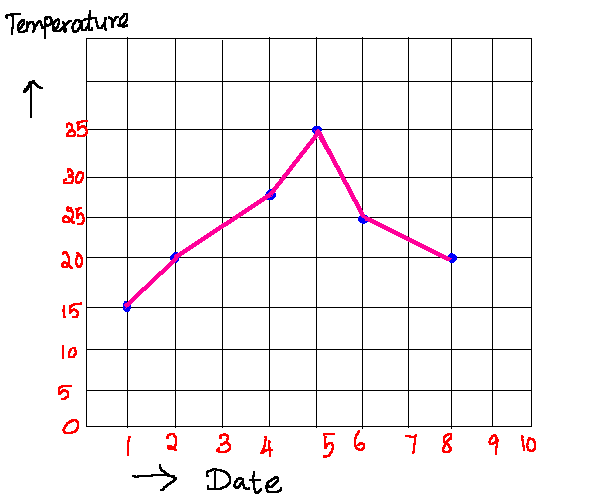
On which 2 days was the temperature the same?
a)
2 and 8
b)
1 and 6
c)
3 and 4
d)
5 and 8
43.
T8 - The Independent Variable is represented on which Axis?
a)
A
b)
X
c)
B
d)
Y
44.
The summary at the end of an experiment that explains the results. 
a)
conclusion
b)
procedures
c)
materials
d)
responding variable
45.

You want to make a graph for an experiment you did about plant growth over a two week period of time. What type of graph would you use?

a)

bar graph

b)

line graph

c)

pictograph

d)

pie chart

46.

What is an observation?

a)

Something you measure or detect with your senses.

b)

The way you feel about something

c)

An educated guess

d)

A theory that has been disproved

47.

Which of the following is NOT a testable question?

a)

How do rockets work?

b)

Does fertilizer help plants grow bigger?

c)

Does heart rate increase with exercise?

d)

Does the freezing point of water change at different elevations?

48.

What is a hypothesis?

a)

An educated prediction or answer to a testable question

b)

A random guess

c)

An observation based on feelings or emotions

d)
49.

An observation that is measurable and made with tools (such as a ruler or scale) is what type

a)

quantitative

b)

qualitative

c)

koalatative

50.

A series of steps designed to help you solve problems and answer questions is

a)

the scientific method

b)

results

c)

observations

d)

the two step

51.
The summary at the end of an experiment that explains the results. 
a)
conclusion
b)
procedures
c)
materials
d)
responding variable
52.
Dependent variable means
a)
the scientist controls what to test
b)
educated guess
c)
ask a question
d)
what is being measured
53.
If you increase the amount of spinach you eat, then you will increase the iron in your blood. 
What's the dependent variable?
a)
increase the amount of iron in your blood
b)
spinach you eat
54.
If I ride my bike to school instead of walking, then I will get to school faster. What is the dependent variable?
a)
True
b)
How fast you get to school
c)
Riding a bike or walking
d)
False
55.
Will a construction paper air plane fly faster than an airplane made from notebook paper? Choose the best hypothesis.
a)
If I make a paper airplane from notebook paper, then it will fly faster than construction paper.
b)
Yes.
c)
No.
d)
I think the construction paper air plane will fly faster.
56.
Which side of a penny will hold more drops of water? Choose the best hypothesis.
a)
If I use the heads side of a penny, then it will hold more drops of water than tails.
b)
Heads
c)
Tails
d)
Tails will hold more drops of water.
57.

Johnny had soccer practice and then swimming lessons. It was late when he got home so he went straight to bed without studying for his math test the next day. Make an inference based on the information above:

a)

Johnny will get a good grade.

b)

Johnny will ace the test.

c)

Johnny will probably fail his math test.

d)

Johnny will study during the test.

58.

Amber looks at the clock again. Still five more minutes! She is not sure she will make it. The seconds tick by. Finally, the bell rings! As her classmates head out the door for recess, Amber sprints down the hall. Make an inference based on the information above:

Where is Amber going?

a)

home

b)

to the office

c)

to the bathroom

59.
Mary smelled smoke. She looked outside and saw a plume of smoke billowing in the sky. A few minutes later, she heard sirens in her neighborhood. You can infer that.....
a)
Her mother was cooking dinner.
b)
A house in the neighborhood is on fire.
c)
Someone needed an ambulance.
d)
There was an accident in the neighborhood. 
60.

The sandwich you left on the table is gone. Crumbs lead to your dog's bed and a piece of meat hangs out of her mouth. You can infer that......

a)

Your mother threw the sandwich away.

b)

Your sister took your sandwich and ate it.

c)

Your cat ate your sandwich.

d)

Your dog ate your sandwich.

61.

Read the text.


"Please take your shoes off," Laura urged. Riley slid off her shoes and stepped into Laura's room. She looked at the orderly space, where everything matched, everything was in place, and everything was spotless.

Riley thought, I don't think Laura would like my room very much.


Based on the text, which sentence is more likely to be true?

a)

Laura rarely asks friends over.

b)

Riley's room is messy.

c)

Riley's room is clean.

62.
A scientist collected the following data on algal growth during an experiment:
Which of the following conclusions could be drawn from the data? 
a)
Algae multiply most rapidly at 35°C.
b)
Algae multiply most slowly at 20°C.
c)
Algae multiply most slowly at 10°C.
d)
Algae multiply most rapidly at 20°C.
63.

What does it mean to draw a conclusion?

a)

To take a random guess at something.

b)

To draw a good guess based on evidence and detail from a source, as well as your own personal experience.

c)

To draw a good guess based on the mood that you are in that day.

d)

To base a good guess on your own personal experience.

64.

Based on the cartoon, which is an appropriate conclusion that can be drawn?

a)

After analyzing the cartoon, I can assume that both dogs are really hungry.

b)

Based on my own experience with dogs, I can assume that they love doing math problems.

c)

After analyzing the cartoon, I can conclude that the bigger dog is basically stating that if anybody tries to take away his dog bones, then they will have consequences.

d)

Based on my own personal experience and evidence from the cartoon, I can assume that the dog thinks that fingers are also dog bones.
