wayground logo

Free Printable Worksheets

Font size

S
M
L
XL
Worksheets

Environmental Problems, Their Causes, and Sustainability

Total questions: 74

Worksheet time: 1hrs 27mins

Name
Class
Date
1.
Which of the following best describes what an ecologist might study?
a)
The effects of pesticides on bee populations
b)
The effects of high blood pressure on human populations
c)
Designing efficient combustion turbines for factories
d)
Identification of dinosaur bones
2.
Fossil fuels are classified as nonrenewable because they.......
a)
require expensive equipment
b)
take millions of years to replace
c)
can be found all over 
d)
provide all the energy we use
3.
Using resources in such a way that we continue living in a developed world, but at the same time we protect the environment. This is the definition of:
a)
Suspensability
b)
Ecology
c)
Sustainability
d)
Ecological precautions
4.
Sustainability refers to
a)
how many species are present in an ecosystem
b)
when a species goes extinct
c)
how long a species lives
d)
the ability to maintain ecological process over long periods of time.
5.
The California Condor population once dropped so low that there were only 8 individuals in the wild.  What term best describes their legal status at that time?
a)
Reduced
b)
Threatened
c)
Endangered
d)
Extinct
6.
What term is given by scientists to the living parts of an ecosystem?
a)
Biotic Factors
b)
Abiotic Factors
c)
Community
d)
Population
7.
Nonrenewable resources
a)
Solar, wind, geothermal
b)
There is an indefinite supply
c)
Coal, oil, natural gas, petroleum
d)
Made in only a few years
8.
Which of the following is considered an ecosystem service?
a)
The input of fertilizers for increased plant growth
b)
transplant of nonnative plants
c)
Filtration and purification of water within a river
d)
Organizing a community clean-up event to improve water quality
9.
The average American's ecological footprint is _________ than the citizens of most other countries.
a)
much smaller
b)
a little less
c)
more valuable
d)
larger
10.
Is solar energy a renewable or a non-renewable source of power?
a)
Renewable
b)
Non-renewable
c)
Half/Half of both
d)
Neither
11.
Which of the following human activities contribute to an increased green house effect?
a)
Harvesting energy from the sun.
b)
Deforestation
c)
Walking to work.
d)
Switching to geothermal powered electricity 
12.

The study of relationships between living organisms and the environment is known as

a)

Environmental Science

b)

Ecology

c)

Natural Capital

d)

Ecosystem

e)

Environmentalism

13.

All of the following are examples of sustainability EXCEPT

a)

Renewable Energy

b)

Green design.

c)

Water Conservation

d)

Climate Control

e)

Exponential growth

14.

A resource that can be replaced in a human lifetime is known as a

a)

Conservative resource

b)

Nonrenewable resource

c)

Important resource

d)

Renewable resource

e)

Sustainable resource

15.

ALL of the following are true of

nonrenewable resources EXCEPT

a)

Exist in a fixed quantity

b)

Can replenish over a short period of time due to geological processes

c)

Are depleted faster than they are replenished

d)

Include metallic minerals which can be recycled or reused

e)

Include energy resources such as coal which can be harvested with a sustainable yield

16.

Plants and trees can be cut down and replanted. These resources are therefore considered to be

a)

Renewable resources

b)

Nonrenewable resources

c)

Perpetual

d)

Exhaustible resources

e)

Sustainable

17.

The "Tragedy of the Commons" refers to the overuse of

a)

Free-access resources

b)

Government subsidies

c)

Privately owned resources

d)

Venture capital

e)

Corporate revenue 13A.

18.

All of the following are true with respect to pollutants EXCEPT

a)

They disrupt life-support systems for living organisms

b)

They can damage property

c)

They create nuisances within an environment

d)

They contribute to the balance within an ecosystem

e)

They can be a hazard to human health

19.
Anything from nature that living things use is called a ______________.
a)
energy
b)
pollution
c)
food
d)
natural resource
20.
When travelling short distances, you can conserve natural resources by ________.
a)
biking
b)
driving
c)
taking a train
d)
flying
21.
Only a small amount of _______ on Earth's surface can be used by humans.
a)
air
b)
water
c)
dirt
d)
sand
22.
Which are ways we use fossil fuels?
a)
eating and drinking
b)
drinking and bathing
c)
paper and building
d)
cars and heat
23.
Which is a way we can protect our natural resources?
a)
litter
b)
recycle
c)
pollute
d)
contaminate
24.
To protect natural resources, we must _______ them by not wasting them.
a)
conserve
b)
dispose
c)
stop
d)
hide
25.
Who uses natural resources?
a)
animals
b)
plants
c)
people
d)
all of the above
26.
A Fossil Fuel is
a)
Materials that are found on Earth that people use
b)
Rock that contains metal 
c)
Fuels that formed years ago from the remains of things that lived millions of years ago.
d)
Resources that cannot be replaced quickly enough to keep from running out. 
27.
Natural Resources are
a)
Materials that are found on Earth that people use. 
b)
Rocks that contain metal
c)
Resources that are continually being replaced and will not run out.
d)
Resources that cannot be replaced quickly enough to keep from running out. 
28.
Non renewable resources are
a)
Materials that are found on Earth that people use.
b)
Rock that contains metal
c)
Fuels that formed from the remains of things that lived millions of years ago
d)
Resources that cannot be replaced quickly enough to keep from running out. 
29.
Which is a Natural Resource
a)
Sunlight
b)
Computers
c)
Cars
d)
Roofs
30.
Which is NOT a natural resource
a)
Car
b)
Corn
c)
Cotton
d)
Dogs
31.
Which is a renewable Resource
a)
Coal
b)
Gasoline
c)
Ore
d)
Crops
32.
All of the following are nonrenewable resources EXCEPT
a)
Coal
b)
animals
c)
petroleum (oil)
d)
natural gas
33.
Which of the following means of transportation uses a renewable resource for its energy source?
a)
solar powered car
b)
coal powered steam train
c)
natural gas car
d)
gasoline truck
34.
A farmer decides that he is going to produce his own energy on the farm by using a type of renewable energy. The renewable energy could come from--
a)
setting up wind turbines
b)
having a coal furnace
c)
using natural gas
d)
burning oil
35.
Which of the following is a way a person could conserve natural resources?
a)
recycling waste materials like plastic, glass, paper, and aluminum
b)
limiting water use when showering, brushing teeth, and shaving
c)
using rechargeable batteries
d)
all of the above are good conservation practices
36.
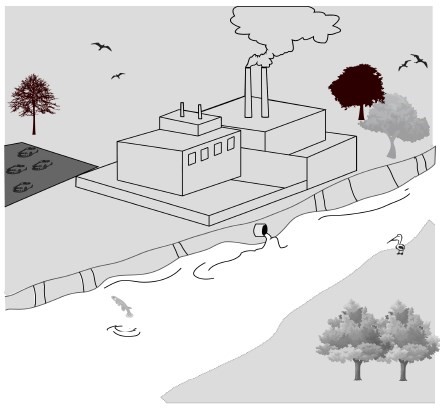
If the factory in this diagram was NOT practicing good environmental conservation, what effect would be produced?
a)
air and water pollution
b)
good fishing for recreation
c)
plentiful animals in the river
d)
purified drinking water
37.
A way the factory could help conserve the river water as a natural resource is to--
a)
filter the water before dumping into the river
b)
remove all of the animals from the area for their protection
c)
set up nets down river to remove contaminated fish
d)
post signs of "No swimming in the river"
38.
Which of the following natural resources are nonrenewable?
a)
Water
b)
Animals
c)
Natural gas
d)
Wind
39.
What does conserving resources mean?
a)
Use as much of the resources as you can
b)
Only use the resources at school
c)
Protecting the resource so it does not run out
40.
The Jones family cares about the environment. They run their dishwasher only when it is completely full. Which of the following BEST explains why they do this?
a)
To save money
b)
To recycle dish soap
c)
To reduce sewage
d)
To conserve water
41.

Claim: the consumption of natural resources by humans has a negative impact on the environment. What data would provide evidence for this claim?

a)

Increased human lifespan and increased ice cap size

b)

Increased human population and decreased habitats for plants and animals

c)

Increased consumption of resources by humans and increased biodiversity (variety) in nature

d)

Increased of fossil fuel burning by humans and decreased use of other resources

42.

Some factories that burn coal produce smoke with harmful chemicals, such as sulfur. Scrubbers are devices that are attached to the smokestacks to reduce the amount of sulfur put into the atmosphere. To evaluate the effectiveness of these devices, what data would need to be collected?

a)

The average amount of sulfur in a certain amount of coal

b)

The amount of coal a factory burns each year and how much sulfur it emits (produces)

c)

The increase in the use of scrubbers by factories that burn coal

d)

The amount of sulfur emitted (produced) by a smokestack before and after the scrubber is attached

43.

Ths graph presents data from a city showing the amount of land used to bury solid waste each year. From 1990 to 1999, the amount of space needed to bury waste increased by 1 to 2 square kilometers per year. In the year 2000, the city started a recycling program to slow the increase of land needed for this burying this solid waste. The city claims that since this recycling program started, the amount of land needed for burying solid waste has decreased.

Which evidence would support this claim?

a)

Data showing that by the year 2010, more than 40% of the citizens were participating in the recycling program

b)

Data showing that the land used for burying solid waste in 2010 was less than 22 square kilometers

c)

Data showing that by the year 2010, there was five times more solid waste being buried than being recycled

d)

Data showing that the land used to build a recycling facility is greater than the amount of land used to bury solid waste

44.

Claim: Carbon dioxide (CO2) emissions can be reduced by increasing the amount of electricity produced by wind.

Which pair of graphs, showing data for CO2 emissions and wind production of electricity would support this claim?

a)
b)
c)
d)
45.

As the human population increases, so does the consumption of natural resources. What are some ways this impacts natural ecosystems and environments?

a)

negative impact

b)

positive impact

c)

habitat loss

d)

environmental pollution

46.

What type of data would be required to show that the

amount of carbon dioxide emissions from the burning of fossil fuels for energy can be reduced by using

renewable resources?

a)

the amount of emissions from the burning of fossil fuels

b)

the amount of scrubbers on a smoke stack

c)

the amount of emissions from renewable sources

d)

the amount of renewable resources in a landfill

47.

Which cycle is shown in this diagram?

a)

Nitrogen

b)

Carbon

c)

Phosphorus

d)

Water

e)

Oxygen

48.

Which cycle is shown in this diagram?

a)

Nitrogen

b)

Carbon

c)

Phosphorus

d)

Water

e)

Oxygen

49.

Which cycle is shown in this diagram?

a)

Nitrogen

b)

Carbon

c)

Phosphorus

d)

Water

e)

Oxygen

50.

An autotroph

a)

is a self feeding organism that does photosynthesis

b)

Is an organism that eats other organisms for energy

c)

is the name for all bacteria

d)

is a being that eats meat only

51.

What are considered "the commons"

a)

Common house hold items like knifes, spoons, and forks.

b)

A renewable resource owned by no one and available for use by anyone at little or no charge

c)

A field where college students can sit outside in between classes

52.

Which of these is not an example of a commons?

a)

The air

b)

The ocean

c)

Privately owned farms

53.

The "Tragedy of The Commons" is...

a)

An economic issue where people do not have enough money to buy basic needs so they resort to stealing and breaking the law.

b)

A type of play where someone tragically dies or gets killed.

c)

Economic issue where individuals tend to take advantage of the natural resource and it becomes unavailable for everyone.

54.

What is overgrazing?

a)

When cows eat so much they get sick and throw up

b)

When a section of land is used for extended periods of time, or without sufficient recovery periods.

c)

When horses eat too much grass

55.

What is a negative consequence of overgrazing?

a)

vegetation or grass is damaged and the ground can no longer be used for feeding or agriculture.

b)

your animals cannot graze for one day

c)

your animals get sick

56.

What is overfishing?

a)

The removal of bad fish from a environment

b)

The removal of fish/ species of fish from a body of water at a rate that the species can not replenish in time.

c)

The removal of dead fish from a body of water

57.

What is one negative consequence oversfishing can lead to?

a)

Fish can grow two heads

b)

Fish species can adapt in order to escape fishermen

c)

Fish species can either become depleted or very underpopulated in that given area.

58.

True or False: "Tragedy of The Commons" also relates to people putting harmful producs into our waterways?

a)

TRUE

b)

FALSE

59.

TRUE or FALSE: Pollution in waterways does not affect the health of the people drinking the contaminated water.

a)

TRUE

b)

FASLE

60.

TRUE or FALSE: The government offering companies a tax break if they use green alternatives is one way to help limit greenhouse gas emissions .

a)

TRUE

b)

FALSE

61.

How is ecological footprint measured?

a)

In terms hectares of land required by each person in a selected area for food, water, transport, housing and waste management

b)

In terms of number of years it would take before resources ran out

c)

In terms of the average life expectancy of a nation

d)

In terms of shoe size, e.g. women's 9

62.
Which is NOT a way to decrease your ecological footprint?
a)
Eating less meat and processed foods
b)
Walking or biking to school
c)
Turning off electricity and water when you're not using it. 
d)
Driving a large car around for fun.
63.

Which is NOT a way to decrease your ecological footprint?

a)

Eating less meat and processed foods

b)

Walking or biking to school

c)

Turning off electricity and water when you're not using it.

d)

Using cars for short journeys

64.

What kinds of resources make up your ecological footprint?

a)

waste production

b)

water and energy use

c)

food and shelter

d)

clothing and transportation

e)

All of the above

65.

Which of the following is a concern of deforestation? Check all that apply.

a)

It can have negative effects on soil quality.

b)

It can raise carbon dioxide levels by reducing the number of trees that can remove it from the atmosphere.

c)

It can compromise the availability of fresh water.

d)

It can lower Carbon dioxide levels.

66.

According to this image, in which continent does the ecological footprint exceed capacity by the largest amount?

a)

Europe

b)

North America

c)

South America

d)

Australia

67.
Pollution _________________________.
a)
is harmful materials put into the environment
b)
found in air, water, and land
c)
effects plants, animals, and people
d)
All of the above
68.
To reduce pollution in the environment, people should ______________ materials.
a)
recycle
b)
pollute
c)
throw away
d)
clean
69.
How can trash effect wildlife?
a)
Wildlife animals cannot hunt prey because of the smell of garbage.
b)
Trash makes it hard for wildlife to camouflage.
c)
Wildlife could eat trash that they think is food.
d)
Wildlife animals are afraid of trash.
70.
__________________ is using materials wisely to protect them.
a)
Pollution
b)
Conservation
c)
Recycling
d)
Smog
71.
Which of the following items could you recycle?
a)
An old newspaper
b)
A plastic soda bottle that is empty
c)
An empty cereal box
d)
All of the above
72.
What is one thing humans can do to positively impact the environment?
a)
They can throw their trash away anywhere. 
b)
They can recycle items if possible.
c)
They can empty their drinks into rivers and other water sources.
d)
They can work in factories that produce a lot of smoke.
73.
How could you reuse a can of soup to prevent it from ending up in the landfill?
a)
You could recycle the can instead of throwing it away.
b)
You could clean it out, paint it, and use it as a pencil holder.
c)
You could throw it in the trash. 
d)
You could put it outside for squirrels to eat out of.
74.
Which is an example of recycling?
a)
Making new glass bottles from old ones
b)
Turning the water off while you brush your teeth
c)
Turning all the lights on when it's dark
d)
Using paper cups instead of glasses