wayground logo

Free Printable Worksheets

Font size

S
M
L
XL
Worksheets

Chapter 3 - Atomic Theory and molar conversions

Total questions: 44

Worksheet time: 1hrs 1mins

Name
Class
Date
1.

Subatomic particles with a negative charge

a)

Electrons

b)

Neutrons

c)

Protons

d)

Quarks

2.
Subatomic particles with a positive charge
a)
neutrons
b)
atomic mass
c)
protons
d)
isotopes
3.
Value representing the number of protons in an element
a)
Atomic Mass
b)
Mass Number
c)
Valence Electrons
d)
Atomic Number
4.
Subatomic particles that are neutral in charge
a)
Neutrons
b)
Protons
c)
Nucleus 
d)
Electrons
5.
Atoms of the same element with a different number of neutrons
a)
Ion
b)
Gluons
c)
Isotope
d)
Quarks
6.

Discovered the proton of the atom through the Gold Foil Experiment

a)

Rutherford

b)

Chadwick

c)

Thomson

d)

Dalton

7.

The number 6.022 x 10²³ is called...

a)

A dozen

b)

Bohr's number

c)

Buckley's number

d)

Avogadro's number

8.

Which has more molecules?

a)

1 mole H2O

b)

1 mole CH4

c)

1 mole Cl2

d)

They're are all the same.

9.

One mole of sulfur (S) is equal to home many atoms?

a)

32 atoms

b)

16 atoms

c)

1.20 x 10²³ atoms

d)

6.022 x 10²³ atoms

10.

To convert from moles to particles, you should multiply by ....

a)
b)
c)
d)
11.

To convert from particles to moles, you should multiply by ....

a)
b)
c)
d)
12.

5.11 x 10²³ atoms of lithium (Li) is equal to how many moles?

a)

1.18 moles

b)

0.351 moles

c)

1.34 moles

d)

0.849 moles

13.

0.75 mole of copper (Cu) is equal to how many atoms?

a)

8.03 x 10²³ atoms

b)

6.02 x 10²³ atoms

c)

4.51 x 10²³ atoms

d)

3.11 x 10²³ atoms

14.

What is the mass of one mole of potassium (K)?

a)

19 grams

b)

39.10 grams

c)

30.97 grams

d)

38 grams

15.

To convert from moles to grams, you should multiply by ....

a)
b)
c)
d)
16.

To convert from grams to moles, you should multiply by ....

a)
b)
c)
d)
17.

0.50 moles of carbon (C) is equal to how many grams?

a)

6.0 grams

b)

12.0 grams

c)

8.0 grams

d)

14.0 grams

18.

36.0 g of beryllium (Be) contains how many moles?

a)

0.25 mol

b)

4.0 mol

c)

45 mol

d)

320 mol

19.

How many atoms would be contained in 454 grams of iron (Fe)?

a)

6.02 x 10²³ atoms

b)

8.14 atoms

c)

4.90 x 1024 atoms

d)

55.85 x 10²³ atoms

20.

Find the mass in grams of 2.25 x 1024 atoms of calcium (Ca).

a)

40.0 grams

b)

255.1 grams

c)

150 grams

d)

9.02 x 1024 grams

21.

What is the mass of 2.50 mol of oxygen gas (O2)?

a)

40.0 g

b)

80.0 g

c)

16.0 g

d)

32.0 g

22.
In an atom, electrons move in definite orbits around the nucleus.
a)
Thomson
b)
Rutherford
c)
Bohr
d)
Democritus
23.
What scientist is best known for his "Plum Pudding" model of the atom?
a)
J.J. Thomson
b)
Ernest Rutherford
c)
John Dalton
d)
Democritus
24.
What contribution did John Dalton make to atomic theory? 
a)
He discovered that every atom was positively charged. 
b)
He discovered that every element consisted of one type of atom that couldn't be divided. 
c)
He discovered that atoms had nuclei. 
d)
He discovered that atoms could be divided into smaller parts. 
25.
The first person to propose a theory about an atom called the Atomos Theory was
a)
Democritus
b)
Rutherford
c)
Dalton
d)
Aristotle
26.
He discovered the electron using cathode ray tube experiment.
a)
Joseph Thomson
b)
John Dalton
c)
Ernest Rutherford
d)
Robert Millikan
27.
His atomic model was depicted similar to a planetary/solar system
a)
Niels Bohr
b)
Joseph Thomson
c)
Ernest Rutherford
d)
Democritus
28.
Electrons are not factored into atomic mass because:
a)
They are so small their mass is negligible
b)
They're not in the nucleus
c)
They're too big
d)
They move so quickly their mass is zero
29.
True or False: The majority of an atom is made up of empty space
a)
True
b)
False
30.

Check all of Daltons Postulates

a)

All matter is composed of extremely small particles called atoms

b)

All atoms of a given element are identical, having the same size, mass, and chemical properties. Atoms of a specific element are different from those of any other element.

c)

Atoms cannot be created, divided into smaller particles, or destroyed.

d)

Different atoms combine in simple whole number ratios to form compounds.

e)

In a chemical reaction, atoms are separated, combined, or rearranged.

31.

The current model of an atom today is

a)

Plum pudding model

b)

Quantum mechanical model

c)

Bohr model

d)

Billiard Ball model

32.
How many neutrons does the isotope of lithium have?
a)
8
b)
3
c)
4
d)
5
33.
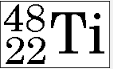
How many protons does this isotope of titanium have?
a)
48
b)
22
c)
26
d)
70
34.
In a correctly written symbol what would be located in the "A" position?
a)
number of neutrons
b)
atomic number
c)
number of electrons 
d)
mass number
35.
How many neutrons in C-14?
a)
6
b)
7
c)
14
d)
8
36.
How many neutrons does the isotope below have?     89 36Kr
a)
53
b)
36
c)
89
d)
125
37.
An atom is electrically neutral when
a)
protons and neutrons are the same
b)
protons and electrons are the same
c)
neutrons and electrons are the same
d)
neutrons balance the protons and electrons
38.
Two isotopes of carbon are carbon-12 and carbon-14.  These isotopes differ from one another by two protons.
a)
true
b)
false
39.

12 protons and 13 neutrons

a)

Mg-12

b)

Mg-13

c)

Mg-25

d)

Mg-24.305

40.

There are two primary isotopes found in any sample of copper: copper-63 and copper-65. The isotope 65Cu composes 69.2% of the sample and 63Cu comprises the other 30.8%. Based on this data, what is the atomic mass of copper?

a)

29 amu

b)

63.546 amu

c)

64.4 amu

d)

63.6 amu

41.

Find the molar mass of CaCO3CaCO_3   

a)

100.09g

b)

100g

c)

100.2g

d)

101g

42.

Find the molar mass of NH3NH_3   

a)

17.04g

b)

17g

c)

14.07g

d)

17.03g

43.

Find the molar mass of NaHCO3NaHCO_3   

a)

84g

b)

.8401g

c)

84.01g

d)

81.04g

44.
Molar mass is in units of ________.
a)
grams
b)
grams/mole
c)
mole
d)
moles/gram