wayground logo

Free Printable Worksheets

Font size

S
M
L
XL
Worksheets

Nuclear Retest

Total questions: 41

Worksheet time: 3610secs

Name
Class
Date
1.
A nuclear reaction where a nucleus splits into two smaller nuclei is... 
a)
Fission
b)
Fusion
c)
Gamma decay
d)
Beta decay
2.
What would two different isotopes of an atom have in common?
a)
Number of neutrons 
b)
Number of protons
c)
Atomic weight 
d)
Atomic mass
3.
What happens when the number of protons in an atom changes? 
a)
The number of electrons changes too 
b)
Usually nothing happens, unless the atom is radioactive 
c)
The atomic nucleus explodes
d)
It becomes a completely different atom, with different properties 
4.
In what part of an atom can protons be found? 
a)
Inside the electrons
b)
Inside the neutrons 
c)
Inside the atomic nucleus 
d)
 Inside the electron shells
5.
What element is the ?
a)
Ag-115
b)
Cd-115
c)
Pd-115
d)
Not Listed
6.
Which type of nuclear radiation is being emitted here?
a)
alpha
b)
beta
c)
gamma
d)
none
7.
Which type of nuclear radiation is being emitted here?
a)
Alpha
b)
beta
c)
gamma 
d)
none
8.
Balance the following equation:
146C --> 0-1e + ________
a)
145B
b)
146C
c)
147N
d)
42He
9.
Negatively charged particles found outside of the nucleus are called
a)
electron
b)
protons
c)
neutrons
d)
nucleons
10.
Positively charged particles found in the nucleus of an atom are called
a)
protons
b)
neutrons
c)
electrons
d)
isotopes
11.
Two or more nuclei combine to form one larger nucleus in the process of nuclear _____.
a)
Fusion
b)
Fission
c)
Tracing
d)
Decay
12.
This is an example of...
a)
Fission  reaction
b)
Fusion reaction
c)
Decomposition reaction
d)
Combustion
13.
When nuclei decay, massive amounts of __________ is released.
a)
energy
b)
jello
c)
protons
d)
neutrons
14.
What type of reaction is this?
a)
alpha
b)
beta
c)
gamma
d)
quiet
15.
Has the highest penetrating power.  Can penetrate our body.  Even several cm thick of lead or several meters thick of concrete cannot stop all of it.
a)
Alpha
b)
Beta
c)
Gamma
16.
Has the lowest penetrating power.  Can only penetrate 0.05 mm into the body and can be stopped by a piece of paper or clothing.
a)
Alpha
b)
Beta
c)
Gamma
17.
What type of nuclear reaction is this?
a)
alpha
b)
beta
c)
gamma
d)
hot
18.
If a sulfur atom has 16 protons, 16 electrons, and 16 neutrons, its atomic mass is:
a)
16
b)
32
c)
48
d)
64
19.
The time needed for half of a radioactive sample to decay is called its __________.
a)
decay period
b)
period
c)
transmutation time
d)
half-life
20.
Gamma rays damage human cells/tissue.
a)
True
b)
False
21.

Where would the electrons be located?

22.

_____is the joining of atomic nuclei

a)

Fusion

b)

chain reaction

c)

Photosynthesis

d)

Fission

23.

_______is the splitting of atomic nuclei

a)

Fission

b)

nuclear reaction

c)

Fusion

d)

bayler reaction

24.
Has the highest penetrating power.  Can penetrate our body.  Even several cm thick of lead or several meters thick of concrete cannot stop all of it.
a)
Alpha
b)
Beta
c)
Gamma
25.

Has the lowest penetrating power.  Can only penetrate 0.05 mm into the body and can be stopped by the skin.

a)
Alpha
b)
Beta
c)
Gamma
d)

Electron capture

26.
Radioactive materials have unstable...
a)
electrons
b)
protons
c)
nuclei
d)
neutrons
27.
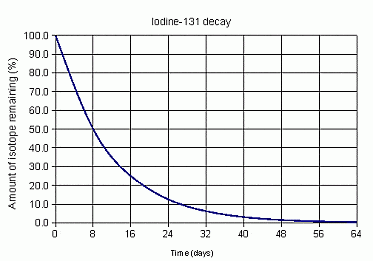
What is the half-life of iodine-131?
a)
32 days
b)
8 days
c)
16 days
d)
24 days
28.
What is Half-life?
a)
The amount of time it takes for some of the nuclei in a sample of the isotope to decay
b)
The amount of time it takes for half the electrons in a sample of the isotope to decay
c)
The amount of time it takes for half the nuclei in a sample of the isotope to decay
d)
the amount of time it takes to double the nuclei in a sample of the isotope to decay
29.

A beta particle is also called _____.

a)

an isotope

b)

a mass number

c)

an electron

d)

a fusion

30.

What term is used to describe an atom that changes into another element because of radioactive decay?

a)

gamma ray

b)

transmutation

c)

alpha particle

d)

electron

31.

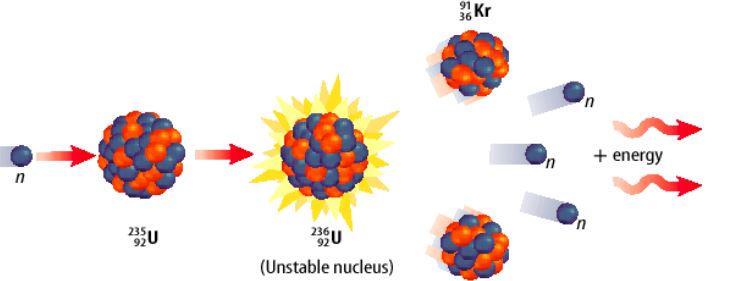
Which nuclear process if shown in the picture?

a)

alpha decay

b)

beta decay

c)

fusion

d)

fission

32.
What is a benefit of nuclear fission?
a)
The ability to absorb energy
b)
The ability to release tremendous amounts of energy
c)
The ability to produce more energy than nuclear fusion
d)
There are no beneficial aspects of nuclear fission
33.
This is an example of...
a)
Fission  reaction
b)
Fusion reaction
c)
Decomposition reaction
d)
Decay
34.

emitted helium nucleus

a)

positron

b)

radioactivity

c)

alpha particle

d)

gamma radiation

e)

beta particle

35.

high-energy photons emitted by a radioisotope

a)

positron

b)

radioactivity

c)

alpha particle

d)

gamma radiation

e)

beta particle

36.

radiation detector that makes use of a gas-filled metal tube

a)

scintillation counter

b)

Geiger counter

c)

neutron moderation

d)

neutron absorption

e)

film badge

37.

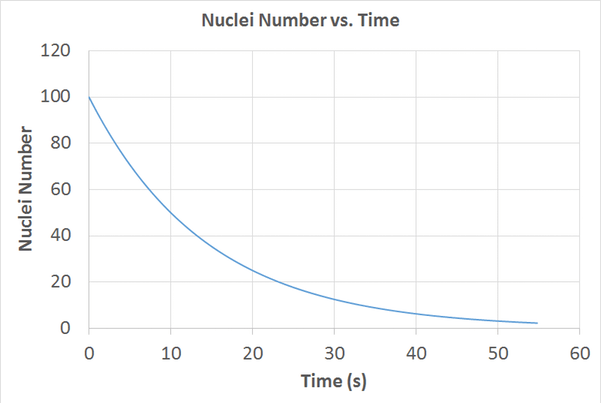
What is the Half life of this isotope?

a)

5 seconds

b)

10 seconds

c)

15 seconds

d)

20 seconds

38.

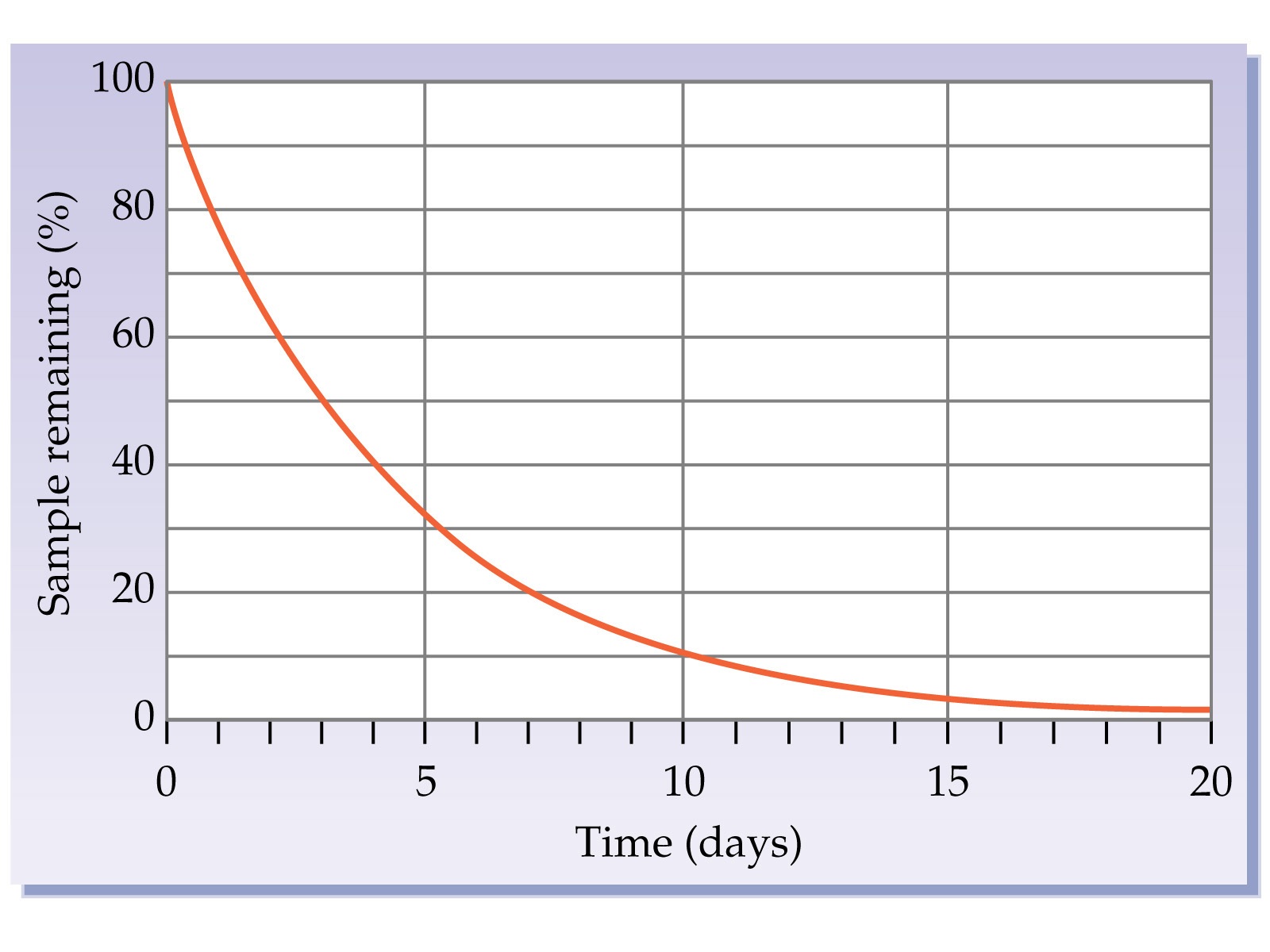
What is the Half Life of this isotope?

a)

3 days

b)

5 days

c)

8 days

d)

10 days

39.

What mineral is used to create Nuclear Power?

a)

Uranium

b)

Cobalt

c)

Iron

d)

Gold

40.

What do Nuclear Power plants Produce?

a)

Tesla cars

b)

Electricity

c)

Water

d)

Carbon dioxide

41.

What is radioactivity?

a)

An unstable atom releases energy to become stable

b)

A stable atom gains energy and becomes unstable

c)

When a bomb goes off.

d)

Negatively charged particles are emitted from the nucleus