
 Worksheets
7. Prokaryotic vs Eukaryotic cells
Total questions: 43
Worksheet time: 38mins


Tiny membrane-bound structures inside a cell that function like organs of a body are called....
cell wall
cell membrane
organelle
organ

Which of the following is a characteristic of both eukaryotic and prokaryotic cells?
contains ribosomes
contains a nucleus
contains several membrane bound organelles
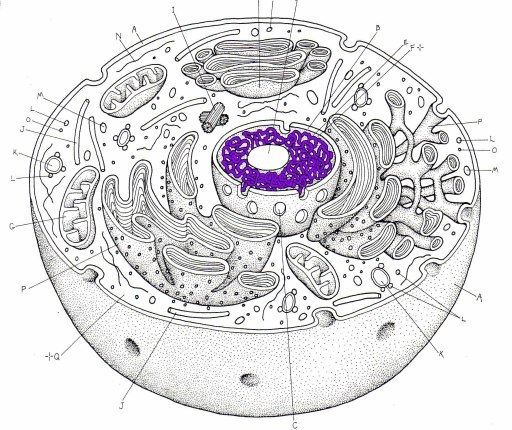
What kind of cell is in the diagram?
Eukaryotic
Prokaryotic
Which of the following distinguishes prokaryotic and eukaryotic cells?
The presence of a nucleus
The presence of ribosomes
The presence of a cell wall
The presence of genetic material
Which of the following best describes prokaryotic DNA?
Prokaryotes have circular DNA that is floating in the cytoplasm.
Prokaryotes have plasmid DNA contained within a nucleus
Prokaryotes have linear DNA that is floating in the cytoplasm.
Prokaryotes have linear DNA contained within a nucleus
Aaniyah is examining a cell under a microscope. She notices a mitochondria inside. Which of the following is a conclusion she might draw?
She is examining a eukaryotic cell.
She is examining a prokaryotic cell.
This cell could be either eukaryotic or prokaryotic.
A fossilized cell is discovered, and evidence suggests it reproduced on its own and had DNA, but a membrane did not enclose its DNA. Which type of organism would this most likely be?
Virus
Fungus
Prokaryote
Eukaryote
Which cell type has the highest degree of complexity?
Archaebacteria
Eubacteria
Eukaryotes
Prokaryotes
Zaquan is examining a cell under a microscope. He notices a ribosome inside. Which of the following is a conclusion he might draw?
He is examining a eukaryotic cell.
He is examining a prokaryotic cell.
This cell could be either eukaryotic or prokaryotic.
Which statement is an accurate comparison of prokaryotic and eukaryotic cells?
Prokaryotic cells have membrane-bound organelles and eukaryotic cells do not have membrane-bound organelles
Prokaryotic cells and eukaryotic cells reproduce by meiosis
Prokaryotic cells have a lower degree of complexity than eukaryotic cells.
Prokaryotic cells are generally larger than eukaryotic cells.
Organelles are found in
prokaryotic cells.
eukaryotic cells.
both
What is endosymbiosis?
The process of cells living together
The process of cells dividing
The process of cells absorbing sunlight
The process of cells releasing energy
Approximately how long ago did the only living organisms on Earth consist of prokaryotes?
1 billion years ago
2 billion years ago
3 billion years ago
4 billion years ago
What is the current best explanation of how complex cells evolved?
The endosymbiotic theory
The photosynthesis theory
The prokaryotic theory
The eukaryotic theory
What do chloroplasts and mitochondria contain?
Their own DNA and ribosomes
Their own nucleus and cytoplasm
Their own chlorophyll and enzymes
Their own mitochondria and chloroplasts
Which of the following is evidence to support the endosymbiotic theory?
Mitochondria and chloroplasts have their own DNA, which is similar to prokaryotic DNA.
Fossil evidence shows that the first forms of life were prokaryotic cells.
All eukaryotic cells have a double-layered membrane composed of phosplipids and proteins.
Prokaryotes have the same number and types of enzymes as eukaryotes.
The theory of Endosymbiosis explains
The origin of eukaryotes
How species develop
How bacteria live
The origin of multi-cellular life
The DNA of these cells is circular and not found within a nucleus.
Prokaryotic cells
Eukaryotic cells
Both prokaryotic and eukaryotic cells
Which type of cell has a cytoplasm?
Prokaryotic cells
Eukaryotic cells
Both prokaryotic and eukaryotic cells
These cells have a circular/loop shaped chromosomes...

