wayground logo

Free Printable Worksheets

NEW

Font size

S
M
L
XL
Worksheets

Review Test 10

Total questions: 55

Worksheet time: 1hrs 22mins

Name
Class
Date
1.
It is the boundary between the crust and the mantle.
a)
mohorovicic discontinuity
b)
lithosphere
c)
outer core
d)
inner core
2.
The upper mantle and the crust make up the ______.
a)
mohorovicic discontinuity
b)
lithosphere
c)
outer core
d)
inner core
3.
It consists of a semi-liquid rock.
a)
crust
b)
mantle
c)
outer core
d)
inner core
4.
The _____ outlines the major trenches in the Pacific Ocean and is an active volcanic and earthquake area.
a)
Alpine-Himalayan belt
b)
circum-Pacific belt
c)
Indo-Australian Plate
d)
Eurasian Plate
5.
These volcanoes are usually associated with seismic activity, presence of hot water springs, and changes in the elevation of the volcano's crater.
a)
extinct
b)
dormant
c)
active
d)
earthquake
6.
These are volcanos that have no known history of eruption but may erupt based on seismic indications of tectonic activity beneath the volcano.
a)
extinct
b)
dormant
c)
active
d)
earthquake
7.
Volcanoes that are not active or have not erupted for a long period of time are called ______.
a)
extinct
b)
dormant
c)
active
d)
earthquake
8.
It is a series of shockwaves traveling through Earth resulting from a sudden release of energy.
a)
extinct
b)
dormant
c)
active
d)
earthquake
9.
It is the point within the Earth where an earthquake rupture starts.
a)
focus
b)
epicenter
c)
seismic waves
d)
fault
10.
It is the point at the surface directly above where an earthquake starts.
a)
focus
b)
epicenter
c)
seismic waves
d)
fault
11.
These are body waves which may move in all directions from the center to the Earth's interior.
a)
focus
b)
epicenter
c)
seismic waves
d)
fault
12.
A landform that rises at least 300m (1000 ft) from its surrounding area is called ______.
a)
mountain
b)
trench
c)
mountain range
d)
fault
13.
A chain of mountains form _____.
a)
earthquakes
b)
trench
c)
mountain range
d)
fault
14.
Where does the first motion of an earthquake occur?
a)
focus
b)
epicenter
c)
seismic waves
d)
fault
15.
Landforms on Earth's crust were formed as a result of ______.
a)
Earth's rotation
b)
many bodies of water
c)
movements of tectonic plates
d)
division of the lithosphere into plates
16.

Which block diagram to the right best shows a transform fault?

a)

1

b)

2

c)

3

d)

4

17.

In which cross section below do the arrows best show the convection occurring within the asthenosphere beneath line XY?

a)

1

b)

2

c)

3

d)

4

18.

Which observation about the Mid-Atlantic Ridge region provides the best evidence that the seafloor has been spreading for millions of years?

a)

the bedrock of the ridge and nearby seafloor is igneous rock

b)

the ridge is the location of irregular volcanic eruptions

c)

several faults cut across the ridge and nearby seafloor

d)

seafloor bedrock is younger near the ridge and older farther away

19.

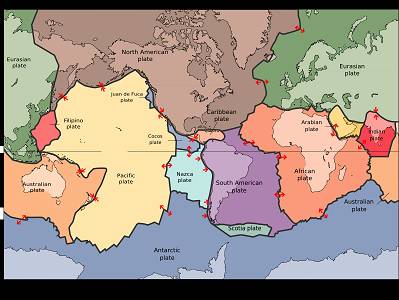
Active volcanoes are most abundant along the

a)

edges of tectonic plates

b)

equatorial ocean floor

c)

23.5oN and 23.5oS parallels of latitude

d)

eastern coastlines of continents

20.
This boundary is described by two plates moving away from eachother along the edges and separating. The resulting gap allows magma to rise and create new crust, forming new lithosphere. 
a)
Convergent Boundary 
b)
Divergent Boundary  
c)
Transform Boundary
21.
This boundary is described as two plates moving past eachother ALONG THE EDGES horizontally.  These boundaries will get stuck or lock against eachother causing earthquakes when they slip and release. 
a)
Convergent Boundary
b)
Divergent Boundary
c)
Transform Boundary
22.
This boundary is described as moving toward one another  When the plates are both continental plates the will crumple up and form a mountains. When they are continental and oceanic plates, subduction occurs  and earthquakes and volcanoes form. 
a)
Convergent Boundary
b)
Divergent Boundary
c)
Transform Boundary
23.
Trenches, deep underwater canyons on the sea floor are created at this type of boundary 
a)
Divergent
b)
Convergent, Subduction Zone
c)
Transform 
24.
New crust is created at this type of  boundary.
a)
Divergent
b)
Convergent, Subduction Zone
c)
Transform 
25.
Mountains are created at this type of  boundary.
a)
Divergent 
b)
Convergent
c)
Transform 
26.
The area around the Pacific Ocean where lots of earthquakes and volcanoes happen is called the ____________.
a)
Ring of Earth
b)
Ring of Fire
c)
Ring of Stone
d)
Ring of Diamond
27.
Lava that is still deep inside the earth is called ____________________________.
a)
lava
b)
magma
c)
volcano
d)
earthquake
28.

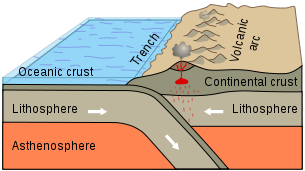
What type of boundary is shown in the diagram?

a)

Divergent

b)

Convergent

c)

Transform

29.

What type of boundary is shown in the diagram?

a)

Divergent

b)

Convergent

c)

Slide/Transform

30.

What type of boundary is shown in the diagram?

a)

Divergent

b)

Convergent

c)

Slide/Transform

31.

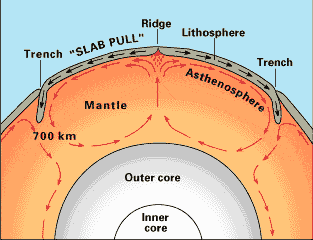
The movement of the tectonic plates is caused by

a)

the rotation of the Earth.

b)

convection currents in the Asthenosphere

c)

the gravity of the iron-nickel core.

d)

the Moho discontinuity.

32.
Subduction zones occur on Earth where dense oceanic crust dives under more buoyant continental crust. These boundaries are characterized by a deep ocean trench next to a high continental mountain range, large numbers of earthquakes and volcanoes. All of this is further evidence for the
a)
big bang theory.
b)
theory of plate tectonics.
c)
origin of the species.
d)
theory of natural selection.
33.

Observe this diagram of a plate boundary. One statement BEST describes what is happening. It is that

a)

the oceanic crust is melting.

b)

the denser ceanic crust is subducting under the less dense oceanic crust

c)

volcanic islands are forming.

d)

the tectonic plates are moving away from each other.
34.
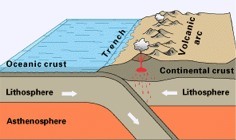
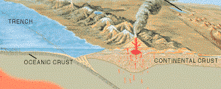
What geological forces might be responsible for this range of mountains?
a)
diverging tectonic plates
b)
erosion of the land by the ocean
c)
converging tectonic plates
d)
deposition of sediments by the ocean
35.
Geologists have long recognized that earthquakes are not randomly distributed on Earth but occur in concentrated areas that coincide with __________ and provide evidence for the theory of ___________ .
a)
mountain ranges; fault zones.
b)
continental borders; supercontinents.
c)
plate boundaries; plate tectonics
d)
areas of liquid magma; sea floor spreading.
36.

The 2004 Indian Ocean tsunami was caused by a shift in two plates that pushed one section of the sea floor under another section of the sea floor by 5 meters. What type of boundary is this?

a)

divergent

b)

convergent

c)

transform

d)

metamorphic

37.
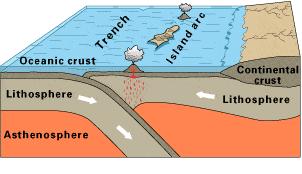
Observe the plate boundary shown here. What type of plate boundary is this? Many geologic events occur at these boundaries. Some are shown, but one is missing. What geologic event would you predict would occur at this plate boundary?
a)
convergent oceanic-oceanic plate boundary; volcano
b)
divergent oceanic-oceanic plate boundary; sea floor spreading
c)
convergent oceanic-continental plate boundary; earthquake
d)
convergent continental-continental plate boundary; mountain building
38.

What is the source of energy that drives plate movement?

a)

the subducton of the sea floor

b)

the different densities of the oceanic and crustal plates

c)

convection currents in the asthenosphere

d)

the friction force between the plates that move past each other
39.

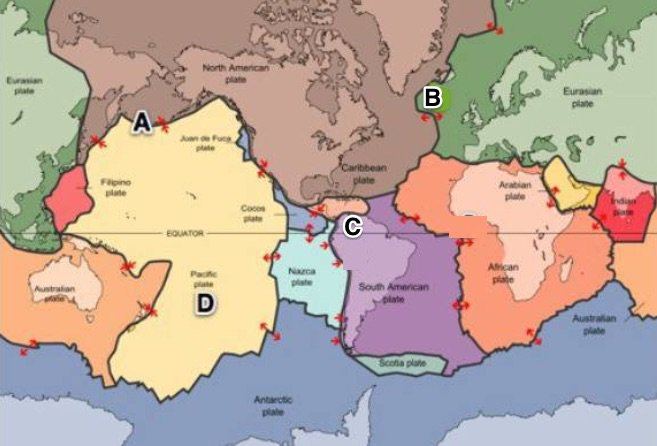
Where would sea floor spreading most likely occur?

a)

At convergent boundaries (oceanic vs. oceanic)

b)

At convergent boundaries (oceanic vs. continental)

c)

At divergent plate boundaries (oceanic vs. oceanic)

d)

At transform plate boundaries

40.
He is the Father of American Rocketry.
a)
Robert Goddard
b)
Yuri Gagarin
c)
Neil Armstrong
d)
James Van Allen
41.
The first artificial satellite was launched on ______.<br />
a)
October 4, 1957
b)
November 3, 1957
c)
February 1, 1957
d)
March 17, 1957
42.
The first artificial satellite is called ______.<br />
a)
Sputnik 1
b)
Luna 1
c)
Explorer 1
d)
Vanguard 1
43.
The first animal launched into space is a/an ______.
a)
fruit fly
b)
monkey
c)
dog
d)
gorilla
44.
When was Sputnik 2, with Laika aboard, was launched?
a)
November 3, 1957
b)
October 4, 1957
c)
February 1, 1957
d)
March 17, 1957
45.

USA's first artificial satellite was launched on ______.

a)

January 31, 1958

b)

October 1, 1958

c)

March 17, 1958

d)

January 2, 1958

46.
The oldest object to orbit Earth and the first space technology to use solar panels is called ______.
a)
Vanguard 1
b)
Sputnik 1
c)
Luna 1
d)
Explorer 1
47.
The oldest object to orbit Earth and the first space technology to use solar panels was launched on ______.
a)
March 17, 1958
b)
February 1, 1958
c)
October 1, 1958
d)
January 2, 1959
48.

When did NASA start its operation?

a)

October 1, 1957

b)

October 1, 1958

c)

October 1, 1959

d)

October 1, 1960

49.
This is when the first man on space successfully orbited the Earth.
a)
April 12, 1961
b)
May 5, 1961
c)
February 20, 1962
d)
January 2, 1959
50.

Who was the first American to orbit Earth in Friendship 7?

a)

John Glenn

b)

Alan Shepard

c)

Neil Armstrong

d)

Yuri Gagarin

51.

Who was the first man to walk on the moon's surface on July 20, 1969?

a)

John Glenn

b)

Alan Shepard

c)

Neil Armstrong

d)

Yuri Gagarin

52.

Who became the first person to journey into outer space traveling aboard Vostok 1 in April of 1961?

a)

John Glenn

b)

Alan Shepard

c)

Neil Armstrong

d)

Yuri Gagarin

53.

Who became the first American astronaut to journey into outer space traveling aboard Freedom 7 in May of 1961?

a)

John Glenn

b)

Alan Shepard

c)

Neil Armstrong

d)

Yuri Gagarin

54.
The first satellite launched into space by Russia 
a)
Space Suit
b)
Sputnik
c)
ISS
d)
Astronaut
55.
Who became the first American to orbit the Earth?
a)
Yuri A. Gargarin
b)
Alan B. Sheppard
c)
John Glenn
d)
Neil Armstrong