wayground logo

Free Printable Worksheets

NEW

Font size

S
M
L
XL
Worksheets

Unit 2 Review

Total questions: 46

Worksheet time: 1hrs 14mins

Name
Class
Date
1.
The building blocks of carbohydrates are?
a)
amino acids
b)
fatty acids
c)
monosaccharides 
d)
nucleotides
2.
An example of a carbohydrate would be?
a)
potatoes 
b)
T-bone steak
c)
chicken leg
d)
cheese
3.
What are the building blocks for proteins?
a)
monosaccharides 
b)
fatty acids
c)
DNA
d)
amino acids
4.
What parts of the body is mainly made from proteins?
a)
muscles
b)
bone
c)
skin
d)
blood
5.
A good example of a nucleic acid would be?
a)
sugar
b)
DNA
c)
fat
d)
glucose
6.
The function of nucleic acids, such as DNA are for building proteins and carrying the ___________ info.
a)
genetic
b)
disease fighting 
c)
bone building 
d)
energy
7.
The three main parts of a nucleotide are the sugar, the phosphate group, and the _____________  base.
a)
carbon
b)
oxygen
c)
nitrogen
d)
hydrogen
8.
The three main elements that make up all life on Earth are?
a)
hydrogen, oxygen, sulfur
b)
hydrogen, oxygen, carbon
c)
carbon, oxygen, uranium 
d)
oxygen, carbon, helium.  
9.
Humans get most of their energy from eating what type of food?
a)
protein
b)
carbohydrates
c)
lipids
d)
meat
10.
What are the building blocks for nucleic acids?
a)
monosaccharides 
b)
amino acids
c)
nucleotides
d)
fatty acids
11.
Nucleotides are monomers of
a)
Carbohydrates
b)
Lipids
c)
Proteins
d)
Nucleic Acids
12.
Monosaccharides are monomers of
a)
Carbohydrates
b)
Lipids
c)
Proteins
d)
Nucleic Acids
13.
Waxes, oils and fats are examples of
a)
Carbohydrates
b)
Lipids
c)
Proteins
d)
Nucleic Acids
14.
Which macromolecule is shown?
 View Figure 1 (if not visible)
a)
lipid
b)
protein
c)
nucleic acid
d)
carbohydrate
15.
Which of the following organic compounds is the main source of energy for living things?
a)
carbohydrates
b)
lipids
c)
nucleic acids
d)
proteins
16.
Which macromolecule stores energy, insulates us, and makes up the cell membrane?
a)
lipids
b)
proteins
c)
carbohydrates
d)
nucleic acids
17.
What are the monomers of DNA?
a)
glycerols
b)
amino acids
c)
fatty acids
d)
nucleotides
18.
Lipids can be digested into what smaller subunits?
a)
nucleic acids
b)
amino acids
c)
fatty acids
d)
glucose
19.
Which group of biomolecules provide quick energy to organisms?
a)
proteins
b)
carbohydrates
c)
lipids
d)
nucleic acids
20.
All polymers are made up of...
a)
monosaccharides
b)
monomers
c)
proteins
d)
None of these
21.
All organic compounds contain the element
a)
carbon
b)
nitrogen
c)
phosphorus
d)
sulfur
22.
Is found in the cell membrane as a bilayer. 
a)
lipids
b)
protein
c)
nucleic acid
d)
carbohydrate
23.
Enzymes are..
a)
nucleic acids 
b)
carbohydrates 
c)
lipids 
d)
proteins 
24.
The organic compounds that have many structural purposes and are used in many processes within the
cell are called ____________________.
a)
Carbohydrates
b)
Lipids
c)
Proteins
d)
Nucleic Acids
25.

Which macromolecule is shown?

a)

lipid

b)

protein

c)

nucleic acid

d)

carbohydrate

26.
Carbohydrates are made of... 
a)
C H O
b)
C H O N
c)
C H O N P
d)
C H O N S
27.
Proteins are made of... 
a)
C H O
b)
C H O N
c)
C H O N P
d)
C H O N S
28.
The diagram shows the general structure of an amino acid. Which type of molecule is formed from amino acids?
a)
lipids
b)
proteins
c)
carbohydrates
d)
nucleic acids
29.
The human body maintains a temperature of around 98.6 degrees at all times. Enzymes are involved in almost every chemical reaction in the body. Which of the following describes the connection between these two statements? 
a)
Enzymes function best at a specific temperature.
b)
The body needs to be warm to prevent hypothermia.
c)
The body is kept relatively warm to prevent too much enzyme action. 
d)
There is no connection between the two statements. 
30.
Like complex carbohydrates, proteins are macromolecules that serve many functions and can be chemically broken down and restructured. Both proteins and complex carbohydrates are which of the following?
a)
 polymers of smaller subunits
b)
sequence of sugars
c)
lipids of large molecules
d)
nucleotides of DNA
31.
What is the function of macromolecule subunit below?
a)
energy
b)
catalyst
c)
stores genetic information
d)
composes the majority of the cell membrane
32.
Glycerol and fatty acids combine to form...?
a)
Carbohydrates
b)
Lipids
c)
Proteins
d)
Nucleic Acids
33.
In a chemical reaction, a reactant binds to an enzyme at a region known as the
a)
catalyst.
b)
product.
c)
substrate.
d)
active site. 
34.
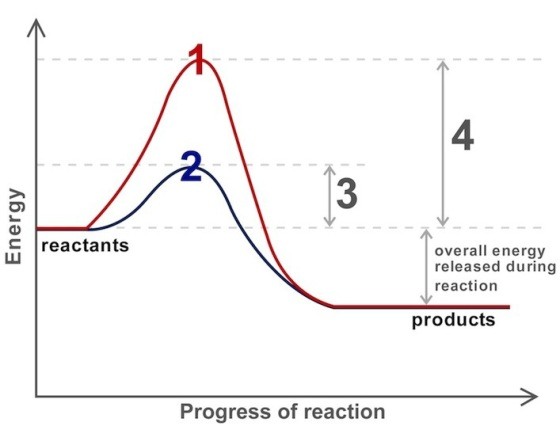
Which line represents an enzyme-catalyzed reaction? 
a)
Line 1
b)
Line 2
35.
Any substance that is acted upon by an enzyme is called a(n)?
a)
Coenzyme
b)
Substrate
c)
Vitamin
d)
Polypeptide
36.
The "lock and key hypothesis" attempts to explain the mechanism of?
a)
Vacuole formation
b)
Pinocytosis
c)
Sharing of electrons
d)
Enzyme are specific to a substrate
37.
Which factor denatures a enzyme?
a)
Excessive heat
b)
Nothing can
c)
Exposure to light
d)
Exposure to bacteria
38.
This is the area on an enzyme that the substrate attaches.
a)
active site
b)
product
c)
catalytic region
d)
reactant site
39.
Enzymes will make a reaction go _______ and use ______ energy.
a)
faster, less
b)
faster, more
c)
slower, less
d)
slower, more
40.

Enzymes are what macromolecule?

a)

Nucleic Acid

b)

Lipid

c)

Protein

d)

Carbohydrate

41.

How does an enzymes shape relate to its function?

a)

the shape of the enzyme has no relation to its function

b)

the enzyme is shaped specially for certain substrates to perform a specific reaction

c)

the enzyme shape acts as a receptor to certain products

d)

the enzyme shape can fit into specific substrates to cease a reaction

42.

A is the

a)

substrate

b)

enzyme-substrate complex

c)

products

43.

B is the

a)

substrate

b)

enzyme-substrate complex

c)

products

44.

C is the

a)

substrate

b)

enzyme-substrate complex

c)

products

45.

An enzyme ________ the activation energy needed for a reaction to occur.

a)

decreases

b)

increases

c)

does nothing to

d)

increases then decreases

46.

Which color line represent a reaction with an enzyme present?

a)

Blue

b)

Red

c)

Both

d)

Neither