
Font size
 Worksheets
Light
Total questions: 59
Worksheet time: 52mins
A basketball is __________.
transparent
translucent
opaque
light source
A tissue is __________.
emit
opaque
transparent
translucent
A dried leaf is __________.
translucent
candle
opaque
transparent


Which object is opaque?
water
plastic bottle
toy car
air
Which object is transparent?
window
wooden block
truck
orange juice
Which object is translucent?
brick
cooking oil
desk
water
Which object is opaque?
air
elephant
window
water
If an opaque object on the path of light becomes very small, light has a tendency to bend around it and not walk in a straight line
Scattering
Dispersion
Difraction
Reflection
The angle of incidence is equal to angle of reflection
True
False
The angle between Normal and Reflecting surface is....
Zero Degree
90 Degree
180 Degree
45 Degree
Plane mirror gives (a) Size of the image
Image formed by a plane mirror is always
Virtual and inverted
Real and inverted
Virtual and erect
Real and erect
in a plane is image is not laterally inverted
True
False
A spherical mirror, whose reflecting surface is curved inwards, that is, faces towards the centre of the sphere, is called
Concave mirror
Convex mirror
Half is concave and half is convex mirror
Always Convex mirror
The centre of the reflecting surface of a spherical
mirror is a point called
Cenrtre of Curvature
Pole
Radius of Curvature
Aperture
The diameter of the reflecting
surface of spherical mirror is called
Focal length
Radius of Curvature
Aperture
Pole
Identify the surface
Concave surface
Convex Surface
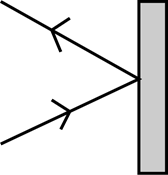
In the illustration, the light ray striking the object is-
The bouncing off of light rays from the surface of an object such as a mirror or other shiny surface is called:
mirror
laser
reflection
refraction
The ray of light that strikes a reflecting surface is called ________.
incident ray
reflected ray
normal ray
none of the above
The angle produced as a source of light bounces off a reflecting surface is called ______.
angle of crookedness
angle of reflection
angle of incidence
angle of bounce
MCQ 02
Why can you see most objects?
A. they emit light
B. light refracts through them
C. light reflects off them
D. they absorb light

Given that the angle of incidence = 30 degrees
a. Draw a ray diagram, labelling clearly the normal, incident ray, angle of incidence, reflected ray and angle of reflection accurately.
Which is the correct diagam?
Which is NOT a source of light?
sun
lightbulb
fire
car
Your light-sensing organ is your
ear
finger
brain
eye
In order to see a picture it must
produce light
reflect light
absorb light
To get the best reflection from a mirror you need
a very shiny surface to reflect lots of light
to stand right in front of it
to shine a bright light on it
it to produce light
MCQ 011
According to the laws of reflection, if i = angle of incidence and r = angle of reflection,
A. i = r
B. i > r
C. r > i
D. i is not equal to r

Which of the following is not a source of light?
A. candle
B. caver’s lamp
C. mirror
D. sun
Law of reflection state that - The angle of incidence is .................. to the angle of reflection.
equal
double
half
What is reflection?
Reflection is the bouncing of light off the surface that it strikes on.
Reflection is the absorbing of light off the surface that it strikes on.
Reflection is the bending of light off the surface that it strikes on.
Reflection is the scattering of light off the surface that it strikes on.
When light bounces back it is _____
Reflected
Refracted
Absorbed
Optical Density

In the diagram, which letter represents the angle of incidence?
A
B
C
D

Which diagram represents specular reflection?
A
B
........... – the angle between the normal and the reflected ray.
Angle of incidence
Angle of reflection
Angle of coincidence
Angle of direction
........... – the angle between the normal and the incident ray.
Angle of incidence
Angle of reflection
Angle of coincidence
Angle of direction
How does light travel
It curves around corners
Really slow
In a straight line
In circles

Which diagram represents diffuse reflection?
A
B
C
D
Given that the angle of incidence = 30 degrees
a. Draw a ray diagram, labelling clearly the normal, incident ray, angle of incidence, reflected ray and angle of reflection accurately.
Which is the correct diagam?

What does the Earth get from the sun?
Only heat
only light
Both heat and light

Which of these provides the best explanation for why the pencil appears broken?
The pencil absorbs the light rays that hit it.
Water reflects light rays away from the pencil.
Light rays are bent by the water in the glass.
The surface of the water reflects the light rays.

At what point is the laser being reflected?
A
B
C
D
Bouncing of a light ray when it strikes a reflecting surface is called.........
Refraction
Dispersion
Reflection
Diffraction
which of the following is not a property of the image formed by a [lane mirror?
virtual and erect
Object size = image size
object distance = image distance
Real and inverted
Which of the following is a concave mirror?


Four students A, B, C and D performed the experiment to determine the focal length of a concave mirror by obtaining the image of a distant tree on a screen. They measured the distances between the screen and the mirror as shown in the above figure.
The correct way of measuring accurate focal length of the mirror is
A
B
C
D
Convex mirror is also called as
converging mirror
diverging mirror
plane mirror
silver mirror

which of the following ray diagrams is correct for the ray of light incident on a concave mirror as shown in the figure 10.6?
A
B
C
D
The point on the spherical mirror at the middle of the surface is called
focus
centre of curvature
pole
radius of curvature
A convex mirror has a focal length 12 cm. Then its radius of curvature is ........ cm
24
12
6
1.2
The focal length of a plane mirror is ........
infinite
zero
1m
100m
When the object is in between the centre of curvature (C) and focus (F) of a concave mirror, then the position of the image is ...........
At focus
At the centre of curvature
at infinity
beyond the centre of curvature

Which mirror is shown in the figure?
convex mirror
concave mirror
plane mirror
silver mirror

Mirror formula is defined as ........
A
B
C
D
When the object is at infinity, a point sized image is formed at ................ by the convex mirror
focus behind the mirror
focus in front of the mirror
radius of curvature
principal axis
The image formed by a concave mirror when the object is placed between the pole and the focus is ......
virtual, erect and magnified
virtual, erect and diminished
real, inverted and magnified
real, inverted and diminished

