wayground logo

Free Printable Worksheets

Font size

S
M
L
XL
Worksheets

Evolution

Total questions: 60

Worksheet time: 36mins

Name
Class
Date
1.
__________ enable an organism to survive in its environment.
a)
adaptations
b)
natural selections
c)
divergence
d)
extinctions
2.

True or false, evolution happens when an individual organism starts changing itself to adapt to its environment. For example, an adult polar bear might start swimming more so it can handle the melting of the polar ice caps.

a)

false, if it had a cub that could swim better due to longer legs or more buoyant bone structure, this could become a more common trait.

b)

True, evolution happens due to changing individuals

c)

maybe, if it chose to.

d)

I wish I had a pet penguin

3.
What is the term for a feature that allows an organism to survive in its environment?
a)
adaptation
b)
variation
c)
homologous structure
d)
vestigial structure
4.
What is the process of which humans breed organisms for certain traits?
a)
artificial selection
b)
descent without modification
c)
inheritance of acquired characteristics
d)
natural selection
5.
Individuals that are well adapted to their environment will survive and produce
a)
better traits
b)
stronger genes
c)
more offspring
d)
fewer mutations
6.
All the individuals of a species that live in a particular area are called a 
a)
group
b)
population
c)
variation
d)
fossil
7.
Which of the following is a term for a group of similar organisms that can reproduce fertile offspring?
a)
individual
b)
population
c)
species
d)
fossil
8.
Mutations are important because they bring about
a)
death of the organism in which they develop
b)
genetic variation needed for a population to evolve
c)
benefits for the individual, not for the population
d)
Hardey-Weinberg equilibrium within a population
9.
Extinction can occur because of which of the following?
a)
All can be causes of extinction.
b)
Increased competition with other species
c)
New predators within the environment
d)
Loss of habitat and/or catastrophes
10.
Finches on the Galapagos Islands had different beaks in order to help them do what?
a)
Build nests
b)
Fight off predators
c)
Collect food sources
d)
Compete with rivals
11.
This scientist came up with the idea of natural selection.
a)
Jean Baptiste Lamarck
b)
Gregor Mendel
c)
Charles Darwin
d)
Thomas Malthus
12.
Survival of the fittest or when favorable adaptations reproduce faster is called what?
a)
Evolution
b)
Adaptation
c)
Natural selection
d)
Fossilization
13.
This occurs when no more of a species is living.
a)
Fossilization
b)
Adaptation
c)
Extinction
d)
Natural selection
14.
Magda is a tall, 11 year old drummer. She has a scar on her right cheek. She is good at swimming. Which of her traits did Magda most likely inherit?
a)
height
b)
the scar
c)
ability to swim
d)
ability to play drums
15.
According to the diagram, which organism is older?
a)
ammonite
b)
coral
c)
gastropod
d)
trilobite
16.
The diagram shows fossils in different rock layers. Which of these statements about the age of these fossils is most likely correct?
a)
Fossil A and C are the same age
b)
Fossil B is older than fossil C
c)
Fossils A is older than fossil B
d)
Fossil D is older than fossil C
17.
The ability of an organism to survive and reproduce in its specific environment 
a)
diversity.
b)
evolution
c)
adaptation
d)
 fitness
18.
Why are advantageous traits more likely to be passed onto offspring?
a)
Because they are more likely to survive and reproduce.
b)
Because they come from dominant alleles.
c)
Because they come from recessive alleles.
d)
Because the trait is an acquired phenotype.
19.
Farmers breed cows to produce high amounts of milk. This is an example of...
a)
Natural Selection 
b)
Variations in a species 
c)
Selective Breeding 
d)
inbreeding
20.
Which of the following is a factor in natural selection?
a)
Individuals of species compete with one another to survive.
b)
All species are genetically diverse.
c)
Individuals better able to adapt to changes leave more offspring.
d)
All are correct 
21.
The fossil record provides evidence that 
a)
Fossils cannot be dated.
b)
All species were formed during Earth’s formation and have changed little since then.
c)
The fossilized species have no connection to today’s species.
d)
Older species gave rise to more-recent species.
22.
Individuals that are better able to cope with the challenges of their environment tend to  
a)
Decrease in population over time.
b)
Leave more offspring than those less suited to the environment.
c)
Leave fewer offspring than those less suited to the environment.
23.
European rabbits were introduced to Australia in 1859. The rabbits reproduced rapidly in their new habitat, displaced other animals, and overgrazed vegetation. In an attempt to reduce the rabbit population, a virus was introduced in 1951. This virus is usually deadly to European rabbits. When the virus was first introduced, the rabbits died in large numbers, but the death rate decreased over time. Which of the following best explains the decrease in the rabbit death rate? 
a)
Young rabbits learned to avoid being infected with the virus.
b)
The lifespan of the virus was too short to affect rabbits over a long period of time.
c)
Natural selection favored rabbits that were resistant to the virus. 
d)
No correct choices.
24.
The Asian shore crab invaded parts of the eastern coast of the United States about 15 years ago. The Asian shore crab preys on blue mussels. In the time since the Asian shore crab arrived, the average shell thickness of the blue mussel population has increased. Which of the following is the most likely reason that this increase in shell thickness has occurred? 
a)
Blue mussels with thick shells attract more crabs that mussels without thick shells.
b)
Blue mussels with thick shells grow in larger colonies than mussels without thick shells.
c)
Blue mussels with thick shells catch more food per day than mussels without thick shells.
d)
Blue mussels with thick shells survive and reproduce more successfully than mussels without thick shells.
25.
The process in which organisms with traits well suited to an environment are more likely to survive and to produce offspring is
a)
Natural Selection
b)
Origin of Species
c)
Genetic Principles
d)
Trait Mechanism
26.
All the individuals of a species that live in a particular area are called a
a)
variation
b)
population
c)
fossil
d)
group
27.
Change over time...
a)
Evolution
b)
Nucleotide 
28.
Charles Darwin came up with this theory 
a)
Natural Selection
b)
Mutation
29.
Darwin wrote that organisms with traits that are best suited to the environment will ________________
a)
increase in number
b)
become extinct
30.
Another word for adapt is ____________.
a)
change
b)
create
31.
Which of the following is NOT an example of natural selection? 
a)
People selectively breeding hamsters.
b)
Insect populations developing resistance to certain pesticides.
c)
Bacteria becoming resistant to antibiotics.
d)
Male birds of certain species developing colorful feathers to attract female mates.
32.
What characteristic did Darwin observe about the finches on the Galapagos Islands?
a)
Their feathers 
b)
Genotypes 
c)
Their beaks
d)
Their body sizes
33.
The environment around Manchester, England, changed during the Industrial Revolution.  How did this change affect peppered moths living in the area?
a)
Natural selection favored moths with dark wings because predators could not see them on the soot-colored trees.
b)
Natural selection favored moths with white wings that were easy for predators to see.
c)
Natural selection favored moths with white wings because predators could not see them on the soot-colored trees.
d)
Natural selection caused moths with white wings to become extinct.
34.

The solidified remain or imprint of a once living thing are called:

a)

Fossils

b)

Homologous Structures

c)

Vestigial Structures

d)

DNA

35.
The similarities of the bones in the diagram provide evidence that---
a)
The organisms shown lived in the same natural envionrment
b)
The organisms shown may have developed from a common ancestor
c)
The organisms shown have the same genetic diseases
d)
All vertebrate species have identical forelimbs
36.
The diagram shows fossils in different rock layers. Which of these statements about the age of these fossils is most likely correct?
a)
Fossil A and C are the same age
b)
Fossil B is older than fossil C
c)
Fossils A is older than fossil B
d)
Fossil D is older than fossil C
37.
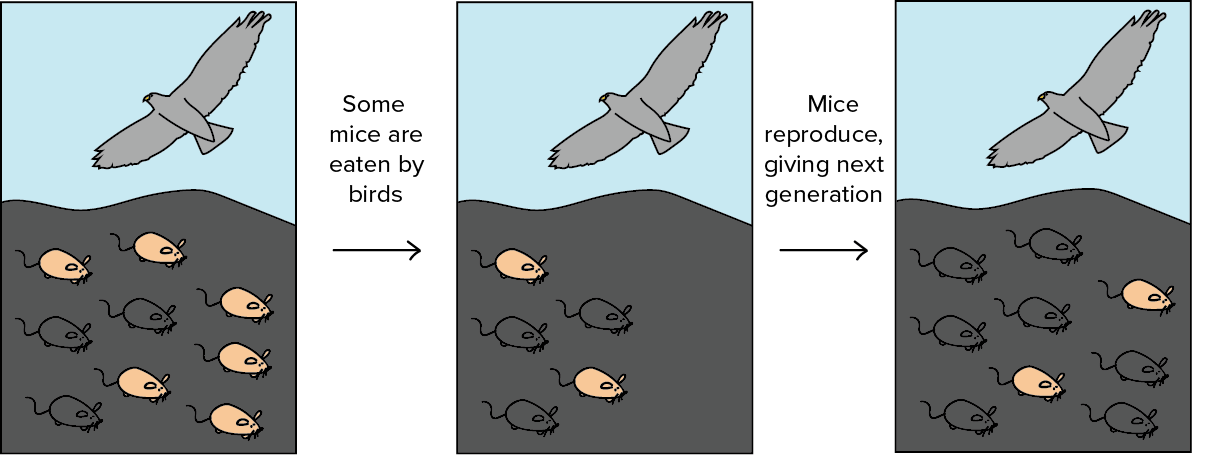
Why is the mouse population changing over time?
a)
The light mice can reproduce more successfully than the dark mice
b)
The hawks eat more dark mice than light mice because the dark mice taste better
c)
The hawks eat more light mice than dark mice because they can see the light mice more easily
d)
The hawks eat more dark mice than light mice because they can see the dark mice more easily
38.

Which scientist is known for his work that he did on the Galapagos Islands to develop his theory of natural selection?

a)

Gregor Mendel

b)

Charles Darwin

c)

Anton Van Leewenhoek

d)

Robert Brown

39.

A species is defined as:

a)

a group of organisms that are extremely different.

b)

a group of organisms that have similar characteristics and always live in the same place.

c)

a group of organisms with similar characteristics and can reproduce to make fertile offspring.

d)

any two organisms to make a hybrid.

40.

Which of the following is true about the picture above?

a)

Camels are highly adapted to cold climates.

b)

There are no benefits to using a camel vs. a horse in the desert.

c)

Camels have directly evolved from whales.

d)

A camels long large intestine, long eyelashes and wide feet allow it to be very adapted to the desert.

41.

Gigantopithecus were very large primates that lived 500,000 years ago. Since none of these mammals are still today, they are said to be....

a)

Extinct

b)

Threatened

c)

Endangered

d)

Declining

42.

Scientists have collected millions of fossils of different organisms, and have developed a timeline of life on Earth. What do we call this?

a)

Mutation

b)

Natural Selection

c)

The theory of evolution

d)

Fossil Record

43.

What most likely caused the finches on the Galapagos Islands to have beaks that were different from the finches on the mainland?

a)

There were different types of predators on the island.

b)

There were different types of food available on the island.

c)

The finches had no water to drink.

d)

The finches on the mainland could not fly high enough.

44.

When looking at two birds of the same species, you notice that one has darker feathers than the other one. You also notice that one has a beak that is just a little longer. These slight differences within members of the same species are called.....

a)

Fossils

b)

Extinction

c)

Meiosis

d)

Variations

45.
Which of the following would represent a sudden environmental change?
a)
Wildfire
b)
Global Warming
c)
Competition for food
d)
Desert encroachment 
46.
Survival of the Fittest and Evolution were proposed by what scientist?
a)
Charles Darwin
b)
Albert Einstein
c)
Steven Hawking
d)
Isaac Newton
47.
Mutations are a change in what?
a)
DNA
b)
tRNA
c)
genotype
d)
phenotype
48.
Where humans have bred organisms together based on traits we like.
a)
Evolution
b)
Natural Selection
c)
Extinction 
d)
Artificial Selection
49.
Genetic differences between organisms of the same species
a)
Variation
b)
Adaptation
c)
Behavior
d)
Environment
50.
A fossil of an extinct dinosaur is found and the anatomy of the fossil shows similarities to that of a bird. What could this mean?
a)
This is purely by chance and isn't significant
b)
The extinct dinosaur and modern bird share a common ancestor
c)
All dinosaurs evolved into birds and that's why there aren't any dinosaurs alive today
d)
Dinosaurs choose to fly, and evolved into birds to escape predation and capture food
51.

Joe tells Gabby his theory about why sea turtles nest on the beach instead of in the ocean. He says, “The turtle eggs would sink to the bottom of the ocean, and the baby turtle would drown. I know this because my uncle is a fisherman, and he told me this information. Gabby tells Joe that his theory is not scientific. Why does Joe’s idea not meet the requirements to be a scientific theory?

a)

Joe’s idea is already a scientific law.

b)

Joe’s idea is not supported by scientific evidence.

c)

Joe’s idea is a good guess that can be tested by experiments.

d)

Joe and his uncle are not scientists.

52.

In 1897, Joseph Thomson discovered that atoms contained electrons. He proposed a change in the atomic theory of that time, and the theory was modified because of his discovery. Since Thomson’s discovery, atomic theory has been further modified. What is the best explanation for why scientific theories are modified?

a)

Theories more than ten years old are usually out of date.

b)

Scientists want to prove that the work of other scientists is wrong.

c)

New evidence that supports a change prompts scientists to modify earlier theories.

d)

So much information is available today that it is harder to focus research and disprove theories.

53.
Scientific theories are based on
a)
general assumptions of how systems work.
b)
mathematical principles that can be proven true.
c)
large amounts of data collected over time.
d)
observations from within only one scientific discipline.
54.
Scientific theories do not change once they have been written down.
a)
True
b)
False
55.

Which of these can change when new evidence is presented?

a)

theory

b)

law

56.

Which of these can be represented mathematically and provide no explanation why a phenomenon occurs?

a)

theory

b)

law

57.

Scientists create both scientific theories and scientific laws as they make observations and conduct experiments about the natural world. Which of the following statements most accurately compares the difference between scientific theories and scientific laws

a)

science laws are based on evidence while science theories are not

b)

science theories involve only biology, while laws involve all types of science

c)

science theories involve mathematical equations, while science laws are based on observations

d)

science theories are ideas that explain natural events, while science laws predict what will happen in a natural event.

58.
Scientific theories can be tested.
a)
True
b)
False
59.

When you do many trails during an experiment then it is called

a)

Variables

b)

Test

c)

Repetition

60.

How can laws be expressed?

a)

By experiments

b)

Groupings

c)

Mathematical Equations