wayground logo

Free Printable Worksheets

NEW

Font size

S
M
L
XL
Worksheets

AP World: Unit 0

Total questions: 77

Worksheet time: 58mins

Name
Class
Date
1.

Which of the following was a result of the Neolithic Revolution?

a)

Gender equality

b)

Pastoralism

c)

Decreased social hierarchy

d)

Specialization of labor

2.

Which of the following was the origin of Hinduism?

a)

Zoroastrianism

b)

Buddhism

c)

Judaism

d)

Vedic religions

3.

Silver is to Potosi as Gold is to...

a)

Mali

b)

Egypt

c)

India

d)

Arabia

4.

Which of the following religions did not employ missionaries to spread their religion?

a)

Islam

b)

Christianity

c)

Buddhism

d)

Hinduism

5.

Which of the following was NOT an example of religious rejection of the material world?

a)

Buddhist monks

b)

Sufi mystics

c)

Christian monks

d)

Shia Islam

6.
Which of the following describes women’s status in the classical civilizations?
a)
Upper-class women had a tendency to live less restricted lives than lower-class women.
b)
Women in general experienced fewer restrictions compared to those living in pastoral societies.
c)
Public life in general was a male domain, while women’s roles took place mostly in domestic settings.
d)
Women in general experienced fewer restrictions as compared to those who lived in Neolithic agricultural village societies.
7.
Zoroastrianism most probably influenced which of the following philosophical or religious traditions?
a)
Daoism
b)
Judaism
c)
Hinduism
d)
None of the above
8.
Which of the following systems of thought provided inspiration for the harsh reunification of China under Qin Shihuangdi?
a)
Confucianism
b)
Daoism
c)
Legalism
d)
Buddhism
9.
Which school of thought contended that the best way to govern was to lead the people by virtue and the rules of propriety?
a)
Legalism
b)
Confucianism
c)
Greek rationalism
d)
None of the above
10.
With which statements would Confucius agree with most strongly?
a)
People should be free to find and pursue their true calling in life.
b)
Men and women should share power equally.
c)
Treating others properly is the key to a good society.
d)
Scholars are less valuable to society than are merchants. 
11.

What justified one dynasty being overthrown by another in China?

a)

Divine Right of Kings

b)

Dynastic Cycle

c)

Mandate of Heaven

d)

Code of Hammurabi

12.
What did Buddhism and Christianity have in common?
a)
They both ultimately died out in the land of their birth as their ideas were absorbed into other religious traditions.
b)
Neither ever became an active missionary religion and did not spread widely beyond the region of their birth.
c)
They both started out as an effort to reform the religions from they which they had come, but soon emerged as separate religions.
d)
They were both associated with a particular people and territory.
13.

What was the name of the revolution that saw the introduction of farming?

a)

Paleolithic Revolution

b)

Farming Revolution

c)

Green Revolution

d)

Neolithic Revolution

14.

All of the following occurred because of the Agricultural Revolution, EXCEPT:

a)

People became sedentary

b)

Men and women's status became much more equal

c)

Work became more specialized

d)

Men gained more dominance over women

15.
Which generalization best describes where the first four civilizations developed?
a)
They all emerged on separate continents.
b)
They all grew up along seacoasts.
c)
They all developed in the same climate zone.
d)
They all formed in river valleys.
16.

This is the spreading out of culture, cultural traits, or a cultural pattern from a central point.

a)

Syncretism

b)

Cultural Obtrusion

c)

Cultural Diffusion

d)

Cultural Appropriation

17.
Which of the following religious figures is considered the greatest prophet in Islam?
a)
Abraham
b)
Siddhartha Guatama
c)
Dali Lama
d)
Mohammed
18.

Which of the following is the oldest of the major world religions?

a)

Islam

b)

Hinduism

c)

Judaism

d)

Christianity

19.
Which of the following religious culture hearths is primarily found on the Arabian peninsula?
a)
Islam
b)
Hinduism
c)
Judaism
d)
Bhuddism
20.

Who is the founder of Buddhism?

a)

Jesus

b)

Siddhartha Gautama

c)

Abraham

d)

Mohammed

21.

One that attempts to be global, to appeal to all people, wherever they may live in the world.

a)

Ethnic Religion

b)

Universalizing religion/faith

c)

religious branch

d)

cosmogony

22.

Which of the following religions has the "5 pillars of faith?"

a)

Hinduism

b)

Buddhism

c)

Islam

d)

Judaism

23.

The belief in one god.

a)

Polytheism

b)

Deity

c)

Monotheism

24.

When someone dies & soul joins a new body. If their life was good or bad you will be reincarnated up or down in rank.

a)

Nirvana

b)

Karma

c)

Reincarnation

25.

A term to describe the profound peace of mind. It is the state of being free from suffering.

a)

Nirvana

b)

Karma

c)

Hinduism

26.

Is the concept that every action has a consequence. The cycle of cause and effect.

a)

Nirvana

b)

Karma

c)

Siddhartha Gautama

27.

A monotheistic religion. Believers believe in the teachings of Jesus.

a)

Christianity

b)

Judaism

c)

Hinduism

28.
Who do Jews, Christians, and Muslims trace their roots back to?  ***Think monotheism
a)
Abraham
b)
Muhammad
c)
Moses
d)
Constantine
29.
What is the importance of Jerusalem to the Islamic faith?
a)
Jerusalem is where Jesus first began preaching about monotheism and social justice.
b)
It is the capital of the Islamic empire
c)
This is the place where Mohammed ascended into heaven with the Angel Gabriel.
d)
Jerusalem is where Abraham gave birth to Moses.  
30.
Judaisms holy book (scripture)  
a)
Bible
b)
Qur'an
c)
Torah
d)
Gospels
31.
The first five books of the new testament.  
a)
Torah
b)
10 Commandments
c)
Gospels
d)
"Good News"
32.
The social structure in India that prevents social mobility.  
a)
Caste System
b)
Eightfold path
c)
Hinduism
d)
Vedas
33.
Form of government based on religious law
a)
Democracy
b)
Reformation
c)
Theocracy
d)
Oligarchy 
34.
All Muslims who are financially capable should make the pilgrimage to Mecca once their lifetimes. 
a)
Zakat
b)
Hajj
c)
Salat
d)
Shahadah 
35.
The relationship that Jews have with God is called the ________________________.  
a)
Agreement
b)
Torah
c)
Old Testament
d)
Covenant 
36.
Who is the messiah, according to Christians?
a)
Moses
b)
Muhammad
c)
Jesus
d)
Abraham
37.
Who is said to be the founder of Daoism?
a)
Tao Ching
b)
Wu Wei
c)
Laozi
38.
How is Daoism different from the teachings of Confucianism?
a)
its religious teachings
b)
its conformation to the ways of nature
c)
its reliance on laws and rituals
39.
What is the emphasis of Daoism?
a)
living in harmony with "the way"
b)
forging a path for oneself
c)
living in strict discipline
40.
What symbol illustrates the two-fold aspect of Daoism?
a)
Qing ming
b)
water
c)
Yin-Yang
41.
Which Chinese philosophy taught that people are naturally wicked and must have strict rules and harsh punishments to force them to do the right thing?
a)
Confucianism
b)
Daoism
c)
Legalism
42.
Which Chinese philosopher is credited with stating  the "Golden Rule": Treat others as you would want to be treated?
a)
Laozi
b)
Confucius
c)
Buddha
43.
What book contains the teachings of Confucius?
a)
The Analects
b)
The Way and Its Power
c)
Legalism for All
44.
Which Chinese philosophy teaches respect at home and in society?
a)
Confucianism
b)
Daoism
c)
Legalism
45.
Confucius, Laozi and Hanfeizi are examples of Chinese...
a)
Gods
b)
Philosophers
c)
Prophets
d)
Emperors
46.
Who is Legalism based off of?
a)
Hanfeizi
b)
Se Lei
c)
Buddha 
d)
Qin
47.
Believes that peace can be achieved through five basic relationships.
a)
Confucianism
b)
Taoism
c)
Legalism
48.

Which belief system supported family order?

a)

Confucianism

b)

Daoism

c)

Legalism

49.

What is is concerned primarily with identifying beliefs about human existence and evaluating arguments that support those beliefs

a)

Philosophy

b)

Religion

c)

Governnment

d)

Polytheism

50.

What was the Socratic method?

a)

A variable and solution technique

b)

A question and answer technique

c)

A experiment and solution technique

d)

A test and and question technique

51.

How do we know about Socrates and what his philosophies were?

a)

Aristotle

b)

Pythagoras

c)

Plato

d)

Pericles

52.

What did Socrates get the Greeks to start thinking about?

a)

How their society should build architecture

b)

How their society views the meaning of life

c)

How their society studies the arts and sciences

d)

How their society should work

53.

What famous leader did Aristotle tutor?

a)

Pisistratus

b)

Plato

c)

Alexander the Great

d)

Socrates

54.

What famous philosopher taught Aristotle?

a)

Plato

b)

Socrates

c)

Alexander the Great

d)

Pericles

55.
I'm a farmer who has been hoarding crops, so my family can eat, and my landowner wants to chop off my hand!  What philosophy does my landowner believe in?
a)
Confucianism
b)
Legalism
c)
Daoism
d)
Buddhism
56.
I am an artisan in town who is tired of the demand of making pottery!!  I have decided to move the country where I can be closer to nature and seek peace!
a)
Buddhism
b)
Daoism
c)
Legalism
d)
Confucianism
57.
I'm a merchant who is very knowledgeable in government.  Which philosophy would support me working in government?
a)
Legalism
b)
Confucianism
c)
Buddhism
d)
Daoism
58.

Which of the following would NOT be considered a Classical civilization?

a)

Babylonian

b)

Han China

c)

Roman Empire

d)

Alexanders Hellenistic Empire

59.
The Persian Empire was significant in that it  
a)
  was the first to create laws  
b)
create the first phonetic alphabet  
c)
created and managed the largest empire of its time    
d)
became the foundation of Western Civilization
60.
Probably the most significant contribution Greece made to Western Civilization would be  
a)
 The Alphabet  
b)
Defeating the Persians twice  
c)
Inventing Democracy    
d)
The use of City States as the main political unit
61.
The culture that spread throughout Alexander's Empire was known as  
a)
Zorastroianism  
b)
Alexandrian 
c)
 Hellenistic    
d)
Achaemenid 
62.

A key reason for the fall of the Roman empire would be

a)

Acceptance of Christianity

b)

Invasion by Muslim empires

c)

Public apathy and corruption

d)

The division of the empire by Diocletian

63.
What dynasty ended the period of warring states and created a large unified state? 
a)
Shang 
b)
Zhou
c)
Qin
d)
Han
64.
What major innovation in government did the Romans develop? 
a)
Democracy 
b)
Oligarchy
c)
Monarchy 
d)
Republic 
65.

The army of terracotta figures shown above was found in the tomb of

a)

Alexander the Great

b)

Cyrus the Great

c)

Julius Caesar

d)

Qin Shiuangdi

66.

Which feature of Russian culture resulted from contacts with the Byzantine Empire?

a)

musical folk instruments

b)

Orthodox Christianity

c)

Slavic language

d)

classical ballet

67.

Spiritual and political leaders of the Muslims were called

a)

scholars.

b)

caliphs.

c)

traders.

d)

khans.

68.

A particular advantage of the Muslim Empire in warfare was its use of

a)

chariots.

b)

archers.

c)

camels.

d)

horses.

69.

The trans-Saharan trade route was used primarily in the exchange of

a)

leather for wood.

b)

iron for horses.

c)

glass for silk.

d)

salt for gold

70.
The Pax Romana was
a)
A program to give land to the poor
b)
A period of Civil Unrest, riots, & wars
c)
Period of peace and prosperity
d)
The leader of the senate
71.
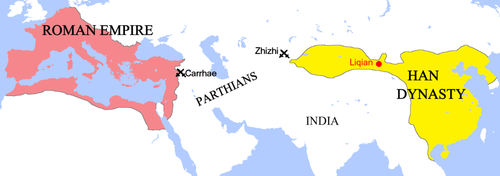
The fall of Rome and the Han Dynasty were caused by ________?
a)
invasions from nomadic tribes
b)
high taxes
c)
a weak central government
d)
all of the above
72.

How did the Ancient Rome contribute to the Western World (America)?

a)

The invention of currency (money)

b)

They were the first society where people could vote.

c)

They were the first to establish polytheism.

d)

The creation of a system of written law (12 Tables)
73.
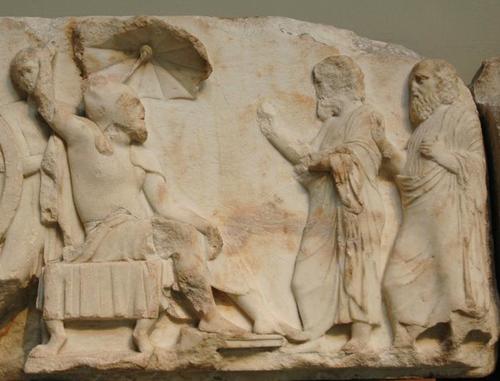
A satrap in the Persia empire was what?
a)
Governor
b)
Tax collector
c)
Judge
d)
Priest
74.
Who conquered Persia?
a)
Rome
b)
Carthage
c)
Gongols
d)
Alexander the Great
75.
The Gupta Empire of Ancient India helped spread ___________?
a)
Christianity
b)
Legalism
c)
Hinduism 
d)
Confucianism
76.
Why was Greek philosophy important?
a)
it helped spread Buddhism
b)
it established one religion
c)
it spread war against Greek city-states
d)
it spread human reasoning to understanding the world
77.
The geography of Ancient Greece allowed for _________
a)
the rise of city-states
b)
the spread of Hinduism
c)
growing of crops such as wheat
d)
the belief in one god