wayground logo

Free Printable Worksheets

NEW

Font size

S
M
L
XL
Worksheets

Lesson 7 - Prices

Total questions: 75

Worksheet time: 1hrs 15mins

Name
Class
Date
1.

The monetary value of a product

a)

price ceiling

b)

target price

c)

economic model

d)

price

2.

Price where quantity supplied equals quantity demanded.

a)

Equilibrium price

b)

Equilibrium quantity

c)

Price floor

d)

Price

3.

The highest legal price that can be charged for a product:

a)

Price

b)

Price ceiling

c)

Price floor

d)

Target price

4.

The lowest legal price that can be paid for a product:

a)

Price

b)

Price Ceiling

c)

Price Floor

d)

Surplus

5.

Which is the opposite of a surplus?

a)

Inelastic

b)

Shortage

c)

Equilibrium

d)

Floor

6.

Which term best describes rent control?

a)

Price ceiling

b)

Subsidy

c)

Equilibrium price

d)

Nonrecourse

7.
The Law of Demand states that as quantity demanded decreases...
a)
wages decrease
b)
production increases
c)
price increases
d)
quality decreases
8.
According to the Law of Supply, what happens as price increases? 
a)
The quantity supplied increases
b)
The quantity supplied decreases
c)
The supply curve shifts to the left
d)
The supply curve shifts to the right
9.
Which of these best describes market equilibrium? 
a)
the price of Pepsi does not vary much from week to week 
b)
Pepsi production provides a good profit for the manufacturer
c)
everyone who wants Pepsi can easily afford to buy it 
d)
the amount of Pepsi for sale matches the amount that people want to buy
10.
Where supply and demand intersect
a)
equilibrium 
b)
elasticity
c)
demand curve
d)
supply curve
11.
What happens when a company purposely prices their products very low, in an attempt to get people to try them? 
a)
equilibrium
b)
price floor
c)
surplus
d)
shortage
12.
a)
The green line is the equilibrium
b)
The green line is the supply curve
c)
The green line is a price ceiling
d)
The green line is a price floor
13.
Which of the following terms describes the primary objective of any business?
a)
demand
b)
profit
c)
supply
d)
money
14.
A shortage can also be referred to as
a)
a surplus
b)
an equilibrium
c)
excess supply
d)
excess demand
15.
Any price where the demand and supply are not equal is referred to as?
a)
surplus
b)
market equilibirum
c)
market disequilibrium
d)
none of the above
16.
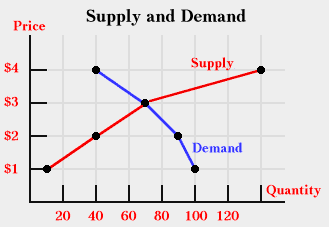
What is the Equilibrium Price?
a)
1
b)
2
c)
3
d)
4
17.
Which of the following could cause the price for automobiles to decrease?
a)
The local factory gives a big raise to its employees.
b)
None of the choices
c)
A brand new automobile dealership opens in town.
d)
The price of gasoline falls.
18.
Farmers in California have had wonderful weather. They have produced the largest crop of watermelons in years. What will happen to the price of watermelons?
a)
The price will go up.
b)
The price will go down.
19.
If there is a surplus in the market, the price is likely to...
a)
increase.
b)
decrease.
c)
fluctuate.
d)
stay the same.
20.
A decrease in demand will result in...
a)
an increase in equilibrium price and a decrease in equilibrium quantity.
b)
a decrease in equilibrium price and a decrease in equilibrium quantity.
c)
an increase in equilibrium price and quantity.
d)
a decrease in equilibrium price and quantity. 
21.
An increase in supply will result in...
a)
an increase in equilibrium price and a decrease in equilibrium quantity.
b)
a decrease in equilibrium price and an increase in equilibrium quantity.
c)
an increase in equilibrium price and quantity.
d)
a decrease in equilibrium price and quantity. 
22.

Which of the following options defines the term "Surplus?"

a)

The point where quantity demanded exceeds or is greater than quantity supplied

b)

The point where quantity demanded and supplied are equal

c)

The point where quantity supplied exceeds or is greater than quantity demanded

d)

The where there is no quantity demand at a particular price

23.

Which of the following options defines the term "shortage?"

a)

The where there is no quantity demand at a particular price

b)

The point at which quantity demanded exceeds or is greater than quantity supplied

c)

The point at which quantity supplied exceeds or is greater than quantity demanded

d)

The point at which quantity demanded and supplied intersect

24.

If the local movie theatre will provide 100 bags of popcorn at $.25, but the 200 people who bought tickets all want popcorn, which of the following economic problems will occur?

a)

A surplus

b)

Market equilibrium

c)

a shortage

25.

Sony claims that they do not have enough resources and labor to supply enough the new PS5, so you will find online market prices for up to $1000. What economic problem is this?

a)

surplus

b)

shortage

c)

Market equilibrium

26.

If there are no houses on the market in the local area and no buyers looking for houses, which of the following has occurred?

a)

Market equilibrium

b)

shortage

c)

surplus

27.

Low prices signal producers to to produce _____ and buyers to buy________.

a)

less, more

b)

more, less

c)

more, more

d)

less, less

28.

What do price ceilings and price floors prevent?

a)

Shortages

b)

Surpluses

c)

Prices reaching equilibrium

d)

Benefits to consumers

29.

High prices signal buyers to buy _______ and producers to produce _________

a)

less, more

b)

more, less

c)

less, less

d)

the same amount, more

30.
According to the price ceiling, what will happen in the market?
a)
A surplus will occur between Qs and Qd
b)
A shortage will occur between Qs and Qd
c)
Excess demand will occur between Q* and Qd
d)
Excess supply will occur between Q* and Qs
31.

When there is a shortage, which of the following would a seller be motivated to do?

a)

Increase production

b)

Increase prices

c)

Both of these

d)

Neither of these

32.

When there is an increase in prices, which of the following would a buyer be motivated to do?

a)

Not buy the product

b)

Buy a substitute

c)

Both of these

d)

Neither of these

33.

Which of the following is NOT true about a market supply and demand curve?

a)

Supply slopes upward; demand slopes downward.

b)

The curves intersect at equilibrium.

c)

There are two curves on one graph.

d)

Supply slopes downward; demand slopes upward.

34.

Based on these graphs, which of the following BEST describes equilibrium?

a)

the point at which the quantity supplied equals the price

b)

the point at which the quantity supplied equals 200 or more

c)

the point at which the price equals $3.00

d)

the point at which the demand and supply both equal 200

35.

Which of the following BEST explains how the situation shown in the graph affects producers and consumers?

a)

It benefits the producer, because the higher price increases profits.

b)

It benefits the consumer, because the price must come down to reach equilibrium.

c)

It benefits the consumer, because the quantity supplied is greater than the quantity demanded.

d)

It benefits neither, because consumers must pay more and producers must throw out excess supply.

36.

How are price ceilings and price floors similar?

a)

Both involve the government's setting of a maximum price.

b)

Both represent input changes that affect demand.

c)

Both bring about disequilibrium in the market.

d)

Both are examples of government price supports.

37.

Falling prices caused quantity demanded to rise and quantity supplied to fall until, once again, they were equal.Which of the following might have forced a firm to cut prices in this scenario?

a)

a surplus in the market

b)

a shortage in the market

c)

equilibrium in the market

d)

elasticity in the market

38.

Which of the following is generally true after a shift in supply or demand?

a)

Supply rises along with demand.

b)

Demand falls as prices rise.

c)

Equilibrium is gradually restored.

d)

Equilibrium price moves down the demand curve.

39.

Which of the following explains why a free market economy is more efficient than a centrally planned economy?

a)

It relies on prices to allocate resources.

b)

It allows experts to determine what goods to produce.

c)

It prevents consumers from engaging in barter.

d)

It keeps prices from going up and down as demand changes.

40.

Which of the following signals does the image below give to consumers?

a)

You can earn high profits by producing more of this product.

b)

You seem to be getting a good price on this product.

c)

Think carefully; the price of this product is rising.

d)

Demand for this product is increasing.

41.
What is the Equilibrium Price?
a)
1
b)
2
c)
3
d)
4
42.
What is the Equilibrium Quantity?
a)
50
b)
60
c)
70
d)
80
43.

When quantity supplied is smaller than quantity demanded, you have a ____________.

a)

shortage

b)

surplus

c)

deficit

d)

equilibrium

44.

Point at which supply and demand curve intersect each other

a)

price ceiling

b)

excess demand

c)

equilibrium

d)

disequilibrium

45.
Equilibrium price is the price at which the quantity of a product demanded by consumers and the quantity supplied by producers
a)
are different.
b)
are equal.
c)
is higher for the product demanded.
d)
is higher for the product supplied.
46.
What is the equilibrium quantity in this graph?
a)
$1.50
b)
$1.00
c)
600
d)
800
47.
Equilibrium in a market means which of the following?
a)
the point at which quantity supplied and quantity demanded are the same
b)
the point at which unsold goods begin to pile up
c)
the point at which suppliers begin to reduce prices
48.
Point at which supply and demand come together
a)
price ceiling
b)
excess demand
c)
equilibrium
d)
disequilibrium
49.
When quantity demanded is more than quantity supplied
a)
price ceiling
b)
excess demand
c)
equilibrium
d)
disequilbrium
50.
When quantity supplied is not equal to quantity demanded
a)
price ceiling
b)
excess demand
c)
equilibrium
d)
disequilibrium
51.
Legal maximum that can be charged for a good.
a)
price ceiling
b)
excess demand
c)
equilibrium
d)
disequilibrium
52.
When quantity supplied is greater than the quantity demanded, what is the condition know as?
a)
abundant supply
b)
disequilibrium
c)
excess availability
d)
excess supply.
53.
What is the government controlled price ceiling on apartment prices called?
a)
floor pricing
b)
rent control
c)
equilibrium level
d)
rent monitoring
54.
When the government sets a price floor on earned income, it is called which of the following?
a)
market equilibrium rate
b)
base-level wage
c)
minimum wage
d)
employment guarantee
55.
Why does the government place price ceilings on some "essential" goods?
a)
to prevent inflation during to reduce supply for these goods
b)
to keep business people from making large profits
c)
to keep the goods from becoming too expensive
d)
to reduce demand for these goods
56.
When quantity supplied exceeds quantity demanded at a certain price.
a)
shortage
b)
fad
c)
search costs
d)
surplus
57.
The financial and opportunity costs consumers pay in looking for a good or service.
a)
shortage
b)
fad
c)
search costs
d)
surplus
58.
When quantity demanded exceeds quantity supplied at a certain cost
a)
shortage
b)
fad
c)
search costs
d)
surplus
59.
Equilibrium in a market means which of the following?
a)
the point at which quantity supplied and quantity demanded are the same
b)
the point at which unsold goods begin to pile up
c)
the point at which suppliers begin to reduce prices
60.
Equilibrium in a market means which of the following?
a)
the point at which quantity supplied and quantity demanded are the same
b)
the point at which unsold goods begin to pile up
c)
the point at which suppliers begin to reduce prices
61.
A situation in which resources are distributed according to price
a)
rationing
b)
black market
c)
supply shock
d)
free market
62.
Business conducted without regard for government controls
a)
rationing
b)
black market
c)
supply shock
d)
free market
63.
At which price is equilibrium?
a)
$1.00
b)
$1.25
c)
$1.50
d)
$1.75
64.
At which quantity does supply and demand reach equilibrium? 
a)
500
b)
600
c)
700
d)
800
65.

What happens to the market when the chocolate bars are priced at $4 each?

a)

surplus

b)

shortage

c)

equilibrium

66.

What happens to the market when the chocolate bars are priced at $1 each?

a)

shortage

b)

surplus

c)

equilibrium

67.

Minimum wage is an example of which of the following

a)

Price floor

b)

Market equilibrium

c)

Market price

d)

Price ceiling

68.

Supply is from the point of view of the____________.

a)

Politician

b)

Consumer

c)

Producer

d)

Individual

69.

If Audrey wants to buy more candy than the store has available, what should the store do to eliminate this excess demand?

a)

Raise the price

b)

Produce more candy

c)

Just do nothing

d)

Set a maximum limit

70.
What is the equilibrium quantity in this graph?
a)
$1.50
b)
$1.00
c)
600
d)
800
71.

Refer to Graph 4-5. According to the graph, what are the equilibrium price and quantity?

a)

$7, 20.

b)

$7, 60.

c)

$5, 40.

d)

$3, 60.

72.

Refer to Graph 4-5. According to the graph, What occurs at a price of $7?

a)

there would be a shortage of 40 units.

b)

there would be a surplus of 40 units.

c)

there would be a surplus of 20 units.

d)

the market would be in equilibrium.

73.

Which letter shows the area of a shortage?

a)

A

b)

B

c)

C

74.

Which letter shows the equilibrium?

a)

A

b)

B

c)

C

75.

Which letter shows the area of surplus?

a)

A

b)

B

c)

C