

Wayground logo

Free Printable Worksheets

Font size

S
M
L
XL
Worksheets

Fun Faraday

Total questions: 42

Worksheet time: 58mins
Name
Class
Date
1.

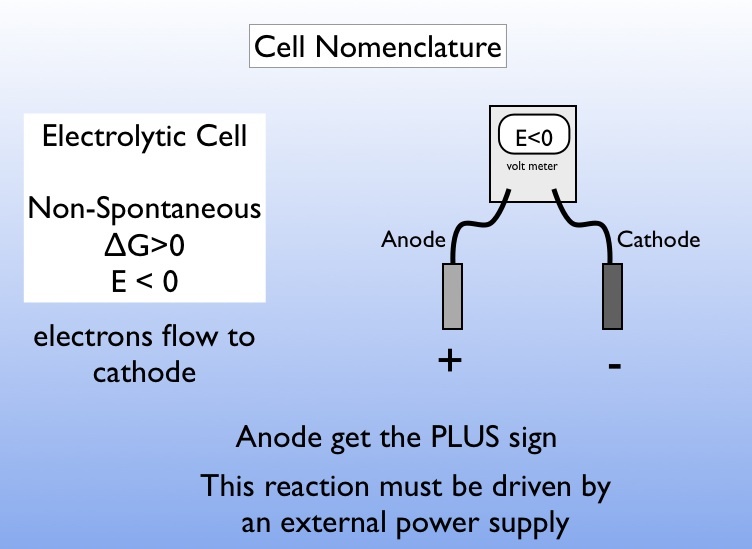
What is an electrolytic cell?

a)

a cell that converts chemical energy into electrical energy

b)

a cell that converts electrical energy into electrical energy

c)

a cell that converts electrical energy into chemical energy

d)

A cell that converts kinetic energy into potential energy.

2.
What is the name of the positive electrode?
a)
cathode
b)
anode
3.
What is the name of the negative electrode?
a)
cathode
b)
anode
4.

The negatively charged ions are attracted to the ________.

a)

anode

b)

cathode

5.

Positive ions (cations) move towards the cathode (-) where they will discharge by....

a)

Breaking apart

b)

Losing electrons

c)

Clumping together.

d)

Gaining electrons

6.
What state must the ionic compound be in to be electrolysed?
a)
aqueous only
b)
solid only
c)
solid or aqueous only
d)
molten or aqueous only
7.
Which statement correctly describes the 2 electrodes?
a)
The anode is negative and the cathode is positive
b)
The anode and cathode are both positive
c)
The anode is positive and the cathode is negative
d)
The anode and cathode are both negative.
8.
What does the Cathode (-) do to ions?
a)
Give electrons to the Positive ions to turn them back into atoms
b)
Take electrons from the positive ions?
c)
Turn ions back into atoms by removing electrons
d)
Turn atoms into ions by adding electrons
9.
In an electrolytic cell, the positive electrode is the
a)
anode, where oxidation occurs
b)
anode where reduction occurs
c)
cathode where oxidation occurs
d)
cathode where reduction occurs
10.

Anions get discharged by ________ electrons at the ___________

a)

gaining, cathode

b)

losing, anode

c)

gaining, anode

d)

losing, cathode

11.
In electrolytic cell, anode will attract...
a)
Cations
b)
Anions
12.
What is the name given to the solution that is being electrolysed?
a)
Salt solution
b)
Electric solution
c)
Mineral solution
d)
Electrolyte
13.

Choose the half-equation that shows the discharge of aluminium ion.

a)

Al3+ - 3e- --> Al

b)

Al2+ + 3e- --> Al

c)

Al3+ + 3e- --> Al

d)

Al3+ --> Al + 3e-

14.

Reduction is....

a)

Gain of electrons

b)

Loss of electrons

c)

Both the loss and gain of electrons

d)

None of these

15.

Oxidation is....

a)

Gain of electrons

b)

Loss of electrons

c)

Both the loss and gain of electrons

d)

None of these

16.

In electrolytic cell which its electrolyte is copper (II) sulphate, copper are used as electrodes. What is the product at the anode?

a)

Oxygen gas and water

b)

Copper metal

c)

Copper (II) ions

d)

Hydrogen gas

17.
What does the Cathode (-) do to ions?
a)
Give electrons to the Positive ions to turn them back into atoms
b)
Take electrons from the positive ions?
c)
Turn ions back into atoms by removing electrons
d)
Turn atoms into ions by adding electrons
18.

What would molten potassium bromide break down into?

a)

Potassium and bromide

b)

Potassium and bromine

c)

Just potassium

d)

Just bromine

e)

Just bromide

19.

What ions are present in molten aluminium oxide?

a)

Al3+, O2-, H+, OH-

b)

Al3+, O2-

c)

Al3+, OH-

20.
Positive ions (cations) will move towards the cathode (-) where they will discharge by....
a)
Breaking apart
b)
Losing electrons
c)
Clumping together.
d)
Gaining electrons
21.
In electrolysis of 0.001 mol/dm3 aqueous NaCl solution, which ion will be selectively discharged at the anode?
a)
Na + ions
b)
Cl - ions
c)
OH- ions
d)
H+
22.
A student decided to silver-plate a locker key using the apparatus shown. In this cell, the key is the
a)
anode and is connected to the positive terminal of the power supply
b)
anode and is connected to the negative terminal of the power supply
c)
cathode and is connected to the positive terminal of the power supply
d)
cathode and is connected to the negative terminal of the power supply
23.
An experiment is set up as shown in the diagram below.  Both electrodes P and Q are made of graphite.  Which of the following gives the correct results as electrolysis proceeds? 
a)
Electrolytes: Aqueous sodium chloride; Mass of P: Remains unchanged;                Mass of Q: Increase
b)
Electrolytes: Aqueous sodium chloride; Mass of P: Increase; Mass of Q: Remains unchanged
c)
Electrolytes: Aqueous copper(II) sulfate; Mass of P: Remains unchanged;             Mass of Q: Increase
d)
Electrolytes: Aqueous copper(II) sulfate;              Mass of P: Increase; Mass of Q: Remains unchanged
24.

What is the half-equation for the discharge of hydroxide ions?

a)

2O2- --> O2 + 4e-

b)

OH- --> OH + e

c)

4OH- --> 2H2O + O2 + 4e-

d)

2H2O + O2 + 4e- --> 4OH-

25.
Object is electroplated with copper using copper(II) sulfate. Which statement is correct?
a)
Positive electrode increases in mass
b)
Concentration of Cu2+ ions in solution decreases
c)
Reduction occurs at positive electrode
d)
Reaction at negative electrode is Cu2+ + 2e– → Cu
26.

The preferential discharge of the ions depends on its position in the (a)   series.

27.

Which is the correct electrochemical series?

a)

Na, Al, Fe, Mg, Zn

b)

Mg, Fe, Zn, Na, Al

c)

Na, Mg, Al, Zn, Fe

d)

Fe, Zn, Na, Mg, Al

28.
What is the product formed at the cathode during the electrolysis of molten magnesium fluoride?
a)
magnesium
b)
hydrogen
c)
fluorine
d)
oxygen
29.
Which statement correctly describes the 2 electrodes?
a)
The anode is negative and the cathode is positive
b)
The anode and cathode are both positive
c)
The anode is positive and the cathode is negative
d)
The anode and cathode are both negative.
30.

In electrolytic cell that uses aqueous copper(II) sulfate as electrolyte and copper plates as electrodes, what is the product at the anode?

a)

Oxygen gas and water

b)

Copper metal

c)

Copper(II) ions

d)

Hydrogen gas

31.

The ions that are present in copper(II) sulphate solution are

a)

Cu2+, SO42-

b)

Cu2+, SO42-, H+

c)

Cu2+, SO42-, OH-

d)

Cu2+, SO42-, H+, OH-

32.
When NaCl solution is electrolysed what has forms at the anode?
a)
Hydrogen
b)
Oxygen
c)
Chlorine
d)
Sodium
33.

Which of the following substances does not produce gas at the cathode during electrolysis process?

a)

Sulphuric acid

b)

Sodium sulphate solution

c)

Copper(II) nitrate solution

d)

Potassium nitrate solution

34.

A student carry out experiment to study electrolysis of copper(II) sulphate solution.

She used copper plate A as anode and copper plate C as cathode.

Which of the following statements is true?

a)

Electrode C becomes thinner

b)

Electrode A becomes thicker

c)

Greenish yellow gas is produced at electrode A

d)

The intensity of the blue colour solution does not change

35.

Concentrated solution of potassium chloride is electrolyzed using carbon electrodes.

Which of the following is the observation for the reaction at anode ?

a)

Greenish-yellow gas released

b)

Colourless bubbles released

c)

Grey shiny solid deposited

d)

Reddish-brown gas released

36.
When NaCl solution is electrolysed what has forms at the anode?
a)
Hydrogen
b)
Oxygen
c)
Chlorine
d)
Sodium
37.
What is the equation to show what happens to Cl ions at the anode.
a)
Cl- --> Cl + e-   
b)
2Cl- --> Cl2 + 2e-   
c)
Cl2 + 2e-   2Cl- 
d)
Cl2 + 2e-  -->  2Cl- 
38.
What is the product formed at the anode during the electrolysis of concentrated copper(II) chloride?
a)
copper
b)
chlorine
c)
hydrogen
d)
oxygen
39.
In the electrolysis of water, hydrogen gas is produced at the 
a)
anode 
b)
cathode
40.

What is the expected observation at positive pole?

a)

nothing happens

b)

colorless gas is evolved

c)

yellowish green gas is evolved

d)

silvery grey solid is deposited.

41.

What is the gas produced at the anode during the electrolysis of very dilute hydrochloric acid?

a)

water

b)

oxygen

c)

hydrogen

d)

chlorine

42.
What is the product formed at the anode during the electrolysis of concentrated copper(II) chloride?
a)
copper
b)
chlorine
c)
hydrogen
d)
oxygen
