wayground logo

Free Printable Worksheets

Font size

S
M
L
XL
Worksheets

Classification

Total questions: 98

Worksheet time: 1hrs 23mins
Name
Class
Date
1.
The 8 levels of classification, most broad to most specific.
a)
Domain, Genus, Family, Order, Class, Phylum, Kingdom, Species
b)
Domain, Species, Kingdom, Genus, Phylum, Family, Class, Order
c)
Domain, Kingdom, Phylum, Class, Order, Family, Genus, Species
d)
Order, Kingdom, Species, Domain, Phylum, Family, Class, Genus
2.

Survival of the fittest means......

a)

Only strong organisms survive

b)

Organisms best adapted to their environment survive the best

c)

Organisms that are most attractive survive the best

d)

Only organisms that have homologous structures survive

3.
The term used to describe the scientific study of how living things are classified.  
a)
Classification
b)
Organization
c)
Domain
d)
Taxonomy 
4.
In the 8 Levels of Classification which levels is the broadest category? 
a)
Kingdom
b)
Family
c)
Species
d)
Domain
5.
In the Kingdom Plantae organisms that make their own food are called_____________. 
a)
Eukaryotes
b)
Heterotrophs
c)
Prokaryotes
d)
Autotrophs
6.
Organisms in the Kingdom Animalia that consume other organisms are called_____________. 
a)
Eukaryotes
b)
Heterotrophs
c)
Prokaryotes
d)
Autotrophs
7.
Who first proposed binomial nomenclature as a way of classifying organisms?
a)
Carolus Linnaeus
b)
Carl's Jr.
c)
Charles Darwin
d)
Henry Groseclose
8.
______ is important to survive in the environment.
a)
Variability
b)
Survival
c)
Niches
d)
Intelligence
9.
Blending in with the environment is - 
a)
natural selection
b)
imitation
c)
mimicry
d)
camouflage
10.
Which trait is most adapted for a cold climate?
a)
thick, furry coat
b)
long, flexible trunk
c)
sharp, curved tusks
d)
broad, powerful body
11.
Why do we use scientific names to name organisms instead of relying on common names?
a)
Because common names vary regionally
b)
Because everyone understands and speaks Latin
c)
To make scientists sound smart
d)
Because they are the most descriptive
12.
Which of the following shows taxonomic groups in order from broadest to most specific?
a)
kingdom, phylum,order, class, genus, species
b)
species, genus, family, order, class, phylum, kingdom
c)
kingdom, phylum, class, order, family, genus, species
d)
phylum, kingdom, order, class, genus, family, species
13.
Fungi are a type of...
a)
decomposer
b)
producer
14.
Tigers, Jellyfish, Gorillas and Sponges are all part of kingdom _______.
a)
Animalia
b)
Plantae
c)
Fungi
d)
Bacteria
15.
Which kingdom is autotrophic AND has a cell wall?
a)
Bacteria
b)
Fungi
c)
Plantae
d)
Protista
16.
 You would find mushrooms in which kingdom?
a)
Plantae
b)
Protists
c)
Fungi
d)
Animalia
17.
Which kingdom do humans belong to?
a)
Plantae
b)
Fungi
c)
Animalia
d)
Protista
18.
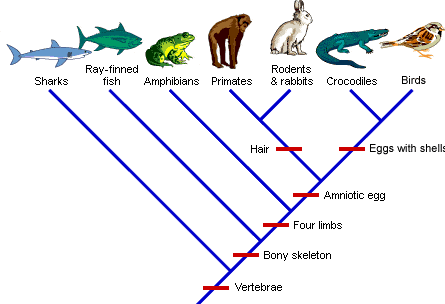
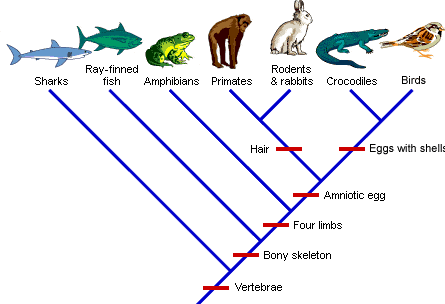
According to this cladogram, sharks are MOST closely related to which organism? 
a)
Amphibians
b)
Ray finned fish
c)
Crocodiles
d)
Birds
19.
Which two orgainsms have hair? 
a)
Sharks & Ray Finned Fish
b)
Primates & Rodents
c)
Birds & Crocodiles
d)
Rabbits & Birds
20.
Most young animals inherit similar appearances, such as shape and color, from their parent animals. Which best describes why a baby deer (fawn) has spots when the adult deer do not?
a)
The spots help camouflage the fawn for protection.
b)
The spots help a fawn to be seen when crossing roads.
c)
The adult deer lose their spots by rubbing against trees.
21.
Emily has brown hair. Which is most likely a true statement about Emily?
a)
Emily’s favorite color is brown.
b)
Emily has a parent with brown hair.
c)
Emily’s older brother has brown hair. 
22.
When a starfish grows a new body off a broken arm, what kind of reproduction is this?
a)
Sexual
b)
Differentiation
c)
Asexual 
d)
Specialization
23.
Where does an off spring get its traits in asexual reproduction?
a)
From both parents
b)
From only one parent
c)
From neither parent
d)
There are no traits handed down
24.
What percentage of chromosomes are handed down by a sperm cell?
a)
75%
b)
25%
c)
50%
d)
100%
25.
Sexual reproduction requires _____ parents and asexual reproduction requires ___ parents
a)
1,1
b)
2,2
c)
2,1
d)
1,2 
26.
What is an advantage of sexual reproduction?
a)
Allows genetic variation
b)
Only needs one parent
c)
Happens very quickly
d)
Offspring are exact copies of parent
27.
What is one disadvantage of sexual reproduction?
a)
Only one parent needed
b)
Off spring are exact copies of parents
c)
Happens very quickly
d)
Needs two parents
28.

What happens in asexual reproduction after budding?

a)

the cell becomes two daughter cells

b)

budding happens again

c)

the nucleus divides itself

29.

Sexual reproduction usually happens in which of these organisms?

a)

animals

b)

plants

c)

fungi

d)

animals & plants

30.

What happens in budding after the bud grows?

a)

another buds grows

b)

the bud breaks off and becomes independent

c)

the bud grows buds on top of it

31.

What is Reproduction?

a)

It is the process of giving rise to offsprings

b)

Making two

c)

making many

d)

two offsprings produced

32.
A mode of reproduction in which an organism arises from two organisms and inherits half of its DNA from each parent
a)
Sexual Reproduction
b)
Asexual Reproduction
c)
Cloning
d)
Fragmentation
33.
What is a characteristic of sexual reproduction?
a)
diverse offspring
b)
identical offspring
c)
faster than asexual reproduction
d)
requires no energy
34.
2 dogs reproduce, 2 sex cells join together & form offspring. The resulting offspring is likely
a)
to express only recessive traits
b)
to be identical to ONE parent
c)
to share some traits from BOTH of its parents
35.
Creates the greatest diversity, & therefore the ability to survive changing environments is
a)
sexual reproduction
b)
asexual reproduction
c)
cloning
d)
fragmentation
36.
Which of the following describes the main advantages of sexual reproduction
a)
requires lots of time/energy
b)
no new gene combos can arise 
c)
diversity
d)
looks identical to the parent
37.
If two organisms reproduce sexually, then their offspring will exhibit a genetic makeup that is -
a)
identical to only one parent
b)
identical to all of its siblings
c)
a unique combination of traits
d)
the recessive traits of each parent
38.
If an environment suddenly changes, which type of reproduction would be most beneficial? Why?
a)
Asexual, because asexual organisms always have variation within species.
b)
Sexual, because sexual organisms have variation within species.
c)
Both Asexual and Sexual reproduction would be beneficial, because they both have variation within species.
d)
Asexual, because asexual organisms have no variation, so they can adapt to a changing environment.
39.
Where does a cell contain it's genetic material?
a)
nucleus
b)
nucleolus
c)
cytoskeleton
d)
golgi
40.
The production of a new organism from two parents
a)
Sexual Reproduction
b)
Asexual Reproduction
c)
Vegetative Propagation
d)
Fertilization
41.
The production of a new organism from a single parent
a)
Sexual Reproduction
b)
Vegetative Propagation
c)
Fertilization
d)
Asexual Reproduction
42.

These determine your physical traits:

a)

Chromosomes/Genes/Nucleus

b)

Emotional traits

c)

Mitochondria/Muscles

43.

Your traits are determined by ________ located in your genes

a)

chromosomes

b)

mitochondria

c)

mitosis

44.

________ is the natural process of passing traits from generation to generation

a)

heredity

b)

mitosis

c)

meiosis

45.

Genetically identical offspring comes from

a)

asexual reproduction

b)

sexual reproduction

46.

The Nucleus stores genetic information and is stored in the _____ of a cell

a)

center

b)

outside

47.

A disadvantage of asexual reproduction is

a)

All offspring are similar and can't adapt to changes quickly

b)

All offspring are not the same and can adapt to changes quickly

48.

Animals are adapted to eat and survive in their specific environment?

a)

true

b)

false

49.

Meiosis takes places inside the

a)

nucleus

b)

skin

c)

muscles

50.

Chromosomes are in the shape of the letter

a)

X

b)

P

51.

When a parent cell divides, it passes on ______ information to its offspring through heredity

a)

genetic

b)

computing

c)

learning

52.

Offspring in asexual reproduction has _________ chromosomes to that of its parent

a)

identical

b)

different

53.
Where, in the eukaryotic cell, is DNA located?
a)
ribosomes
b)
nucleus
c)
E.R.
d)
cytoplasm
54.
What is the science of organizing, classifying and naming living things.
a)
taxonomy
b)
taxadermy
c)
taxicab
d)
toxicology
55.
If two species share the same class, they also share the same______.
a)
phylum
b)
order
c)
genus
d)
species
56.
The correct order of classification from the BROADEST group to the most narrow is:
a)
Species, Genus, Family, Order, Class, Phylum, Kingdom
b)
Kingdom, Phylum, Class, Family, Order, Genus, Species
c)
Kingdom, Family, Order, Phylum, Class, Genus, Species
d)
Kingdom, Phylum, Class, Order, Family, Genus, Species
57.
An organism that has cells that lack a nucleus are called:
a)
Eukaryote
b)
Heterotroph
c)
Prokaryote
d)
Autotroph
58.
An organism that gets its food by consuming other organisms is known as a:
a)
heterotroph
b)
autotroph
c)
prokaryote
d)
eukaryote
59.
Which characteristics best describes the Plant Kingdom?
a)
unicellular; eukaryote; autotroph
b)
multicellular, prokaryote, autotroph
c)
multicellular, eukaryote, autotroph
d)
unicellular, prokaryote, heterotroph
60.
Which characteristics best describes the Animal Kingdom?
a)
unicellular, eukaryote, autotroph
b)
multicellular, prokaryote, heterotroph
c)
multicellular, eukaryote, autotroph
d)
multicellular, eukaryote, heterotroph
61.
Which characteristics best describe the Kingdom Protista?
a)
multicellular, eukaryote, heterotroph and autotroph
b)
multicellular and unicellular, heterotoph and autotroph, eukaryote
c)
unicellular, autotroph, prokaryote
d)
multicellular and unicellular, prokaryote, heterotroph
62.
Which characteristics best describe the Kingdom Fungi?
a)
multicellular and unicellular, eukaryote, autotroph
b)
multicellular and unicellular, prokaryote, heterotroph
c)
multicellular, eukaryote, heterotoph
d)
multicellular and unicellular, eukaryote, heterotroph
63.
Which characteristics best describes the Kingdoms Eubacteria and Archaebacteria?
a)
unicellular, prokaryote, heterotroph
b)
unicellular, prokaryote, heterotroph and autotroph
c)
multicellular, eukaryote, autotroph
d)
multicellular, prokaryote, heterotroph and autotroph
64.
The study of how things are classified is known as:
a)
binomial nomenclature
b)
a dichotomous key
c)
taxonomy
65.
What is taxonomy?
a)
The study of DNA and RNA
b)
The study of how organisms are related
c)
The study of classifying and describing organisms
d)
The study of organisms in their habitat
66.
Choose the correct order of taxa from LARGEST to SMALLEST
a)
Species, Genus, Family, Order, Class, Phylum, Kingdom
b)
Family, Kingdom, Order, Phylum, Class, Order, Species, Genus
c)
Kingdom, Phylum, Class, Order, Family, Genus, Species
d)
Phylum, Order, Species, Family, Genus, Kingdom
67.
The three Domains are:
a)
Plant, Animal, Bacteria
b)
Bacteria, Archaea, Eukarya
c)
Fungi, Animal, Plant
d)
Invertebrates, Vertebrates, Plants
68.
Having a wide variety and lots of different species (like that in a rain forest) is called:
a)
Biodiversity
b)
Species Richness
c)
Phylogeny
d)
Systematics
69.
Moss, Sunflowers, Pine trees, and algae are all in this kingdom:
a)
Fungi
b)
Anamalia
c)
Plantae
d)
Bacteria
70.
The scientific name for an organism is made from the:
a)
class and family name
b)
genus and species name
c)
domain and kingdom name
d)
kingdom and phylum name
71.
Mold would belong to which kingdom?
a)
Animal
b)
Archaea
c)
Plant
d)
Fungi
72.
Which domain includes all multicellular plants and animals?
a)
Archaea
b)
Eukarya
c)
Eubacteria
d)
Protista
73.
Which taxonomic category is higher than the others?
a)
class
b)
genus
c)
order
d)
phylum
74.
What goal does Taxonomy accomplish?
a)
explains the differences between living organisms
b)
classifies living organisms into groups
c)
predicts the types of undiscovered organisms
d)
establishes relationships of organisms with their habitat
75.
Which of the following shows the taxa in the correct order?
a)
kingdom-phylum-order-class-family-genus-species
b)
kingdom-class-order-family-phylum-genus-species
c)
kingdom-phylum-class-order-family-genus-species
d)
kingdom-phylum-family-order-class-genus-species
76.
Tigers, Jellyfish, Gorillas and Sponges are all part of kingdom _______.
a)
Animalia
b)
Plantae
c)
Fungi
d)
Bacteria
77.
The 8 levels of classification, most broad to most specific.
a)
Domain, Genus, Family, Order, Class, Phylum, Kingdom, Species
b)
Domain, Species, Kingdom, Genus, Phylum, Family, Class, Order
c)
Domain, Kingdom, Phylum, Class, Order, Family, Genus, Species
d)
Domain, Kingdom, Species, Phylum, Family, Order, Class, Genus
78.
What is NOT true about plants and fungi?
a)
They both have cell walls
b)
They are both Eukaryotic 
c)
They both are autotrophs
d)
They both reproduce sexually and asexually 
79.
Which Domain/Kingdom is capable of living in extreme environments like hot springs, geysers, or very salty waters?
a)
Bacteria
b)
Archaea
c)
Eukarya
80.
Which of the following does not belong in the Fungi Kingdom? 
a)
Yeast
b)
Ameoba
c)
Mold
d)
Mushroom
81.
The method bacteria use to reproduce is
a)
asexual
b)
sexual
c)
artificial selection
d)
replication
82.
What is a species?
a)
A group of organisms that can mate with each other and produce fertile offspring. 
b)
A group of organisms that genetically are very different from each other. 
c)
A group of organisms that can mate, but do not produce offspring.
d)
Indivual organisms that live in the same environment. 
83.
Why do scientists classify living things?
a)
It helps scientists trap species to study
b)
It is easier to study organisms when grouped 
c)
It is a good way to keep organisms calm
d)
It is helpful when dissecting an organism
84.
An early classification system had two groups: Plants and Animals. What is wrong with that system?
a)
It is too specific
b)
It is too narrow minded
c)
It is too broad
d)
It is too fancy 
85.
Which taxa has more organisms, family or phylum?
a)
phylum
b)
family
c)
they are equal
d)
not enough information to answer
86.
Which kingdom contains only multicellular autotrophs?
a)
fungi
b)
plant
c)
animal
d)
protist
87.
What do plants and fungi have in common?
a)
They are both autotrophic
b)
They are both unicellular
c)
They both have cell walls
d)
They both are prokaryotes 
88.

Which organisms can you find living in extreme places such as salt lakes, hot springs and deep sea trenches

a)

bacteria

b)

Plantae

c)

Archea

d)

Protists

89.
Which kingdom do humans belong to?
a)
Plantae
b)
Fungi
c)
Animalia
d)
Protista
90.
What is the most specific level of classification?
a)
Family
b)
Domain
c)
Species
d)
Carolus Linnaeus
91.
The 8 levels of classification, most broad to most specific.
a)
Domain, Genus, Family, Order, Class, Phylum, Kingdom, Species
b)
Domain, Species, Kingdom, Genus, Phylum, Family, Class, Order
c)
Domain, Kingdom, Phylum, Class, Order, Family, Genus, Species
d)
Order, Kingdom, Species, Domain, Phylum, Family, Class, Genus
92.
Members of this kingdom never have a cell wall
a)
Animalia
b)
Plantae
c)
Archaebacteria
d)
Protista
93.
Molds, yeast, and mushroom belong to kingdom:
a)
Eubacteria
b)
Archaebacteria
c)
Protista
d)
Fungi
94.
The grouping, Genus is just before the most specific category.
a)
TRUE
b)
FALSE
95.

(Taxonomy) Classifying organisms based on their characteristics is called...

a)

taxonomy

b)

sorting

c)

organizing

d)

grouping

96.

(Taxonomy) Which level of classification is the most broad?

a)

Species

b)

Class

c)

Domain

d)

Kingdom

97.

(Taxonomy) Which level is the most specific?

a)

Domain

b)

Family

c)

Species

d)

Genus

98.

(Taxonomy) How many common names does an organism have?

a)

1

b)

2

c)

3

d)

many