wayground logo

Free Printable Worksheets

Font size

S
M
L
XL
Worksheets

8th grade 1st 6 weeks

Total questions: 116

Worksheet time: 4hrs 11mins

Name
Class
Date
1.
Which of these is a property of metals?
a)
It's malleable
b)
It can't conduct electricity
c)
They are used in food
d)
It's very brittle
2.
Which of the following is NOT a characteristic of most metals?
a)
Brittle
b)
Good conductor
c)
Ductile
d)
Malleable
3.

All of the following would classify an element as a metal except?

a)

Dull

b)

Luster

c)

Malleable

d)

Ductile

4.
Describe what luster means
a)
How an object reflects light
b)
How soft an object is
c)
If an object floats
d)
If an object can be dug out of the earth.
5.
When an object changes shape when struck by a hammer.
a)
luster
b)
malleable
c)
brittleness
d)
ductile
6.
If you have a material that can conduct electricity well it is probably a...
a)
Metalloid
b)
Matter
c)
Non-metal
d)
Metal
7.
Unlike non-metals, most metals tend to —
a)
conduct electricity and heat well.
b)
be gases at room temperature.
c)
break easily when hammered.
d)
have less luster and shine.
8.
All of the following would classify an element as a metal except?
a)
Dull
b)
Luster
c)
Malleable
d)
Hard
9.
Which of these is a property of metals?
a)
It's malleable
b)
It can't conduct electricity
c)
They are used in food
d)
It's very brittle
10.
Which of the following is a good conductor of heat?
a)
Metal
b)
Nonmetal
c)
Metalloid
11.
Which elements are found on the left to middle of The Periodic Table? 
a)
Metals
b)
Nonmetals
c)
Metalloids
d)
Candles
12.
Iron is a good conductor, malleable and magnetic. What type of element is Iron? 
a)
Metal
b)
Nonmetal
c)
Metalloid
13.

Most metals are solid at room temperature

a)

False

b)

True

14.
The word “luster” refers to which property of matter?
a)
The ability to conduct electrical or thermal energy
b)
Capable of being drawn out into thin wires
c)
The way a surface appears when it reflects light
d)
Suitable for being shaped by beating or rolling
15.
Where are the non-metallic elements found in the periodic table?
a)
In the middle
b)
In the top rows
c)
On the left-hand side
d)
On the right-hand side
16.
Which of these grouping of elements could have the characteristic of luster (shiny)?
a)
Metal
b)
Nonmetal
c)
metalloids
d)
Both metals and metalloids
17.
Which elements are found on the left to middle of The Periodic Table? 
a)
Metals
b)
Nonmetals
c)
Metalloids
d)
Candles
18.
Which type of elements touch the zigzag line?
a)
Metals
b)
Nonmetals
c)
Metalloids
d)
Metals and Metalloids
19.
What is the chemical symbol for Calcium?
a)
C
b)
Ca
c)
Cal
20.
What is the chemical symbol for Carbon?
a)
C
b)
Ca
c)
Car
21.
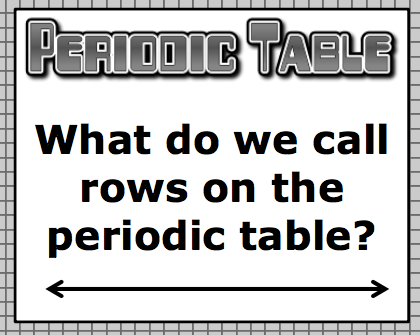
a)
Periods
b)
Groups
22.
A neutron has a charge of
a)
+2
b)
No charge
c)
-1
d)
+1
23.
What does the 1.00794 stand for?
a)
Hydrogen
b)
atomic number
c)
atomic mass
d)
atomic explosion
24.
In the modern periodic table elements are arranged by:
a)
atomic mass
b)
atomic number
c)
valence electrons
d)
number of isotopes
25.
How many protons are in Beryllium?
a)
4
b)
9
c)
5
d)
2
26.
Most of the elements on the periodic table are classified as "metal".
a)
True
b)
False
27.
all matter is made of what 
a)
energy 
b)
atoms 
c)
electrons 
d)
compounds 
28.

What are the elements in group 1 (the far left) of the periodic table called?

a)

Alkali metals

b)

Alkaline earth metals

c)

Halogens

d)

Noble gases

29.

What are the elements in group 18 (the far right) of the periodic table called?

a)

Alkali metals

b)

Alkaline earth metals

c)

Halogens

d)

Noble gases

30.

What are the elements in group 17 of the periodic table called?

a)

Alkali metals

b)

Alkaline earth metals

c)

Halogens

d)

Noble gases

31.

What are the elements in groups 3-12 of the periodic table called?

a)

Transition metals

b)

Non-metals

c)

Metalloids

d)

Metals

32.

What are the elements found along the "staircase" called? They have properties of both metals and non-metals.

a)

Metalloids

b)

Non-metals

c)

Transition metals

d)

Metals

33.

Hydrogen is a:

a)

Alkali metal

b)

Metalloid

c)

Non-metal

d)

Noble gas

34.

The positively charged particle in the nucleus of an atom is a:

a)

Proton

b)

Neutron

c)

Electron

d)

Shell

35.

The neutral particle in the nucleus of an atom is a:

a)

Proton

b)

Neutron

c)

Electron

d)

Shell

36.

A tiny, negatively charged particle that moves around the nucleus of an atom in clouds/shells is called:

a)

An electron

b)

A proton

c)

A neutron

d)

A shell

37.

The number of protons in the nucleus of an atom is equal to the:

a)

Atomic number

b)

Atomic mass

c)

Number of neutrons

d)

Number of valence electrons

38.

The total number of protons and neutrons in an atom's nucleus is equal to the:

a)

Atomic number

b)

Atomic mass

c)

Number of valence electrons

d)

Number of electron shells

39.

The horizontal rows on the periodic table are called:

a)

Shells

b)

Periods

c)

Groups

d)

Horizontals

40.

The vertical columns on the periodic table that have common properties are called

a)

Groups

b)

Periods

c)

Shells

d)

Valences

41.

The subatomic particles that are located the farthest from the nucleus are:

a)

Valence electrons

b)

Valence protons

c)

Periodic electrons

d)

Periodic protons

42.

The number of electron shells an atom has is equal to the element's:

a)

Period number

b)

Group number

c)

Valence number

d)

Atomic number

43.

The number of valence electrons an element has is equal to its:

a)

Period number

b)

Group number

c)

Valence number

d)

Atomic number

44.

The horizontal rows on the periodic table are called

a)

groups

b)

families

c)

periods

d)

atomic numbers

45.

Each vertical column on the periodic table is called a...

a)

group

b)

tower

c)

period

d)

crew

46.

On the periodic table, elements on the right side of the "stair-step" line are classified as:

a)

nonmetals

b)

metals

c)

gases

d)

Halogens

47.

Elements in the same group or family have the same number of

a)

neutrons

b)

valence electrons

c)

electrons

d)

energy levels

48.

Electrons...

a)

are found in the nucleus

b)

give us the atomic number of an element

c)

are how we identify each elements

d)

have a negative charge

49.

Elements in the same period have the same number of

a)

neutrons

b)

valence electrons

c)

electrons

d)

energy levels

50.
Each column in the periodic table is called a 
a)
period
b)
group
c)
cluster
d)
unit
51.
The atoms along the staircase are called 
a)
metals
b)
nonmetals
c)
metalloids
d)
noble gases
52.
What is the number of protons that the element in this image contain?
a)
14
b)
7
c)
15
d)
18
53.

If an atom has 12 protons, which of the following must it also have to be considered a neutral atom?

a)

12 neutrons

b)

12 electrons

c)

12 protons

d)

24 protons and neutrons

54.
If an atom has 10 protons, 10 neutrons, and 10 electrons, what is the mass of the atom?
a)
10
b)
20
c)
30
55.

What two particles determine the mass number?

a)

Protons and electrons

b)

Electrons and neutrons

c)

Protons and neutrons

56.

What is the atomic number of this atom shown in the Bohr model?

a)

11

b)

12

c)

13

d)

can't be determined

57.

What is the mass number of the atom shown in the Bohr model?

a)

11

b)

12

c)

23

d)

Can't be determined

58.
What subatomic particles would you find in the nucleus of an atom?
a)
Protons only
b)
Protons and Neutrons
c)
Neutrons and Electrons
d)
Protons and Electrons 
59.
What subatomic particle is electrically neutral (no charge)?
a)
Proton
b)
Ion
c)
Neutron
d)
Electron
60.
What is the mass of an atom if it has 11 protons, 12 neutrons, and 11 electrons?
a)
22
b)
11
c)
34
d)
23
61.
What subatomic particle(s) would be found orbiting the nucleus?
a)
Neutrons only
b)
Electrons only
c)
Protons and Neutrons
d)
Protons and Electrons
62.
Protons and Electrons balance the charge of an atom.
a)
True
b)
False
63.
What particle uniquely identifies an element?
a)
Number of Valence Electrons
b)
Number of Protons
c)
Number of Electrons
d)
Atomic Mass
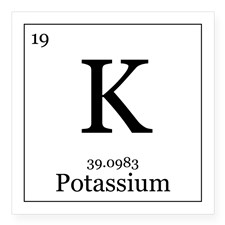
64.
How many neutron are in the atom "K"?
a)
7
b)
2
c)
39
d)
20
65.
What is the formula for density?
a)
density = mass x volume
b)
density = mass / volume
c)
density = mass + volume
d)
density = mass - volume
66.
If an object has a density of 3.6 g/mL and you put it into water, will it sink or float?  
a)
sink
b)
float
67.
If an object has a density of 0.6 g/mL and you put it into water, will it sink or float?  
a)
sink
b)
float
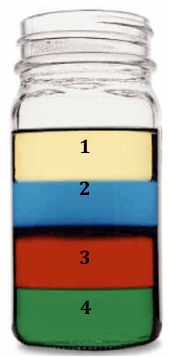
68.
Put the liquids in order from most dense to least dense?
a)
4, 3, 2, 1
b)
1, 2, 3, 4
c)
3, 4, 2, 1, 
d)
4, 3, 1, 2
69.
Frank has a paper clip. It has a mass of 9g and a volume of 3cm3. What is its density?
a)
3 g/cm3
b)
1/3 g/cm3
c)
27 g/cm3
d)
39 g/cm3
70.
What is the density of Object X if the mass of this object is 50 grams?
a)
10.0 g/cm3
b)
15.0 g/cm3
c)
2  g/cm3
d)
25.0 g/cm3
71.
Find the density of a 2 cm x 2 cm x 2 cm cube with a mass of 64 g.
a)
6 cm3
b)
12 g/cm3
c)
128 g/cm3
d)
8  g/cm3
72.
Jill has a gel pen. The gel pen has a mass of 8g and a volume of 2cm3. What is the density of the pen?
a)
4 g/cm3
b)
16 g/cm3
c)
.25 g/cm3
d)
64 g/cm3
73.
What is the density of a liquid that has a mass of 27g and a volume of 30ml?
a)
0.9 g/ml
b)
3 g/ml
c)
57 g/ml
d)
810 g/ml
74.
A piece of copper has a mass of 89g and a volume of 10 cm3.  What would be the density of the copper?
a)
0.89 g/cm3
b)
89 g/cm3
c)
8.9 g/cm3
d)
890 g/cm3
75.
A block has a mass of 54g and a volume of 20cm3.  What is the density of the block?
a)
74 g/cm3
b)
1080 g/cm3
c)
34 g/cm3
d)
2.7 g/cm3
76.
Put the liquids in order from most dense to least dense?
a)
4, 3, 2, 1
b)
1, 2, 3, 4
c)
3, 4, 2, 1, 
d)
4, 3, 1, 2
77.

If an atom has 10 protons, 10 neutrons, and 10 electrons, what is the mass of the atom?

a)

10

b)

20

c)

30

78.

What does the 1.00794 stand for?

a)

Hydrogen

b)

atomic number

c)

atomic mass

d)

atomic explosion

79.

Particles in an atom that are neutral and have no charge are

a)

negatrons

b)

electrons

c)

neutrons

d)

protons

80.

True or False: Neutrons have a negative charge

a)

True

b)

False

81.
The particles that are found in the nucleus of an atom are _____.
a)
Neutrons and electrons
b)
Electrons only
c)
Protons and neutrons
d)
Protons and electrons
82.
An atoms overall charge is _____.
a)
Positive 
b)
Depends on its mood 
c)
Neutral 
d)
Negative 
83.
Particles in an atom that are neutral and have no charge are ______. 
a)
Negatrons 
b)
Electrons 
c)
Neutrons 
d)
Protons 
84.
An atom with atomic number 6 would have how many protons?
a)
6
b)
12
c)
3
d)
Cannot be determined 
85.
The positive particles of an atom are 
a)
Electrons 
b)
Positrons 
c)
Neutrons 
d)
Protons 
86.

Elements in the same group have __________

a)

Similar Properties

b)

Same number of shells

c)

Similar Mass

87.

What do all elements in the same period have?

a)

same number of shells

b)

same number of electrons

c)

belong in the same family

88.

The columns in the periodic table are called ___________.

a)

Towers

b)

Herds

c)

Groups

89.

Rows on the periodic table are called ___________.

a)

Periods

b)

Sentences

c)

Fences

90.

Valence means......

a)

inside

b)

outside

c)

full

91.

We use M.A.N. to find the number of .....

a)

Protons

b)

Electrons

c)

Neutrons

d)

Shells

92.

All elements in the same row have the same number of shells.

a)

True

b)

False

c)

Sometimes

93.

The first energy shell can hold ______ electrons.

a)

2

b)

8

c)

18

94.

As you move left to right on a row or period what happens?

a)

Atomic number increases by 1

b)

Electrons decrease

c)

Number of shells decrease

d)

Nothing

95.

Protons have a ____________ charge, neutrons have a ____________ charge, and electrons have a ____________ charge.

a)

positive; negative, neutral

b)

positive, neutral, negative

c)

neutral, negative, positive

d)

negative, neutral, positive

96.

You found an element that has a high luster, is a poor conductor of electricity, has a high melting point, and doesn't react with acid. The substance you found is most likely a

a)

Metal

b)

Non-Metal

c)

Metalloid

97.

The image shows an example of a metalloid. What physical characteristic does this element share with metals?

a)

Shiny luster

b)

poor conductivity

c)

dull appearance

98.

The term "semiconductor" means that elements

a)

are poor conductors of electricity

b)

are good conductors of electricity

c)

can conduct electricity under certain circumstances.

99.

poor or no conductivity is a physical property of

a)

Non-Metals

b)

Metals

c)

Metalloids

100.

Having a high luster is mainly a physical property of

a)

Metalloids

b)

Non-Metals

c)

Metals

101.

Metalloids are found

a)

along the staircase (zig-zag line) on the Periodic Table

b)

on the right side of the Periodic Table

c)

on the left side of the Periodic Table

102.

Non-metals are found

a)

on the left side of the Periodic Table

b)

along the staircase (zig-zag line) on the Periodic Table

c)

on the right side of the Periodic Table

103.

Metals are found

a)

on the left side of the Periodic Table

b)

on the right side of the Periodic Table

c)

along the staircase (zig-zag line) on the Periodic Table

104.
If a material can easily be drawn into the shape of a wire, it is
a)
Ductile
b)
Magnetic
c)
Malleable
d)
Reactive
105.
Silicon is a semiconductor and has properties of both metals and nonmetals. What type of element is Silicon? 
a)
Metal
b)
Nonmetal
c)
Metalloid
d)
Pretty
106.
How do metals differ from nonmetals?
a)
metals are shiny, nonmetals are dull
b)
metals are good insulators, nonmetals are good conductors
c)
metals are powdery
d)
nonmetals are shiny
107.
Which of the following correctly lists the three main groups of elements from greatest conductivity to least conductivity?
a)
Nonmetals -metalloids-metals
b)
metals-nonmetals-metalloids
c)
metalloids-metals-nonmetals
d)
metals-metalloids-nonmetals
108.
Which of the following is a property of a non-metal?
a)
Conducts electricity and heats well
b)
Can be hammered into thin sheets
c)
Is brittle and breaks easily
d)
Has a shiny, metallic luster
109.
A student is given a sample of an unknown substance. He is asked to determine if it is classified as a metal, a metalloid, or a nonmetal. He discovered that the unknown element conducted some heat and electricity, had a shiny luster, and broke easily. This element is most likely a 
a)
metal
b)
nonmetal
c)
metalloid
d)
cannot be determined
110.
All of the following would classify an element as a metal except?
a)
Dull
b)
Luster
c)
Malleable
d)
Hard
111.
Iron is a good conductor, malleable and magnetic. What type of element is Iron? 
a)
Metal
b)
Nonmetal
c)
Metalloid
d)
Pretty
112.
Brittle
a)
Metal
b)
Nonmetal
113.
Good conductor of heat
a)
Metal
b)
Nonmetal
114.
Which of these is a property of metals?
a)
It's malleable
b)
It can't conduct electricity
c)
They are used in food
d)
It's very brittle
115.
Which of these grouping of elements could have the characteristic of luster (shiny)?
a)
Metal
b)
Nonmetal
c)
metalloids
d)
Both metals and metalloids
116.

Metals can be drawn into thin wires. This property is known as being

a)

malleable

b)

ductile

c)

conductive

d)

lusterous