
Font size
 Worksheets
Fresh and Salt Water Systems Review1
Total questions: 46
Worksheet time: 36mins

4.What % of earth's water is fresh water ?
5%
3%
70%
1%

6.What % of earth's water is in the ocean?
70%
85%
90%
97%
Why is fresh water a limited resource?
It isn't because it is a renewable resource
97% of water is in the oceans and too salty to drink.
Only 2.5% is drinkable and is stored in icecaps, rivers, and lakes.
Which of the following is a true statement about surface water?
It makes up less than 1 percent of all water on Earth.
Sluggish waters make natural lakes poor water sources.
Drought conditions reduce the amount of surface water worldwide.
All large cities use surface water as a water source.
Most large cities get water for households and industries from:
deep wells.
pumps connected to springs.
rivers and lakes.
removing salt from sea water.
What is an inexpensive solution to providing everyone with more fresh water to use?
desalination
water conservation
drilling more wells into aquifers
building more dams
Why is most of Earth's water not available to drink?
It is contaminated.
It is in the polar ice caps.
It is underground.
It has a high level of salinity.
What percent of Earth's freshwater is available for humans to use?
3
less than 1
97
10
The gravitational pull that the moon exerts on Earth is
greater on solids than liquids
the main cause of high and low tides
responsible for longshore currents
responsible for tsunamis

Which tide occurs at 1 and 3?
low tide
high tide
long tide
neap tide
Which of the following BEST explains why there are tides in Earth’s oceans?
The rotation of Earth make the oceans bulge away from the planet
Gravity from the moon and the sun pulls more on water at certain times
The currents in the ocean change the depth of the water
The sun makes the water in the ocean become warmer and expand
Tides are the regular rise and fall of ocean water.
True
False
Tides rise and fall about_________ a day.
once
monthly
twice


Water is able to move rocks as big as a boulder.
True
False
Waves and currents help to form beaches.
True
False
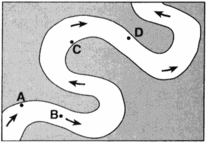
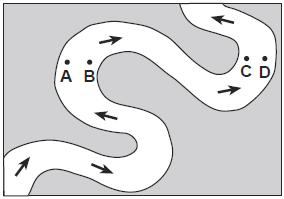
Which two locations have the greatest stream velocities?
A and B
B and C
C and D
D and A
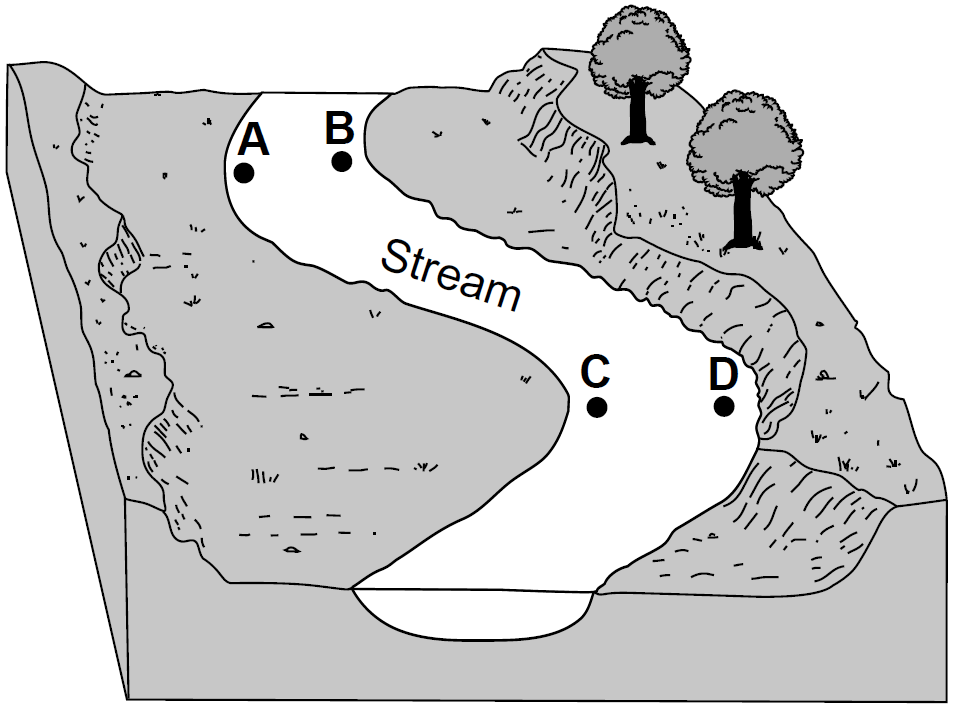
At which two locations would the stream most likely be the deepest?
A and B
B and C
C and D
D and A

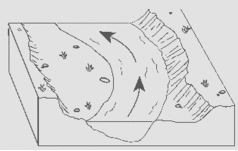
The streambank on the outside of this meander is steeper than the streambank on the inside of this meander because the water on the outside of this meander is moving
faster, causing erosion
slower, causing erosion
faster, causing deposition
slower, causing deposition

At which point does the greatest stream erosion occur?
A
B
C
D
This is the amount of oxygen absorbed by the water.
Dissolved Oxygen
Carbon Dioxide
Nitrogen
Phosphorus
When harmful substances mix with our waterway systems, the result is __________________.
erosion
water pollution
irrigation
crop rotattion
True or False? If water has a pH of 7.1, then it is good quality fresh water.
True
False
What is salinity?
The property of containing salt
The amount of suspended solids
Describes the condition of the water
Describes how acidic or basic water is
Why are too many nutrients (like nitrates and phosphates) bad for our waters?
Nutrients decrease the pH of the water, causing it to become increasingly acidic
Nutrients change the salinity of the water
Wetlands filter out runoff that may contain nutrients
Nutrients in the water cause too much algae growth, which decrease the level of oxygen in the water
True or False: A substance with a pH of 9 is considered basic.
True
False
What is pH?
The property of containing salt
The measure of the amount of oxygen that is dissolved in water
The amount of suspended solids in water
The measurement of the acidity or basicity of water
What does Dissolved Oxygen mean?
How much acid is in the water
How cold the water is
DO
How much oxygen is in the water
pH is the measurement of
how acidic or basic a solution is.
just the acidity of a solution.
how acidic or basic the atmosphere is.
Non of the above.

