
NEW
Font size
 Worksheets
Skeletal System
Total questions: 56
Worksheet time: 57mins

What bone is highlighted?
Skull (Cranium)
Mandible
Femur
Scapula
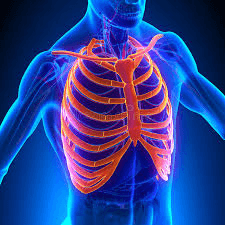
What bone is highlighted?
Ribs
Cranium
Clavicle
Femur
The joint with a rounded end of bone fitting snug within another bone.
ball and socket joint
hinge joint
pivot joint
gliding joint
The joint that moves in one direction, like a door
ball and socket joint
hinge joint
pivot joint
gliding joint
The joint in which bones slip over other bones, allowing free movement.
ball and socket joint
hinge joint
pivot joint
gliding joint
How many bones are in an adult body?
106
206
306
406

What bone is highlighted?
Femur
Cranium
Ribs
Skull

What is the place where two bones meet?
bones
tendons
ligament
joint

What do the bones make?
veins
cartilage
red blood cells
bone marrow
What is the largest and strongest bone in the body?
skull
vertebrae
femur
ribs

What bone is highlighted?
Skull (Cranium)
Mandible
Scapula
Clavicle

What bone is highlighted?
Skull (Cranium)
Scapula
Clavicle
Mandible

What bone is highlighted?
Skull (Mandible)
Clavicle
Mandible
Scapula

What bone is highlighted?
Radius
Ulna
Humerus
Carpals

What bone is highlighted?
Tibia
Fibula
Femur
Humerus
From wrist to fingertip, what is the order of bones?
Carpals, metacarpals, phalanges
Phalanges, metacarpals, carpals
Carpals, phalanges, metacarpals
Metacarpals, carpals, phalanges
From ankle to toe, what is the order of bones?
Tarsals, metatarsals, phalanges
Phalanges, metatarsals, tarsals
Metatarsals, phalanges, tarsals
Tarsals, phalanges, metatarsals
The scientific name for the skull is the _____________.
Cranium
Zygomatic process
The bones at the end of our fingers and toes are known as _______________.
Tarsals
The phalanges
The vertebra is a gliding joint.
True
False
The shoulder and hip are ball and socket joints.
True
False
The forearm bone closest to the thumb is the __________.
Ulna
Radius
Babies have more bones than adults.
True
False
The carpals are your ankle bones.
True
False
The patella is commonly known as your knee cap.
True
False
Long bones are longer than they are wide.
True
False
Which of the following is NOT a function of bones?
hematopoiesis
storage
maintenance of body temperature
protection
Which of the following is NOT a bone area associated with the axial skeleton?
pelvic girdles
the skull
rib cage
vertebral column
The ends of a long bone are called the
diaphysis
epiphyses
periosteum
endosteum
Which of the following is NOT an example of a long bone?
humerus
tibia
radius
talus
Bone forming cells:
osteocytes
osteoblasts
osteoclasts
osteomasts
Bone destroying cells:
osteocytes
osteoblasts
osteomasts
osteoclasts
Occurs when the bones of inactive people tend to lose mass:
atrophy
ossification
shingles
osteoarthritis
Mature bone cells:
osteoblasts
osteomasts
osteocytes
osteoclasts
Blood cell formation:
ossification
hemostasis
hematopoiesis
hemophilia
Remnant of the growth plate:
epiphyseal plate
spongy bone
epiphyseal line
lacunae
The long shaft of a bone:
epiphyses
diaphysis
periosteum
endosteum
An example of a long bone is?
Spinal Cord
Wrist Bone
Thigh Bone
Sternum
What type of bone is the patella?
Flat Bone
Long Bone
Irregular Bone
Sesamoid Bone
How many classifications of bones are there?
5
4
6
3
The skull bones, hyoid bone and vertebral column bones are found in which skeleton
Axial Skeleton
Appendicular Skeleton
How many pairs of ribs are in the thoracic cage?
7
2
12
10


Name the bone located at number 12.
Patella
Clavicle
Sternum
Scapula


This long bone helps protect the heart and lungs and is called the:
scapula
clavicle
vertebrae
sternum
Which of the following is NOT an example of a long bone?
humerus
tibia
radius
talus

