wayground logo

Free Printable Worksheets

NEW

Font size

S
M
L
XL
Worksheets

M3 Atomic structure, Isotopes and radioactivity

Total questions: 48

Worksheet time: 49mins

Name
Class
Date
1.

Which of the following is not a particle of atom?

a)

Proton

b)

Electron

c)

Positron

d)

Neutron

2.

The nucleus of an atom has

a)

Proton and electron

b)

Proton and neutron

c)

Electron and neutron

d)

Proton only

3.

Mass number is the total number of

a)

Protons, electrons and neutrons

b)

Protons and electrons

c)

Protons and neutrons

d)

Electrons and neutrons

4.

The mass number of an element is 31 and the atomic number is 15. How many electrons does it have?

a)

14

b)

15

c)

16

d)

31

5.

The mass number of an element is 31 and the atomic number is 15. How many neutrons does it have?

a)

15

b)

14

c)

16

d)

31

6.

A neutral atom of an element has 19 electrons and 20 neutrons. What is its atomic number?

a)

39

b)

19

c)

20

d)

1

7.

Isotopes have same atomic number but different

a)

number of protons

b)

number of electrons

c)

number of neutrons

8.

Spontaneous emission of radiation when an isotope becomes unstable is called

a)

Radioactivity

b)

Diffusion

c)

Reflection

d)

Magnetism

9.

The dense central region of an atom where its neutrons and protons are is its

a)

nucleus

b)

electron cloud

c)

core

d)

center

10.
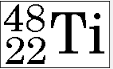
How many protons does this isotope of titanium have?
a)
48
b)
22
c)
26
d)
70
11.
How many neutrons does the isotope of lithium have?
a)
8
b)
3
c)
4
d)
5
12.

In a correctly written symbol what would be located in the "A" position?

a)

number of neutrons

b)

atomic number

c)

average mass

d)

mass number

13.

What is an isotope?

a)

A charged atom

b)

Two atoms of the same element with different amounts of neutrons

c)

Two atoms of the same element with different amounts of protons

d)

A neutral atom

14.

Which two components of an atom contribute to the mass?

a)

Protons and neutrons

b)

Protons and electrons

c)

neutrons and electrons

15.

Electrons have virtually no mass.

a)

True

b)

False

16.
What is the atomic number of an element with 12 protons, 13 neutrons and 12 electrons?
a)
12
b)
13
c)
25
d)
24
17.
Which is an electron?
a)
A
b)
B
c)
C
18.
Which is a proton?
a)
A
b)
B
c)
C
19.
Which is a neutron?
a)
A
b)
B
c)
C
20.

An alpha particle has a ___ charge

a)

positive

b)

no

c)

negative

21.

Atomic decay or the process of radioactivity is a random process.

a)

True

b)

False

22.
Discovered the nucleus of the atom through the Gold Foil Experiment
a)
Rutherford
b)
Chadwick
c)
Thomson
d)
Dalton
23.
Discovered the neutron within the atom
a)
Democritus
b)
Thomson
c)
Rutherford
d)
Chadwick
24.

John Dalton stated:

a)

Atoms are tiny, invisible particles.

b)

Atoms of one element are all the same.

c)

Atoms of different elements are different.

d)

Compounds form by combining atoms.

e)

All of the statements listed.

25.
True or False: The majority of an atom is made up of empty space
a)
True
b)
False
26.
The word "atom" comes from a Greek word that means
a)
Invisible
b)
Indivisible
c)
Undivided
27.
What scientist is best known for his "Plum Pudding" model of the atom?
a)
J.J. Thomson
b)
Ernest Rutherford
c)
John Dalton
d)
Democritus
28.

His model of an atom has electrons moving in definite orbits with specific energies around the nucleus.

a)

Thomson

b)

Rutherford

c)

Bohr

d)

Democritus

29.
He first measured the mass and charge of an electron using the oil drop experiment.
a)
Joseph Thomson
b)
Robert Millikan
c)
John Dalton
d)
Niels Bohr
30.

First person to propose the concept of an atom

a)

Rutherford

b)

Democritus

c)

Dalton

d)

Bohr

31.

Which of the following shows the correct order of Atomic Theory Timeline

a)

Rutherford, Bohr, Dalton, Democritus, Thomson

b)

Bohr, Democritus, Thomson, Rutherford, Dalton

c)

Dalton, Thomson, Rutherford, Bohr, Democritus

d)

Democritus, Dalton, Thomson, Rutherford, Bohr

32.

Thomson Experimented with ______

a)

Gold Foil

b)

alpha particles

c)

cathode rays

d)

protons

33.

Rutherford experimented with ____

a)

Gold foil and alpha particles

b)

Cathode rays and alpha particles

c)

electron and alpha particles

d)

gold foil and cathode rays

34.
Which model suggested that: Atoms mostly consist of positively charged material with negatively charged particles (electrons) located throughout the positive material.
a)
Bohrs Model
b)
Plum Pudding Model 
c)
Democritus Model
d)
Our current model 
35.

What types of radiation are affected by magnetic fields?

a)

all of them

b)

alpha and beta

c)

beta and gamma

d)

alpha and gamma

36.
What is the missing isotope that will balance the following nuclear equation?
94Be  +  11H →  _____  +  42He
a)
105B
b)
105Ne
c)
63Li
d)
63C
37.

 Balance the following nuclear equation:

            1327Al + 01n  1124Na  +   ?\ \ \ \ \ \ \ \ \ \ \ _{13}^{27}Al\ +\ _0^1n\ \longrightarrow\ _{11}^{24}Na\ \ +\ \ \ ?  


a)

    24He\ \ \ _2^4He  

b)

    25H\ \ \ _2^5H  

c)

    1342 Al\ \ \ _{13}^{42\ }Al  

d)

    1425Si\ \ \ _{14}^{25}Si  

38.

 Balance the following nuclear equation:

            92238U + 01n  1   0e  +   ?\ \ \ \ \ \ \ \ \ \ \ _{92}^{238}U\ +\ _0^1n\ \longrightarrow\ _{-1}^{\ \ \ 0}e\ \ +\ \ \ ?  


a)

    93239Np\ \ \ _{93}^{239}Np  

b)

    94239Pu\ \ \ _{94}^{239}Pu  

c)

    93238 Np\ \ \ _{93}^{238\ }Np  

d)

    94238Am\ \ \ _{94}^{238}Am  

39.

 Balance the following nuclear equation:

            94239Pu + 24He  ? +  01n\ \ \ \ \ \ \ \ \ \ \ _{94}^{239}Pu\ +\ _2^4He\ \longrightarrow\ ?\ +\ \ _0^1n  


a)

    96242Cm\ \ \ _{96}^{242}Cm  

b)

    94242P\ \ \ _{94}^{242}P  

c)

    93238 Pu\ \ \ _{93}^{238\ }Pu  

d)

    96240C\ \ \ _{96}^{240}C  

40.

 Balance the following nuclear equation:

            ? + 24He       817O  +   11H\ \ \ \ \ \ \ \ \ \ \ ?\ +\ _2^4He\ \ \ \ \longrightarrow\ \ \ _8^{17}O\ \ +\ \ \ _1^1H  


a)

    714N \ \ \ _7^{14}N\   

b)

    917P\ \ \ _9^{17}P  

c)

    914 F\ \ \ _9^{14\ }F  

d)

    814O\ \ \ _8^{14}O  

41.

 Balance the following nuclear equation:

            82208Pb +  ?       112277Cn  +   01n\ \ \ \ \ \ \ \ \ \ \ _{82}^{208}Pb\ +\ \ ?\ \ \ \ \longrightarrow\ \ \ _{112}^{277}Cn\ \ +\ \ \ _0^1n  


a)

    3070Zn \ \ \ _{30}^{70}Zn\   

b)

    11217P\ \ \ _{112}^{17}P  

c)

    4070 Zr\ \ \ _{40}^{70\ }Zr  

d)

    814O\ \ \ _8^{14}O  

42.

 Balance the following nuclear equation:

            2656Fe +  24He       1   0 e  +  ?\ \ \ \ \ \ \ \ \ \ \ _{26}^{56}Fe\ +\ \ _2^4He\ \ \ \ \longrightarrow\ \ \ _{-1}^{\ \ \ 0}\ e\ \ +\ \ ?  


a)

    2960Cu \ \ \ _{29}^{60}Cu\   

b)

    3960C\ \ \ _{39}^{60}C  

c)

    2940 Si\ \ \ _{29}^{40\ }Si  

d)

    814O\ \ \ _8^{14}O  

43.

 Balance the following nuclear equation: (Hint: I am looking for the coefficient)

            98252Cf +  510B       ?01n  + 103259Lr\ \ \ \ \ \ \ \ \ \ \ _{98}^{252}Cf\ +\ \ _5^{10}B\ \ \ \ \longrightarrow\ \ \ ?_0^1n\ \ +\ _{103}^{259}Lr  


a)

b)

4

c)

d)

44.

Balance the following nuclear equation:

            ? +  24He          14   30 Si +  11H\ \ \ \ \ \ \ \ \ \ \ ?\ +\ \ _2^4He\ \ \ \ \longrightarrow\ \ \ _{\ \ \ 14}^{\ \ \ 30}\ Si\ +\ \ _1^1H 


a)

    1327Al\ \ \ _{13}^{27}Al 

b)

    1527Ar\ \ \ _{15}^{27}Ar 

c)

    1440 Si\ \ \ _{14}^{40\ }Si 

d)

814O\ \ \ _8^{14}O

45.

 Balance the following nuclear equation:

            2658Fe + 201n     27   60Co +   ?\ \ \ \ \ \ \ \ \ \ \ _{26}^{58}Fe\ +\ 2_0^1n\ \longrightarrow\ _{\ \ \ 27}^{\ \ \ 60}Co\ +\ \ \ ?  


a)

    1   0e\ \ \ _{-1}^{\ \ \ 0}e  

b)

    01n\ \ \ _0^1n  

c)

    11H\ \ \ _1^1H  

d)

    94238Am\ \ \ _{94}^{238}Am  

46.

In a correctly written symbol what would be located in the "Z" position?

a)

number of neutrons

b)

atomic number

c)

average mass

d)

mass number

47.

A Beta particle has a ___ charge

a)

positive

b)

no

c)

negative

48.

A gamma ray has a ___ charge

a)

positive

b)

no

c)

negative