
Font size
 Worksheets
Internal
Total questions: 50
Worksheet time: 29mins
When a Diode is used as a half wave rectifier ....
It rectifies only one half of the input AC signal
It rectifies both the halves of the input AC signal
Which image shows the output of a sine-wave after it has gone through a diode? (Half-wave rectified)


The function of rectifier is
To increase or decrease the AC voltage in a circuit
Converting the AC voltage into pulse DC voltage
Smooth out the ripple contained in the pulses of pulse DC voltage
Maintain a constant DC voltage output across a load
The number of diodes used to build a bridge rectifier
1
2
3
4
The applied input a.c. power to a half-wave rectifier is 100 watts. The d.c. output power obtained is 40 watts. What is the rectification efficiency ?
40%
60%
80%
90%
Efficiency of a centre tapped full wave rectifier is _________
50%
46%
70%
81.2%
Each diode in half-wave and full-wave rectifiers can only conducts current in either the positive or negative half-cycles of the AC voltage supply.
True
False

What is the type of transistor shown in the diagram below?
𝑝𝑛𝑝
𝑛𝑝𝑛
𝑛𝑛𝑝
𝑝𝑝𝑛
𝑝𝑝𝑝
How does a transistor affect voltage?
It causes voltage to decrease
It reduces large voltage changes
It does not affect voltage
It amplifies small voltage changes
It causes the voltage to go to zero
Current through the collector is ____ the current
through the base.
a little smaller than
a little larger than
much smaller than
much larger than
the same as
Zener diode conducts in ________________ conditions
forward bias only
reverse bias only
both forward and reverse bias
Zener diode is used in _______________ applications
Voltage regulator applications
Voltage storage applications
We can increase the amplitude of full wave bridge rectifier by connecting ________________________ with resistor
a capacitor in parallel
a capacitor in series
an inductor in series

What electrical component is used to smooth half wave current signals?
Resistor
Diode
Capacitor
Voltage regulator
In a Transistor ………………..
IE = IC + IB
IC = IE + IB
IE = IC – IB
IB = IC + IE
Which terminal was heavily dopped....?
Emitter
Base
Collector
None of the above
In CB configuration, the value of α is
IEIC
IBIE
ICIB
ICIE
C-B Reverse Bias
C-B Reverse Bias
C-B Forward Bias
C-E Forward Bias
Amplifier circuit will be in which configuration
CE
CB
CC
None
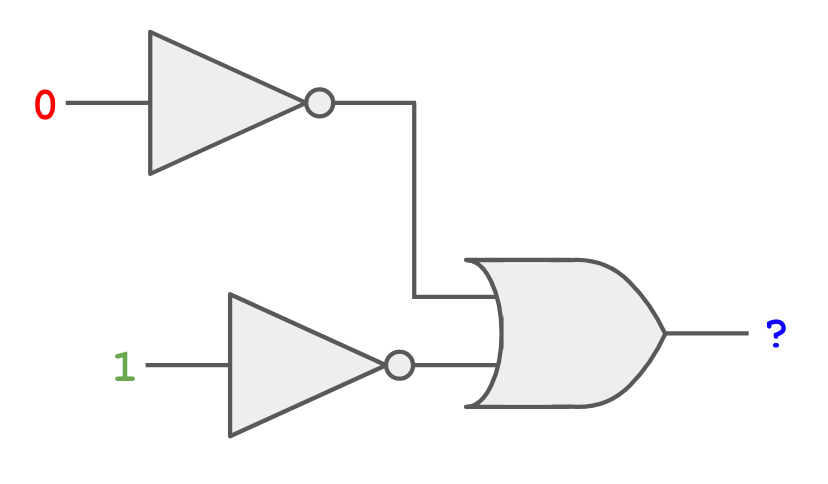
What will the circuit's output be?
1
0
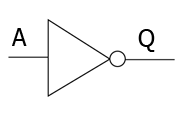
Which logic gate is this?
AND
OR
NOT
A Polarizing filter is used to reduce glare on reflective surfaces including glass, windows, and water.
True
False
The polarisation angle for a medium is 60 degree .What is the critical angle for that medium in degree.
30.3
35.3
39
40
A certain monochromatic light travelling in air is incident on a glass plate at a polarising angle. Angle of refraction in glass is found to be 32 degree. The polarising angle is
50
40
58
48
Two polaroids A and B are parallel. How should be a third polaroid C placed between A and B so that the intensity of the emergent light be maximum
plane of C be perpendicular to A or B
plane of C be parallel to A or B
plane of C can be in any direction
plane of C does not decide the intensity
The phase difference between the output and input voltages of a CE amplifier in degree is
0
180
90
270
The purpose of emitter capacitor (i.e. capacitor across RE) is to ……….
Avoid voltage gain drop
Forward bias the emitter
Reduce noise in the amplifier
None of the above
A transistor oscillators must employ
Possitive feedback
Negative feedback
Neither negative nor positive feedbacks
None of the above
An oscillator circuit is mainly ..... converter
A.C. to A.C.
D.C. to D.C.
A.C. to D.C.
D.C. to A.C.
An inverter gates can be developed using
Two diodes
Resistance and capacitance
Transistor
Inductance and capacitance
Two input exclusive NOR gate gives high output
When one input is high and the other is low
Only when both the inputs are low
When both the inputs are the same
Only when both the inputs are high
What should be the phase difference between the two plane-polarized waves, vibrating at right angles to each other, to produce circularly polarized light?
π/6
π/2
π/4
π/3
Sound waves can be polarized.
True
False
Which of the following is a uniaxial crystal?
Borax
Mica
Quartz
Selenite
If the phase difference between two rays is π/2 and the angle of incidence is not equal to π/4, the emergent light is __________
Linearly Polarized
Elliptically Polarized
Circularly Polarized
Non-Polarized
The velocity of light in water is 2.2 X 10⁸ m/s. What is the polarizing angle of incidence?
47.23o
51.02o
53.74o
65.36o
What should be the thickness of quarter-wave plate for a light of wavelength 5890 Å if µe = 1.553 and µo = 1.544?
1.33 X 10⁻³ cm
1.43 X 10⁻³ cm
1.53 X 10⁻³ cm
1.63 X 10⁻³ cm
A tube of length 20cm containing a 10% sugar solution rotates the plane of polarization by 13.2°. What is the specific rotation of sugar solution?
66°
55°
44°
33°
The angle of polarization for any medium is 60 degree, what will be critical angle for this?
sin−13
tan−13
cos−13
sin−1 31
Plane polarized light is passed through a polaroid. On viewing through the polaroid we find that when the polaroid is given one complete rotation about the direction of the light, one of the following is observed
The intensity of light gradually decreases to zero and remains at zero
The intensity of light gradually increases to a maximum and remains at maximum
There is no change in intensity
The intensity of light is twice maximum and twice zero
A ray of light is incident on the surface of a glass plate at an angle of incidence equal to Brewster's angle φ. If μ represents the refractive index of glass with respect to air, then the angle between reflected and refracted rays is
90+ψ
sin−1(μcosψ)
90°
90°−sin−1(sin μψ)
Polarised glass is used in sun glasses because
It reduces the light intensity to half an account of polarisation
It is fashionable
It has good colour
t is cheaper
The transverse nature of light is shown by
Dispersion of light
Polarisation of light
Refraction of light
Interference of light
A calcite crystal is placed over a dot on a piece of paper and rotated, on seeing through the calcite one will be see
One dot rotating about the other
Two rotating dots
Two stationary dots
One dot
When light is incident on a doubly refracting crystal, two refracted rays-ordinary ray (O-ray) and extra ordinary ray (E-ray) are produced. Then
Both O-ray and E-ray are polarised perpendicular to the plane of incidence
Both O-ray and E-ray are polarised in the plane of incidence
E-ray is polarised perpendicular to the plane of incidence and O-ray in the plane of incidence
E-ray is polarised in the plane of incidence and O-ray perpendicular to the plane of incidence
Vo and VE represent the velocities, μoand μE the refractive indices of ordinary and extraordinary rays for a doubly refracting crystal. Then
VO≥VE , μO≤μE if the crystal is calcite
VO≤VE , μO≤μE if the crystal is quartz
VO ≤VE , μO≥μE if the crystal is calcite
VO≥VE , μO≥μE if the crystal is quartz
Refractive index of material is equal to tangent of polarising angle. It is called
Brewster's law
Lambert's law
Malus's law
Bragg's law

A Zener diode, having breakdown voltage equal to 15 V, is used in a voltage regulator circuit shown in the figure. The current through the diode is
10 mA
15 mA
20 mA
5 mA
A crystal diode has forward resistance of the order of
kΩ
Ω
MΩ
none of the above
When a PN junction diode is reverse biased
Electrons and holes are attracted towards each other and move towards the depletion region
Electrons and holes move away from the junction depletion region
Height of the potential barrier decreases
No change in the current takes place

