Wayground logo

Free Printable Worksheets

Font size

S
M
L
XL
Worksheets

speed Quiz review

Total questions: 37

Worksheet time: 53mins

Name
Class
Date
1.

Distance / Time equals

a)

speed

b)

velocity

c)

acceleration

d)

10 m/s

2.

Distance / Time in a direction equals

a)

speed

b)

velocity

c)

acceleration

d)

displacement

3.

A car drives 250 km in 2.75 hours. What is its speed?

a)

102.04 km/hr

b)

0.01 km/hr

c)

687.5 km/hr

d)

90.91 km/hr

4.

Total distance traveled in total time is:

a)

speed

b)

velocity

c)

average speed

d)

instantaneous speed

5.

Speed at a specific moment in time is:

a)

speed

b)

velocity

c)

average speed

d)

instantaneous speed

6.

To solve for distance, you use the equation:

a)

Distance = speed x time

b)

Distance = speed / time

c)

Distance = time / speed

d)

Distance = speed + time

7.
Distance and direction of an object's change in position from a starting point
a)
displacement
b)
distance
c)
motion
d)
reference point
8.
Bill runs 400 meters to Andy's house, turns around, and runs 400 meters back home.  What is Bill's displacement?
a)
0 meters
b)
400 meters
c)
800 meters
d)
1600 meters
9.
Bill runs 400 meters to Andy's house, turns around, and runs 400 meters back home.  What is Bill's distance?
a)
0 meters
b)
400 meters
c)
800 meters
d)
1600 meters
10.
David walks 3 km north, and then turns east and walks 4 km. What is the distance?
a)
7 km
b)
3 km
c)
4 km
d)
1 km
11.

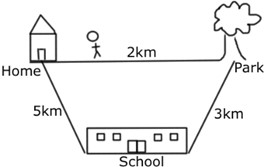
Jerry walked from home to school, then from the school to the park. What is his total displacement?

a)

2 km

b)

5 km

c)

8 km

d)

10 km

12.
A person walks 50 meters directly north, stops, and then travels 32 meters directly south.  What is their displacement?
a)
82 meters
b)
18 meters
c)
28 meters
13.
A car drives 84 meters forward.  It's displacement and distance would be the same.
a)
True
b)
False
14.

Distance is

a)

scalar

b)

vector

15.

displacement is

a)

scalar

b)

vector

16.

distance can never be less then displacement

a)

true

b)

false

17.

displacement can never be less then distance

a)

true

b)

false

18.

an object can have a constant speed and a changing velocity

a)

true

b)

false

19.

speed is a

a)

vector

b)

scalar

20.

velocity is

a)

scalar

b)

vector

21.
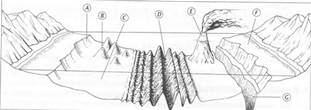
What is letter D?
a)
Cont. Shelf
b)
Mid-Ocean Ridge
c)
Volcanic Island
d)
Seamount
22.
True or False : Sea-floor Spreading adds new material to the ocean floor?
a)
True
b)
False
23.
The OLDEST seafloor is located? 
a)
Closest to the mid-ocean ridge
b)
Farthest from the mid-ocean ridge
24.
What is a divergent boundary? 
a)
two plates moving towards each other
b)
two plates rubbing side to side
c)
two plates moving away from each other
d)
happens in the lithosphere
25.

Where are the youngest rocks found on the ocean floor?

a)

near the mid-ocean ridge

b)

far from the mid ocean ridge

c)

half-way between near and far from the mid-ocean ridge

d)

all the ocean-floor rocks are the same age

26.
Erosion tends to be more destructive when the mass wasting occurs on ______ slopes. 
a)
Small
b)
Flat
c)
Steep
d)
Bumpy 
27.
The wearing away of rocks and soil is ?
a)
erosion
b)
weathering
c)
deposition
d)
biological weathering
28.
What causes erosion?
a)
ice and snow
b)
wind and ice
c)
weathering and deposition
d)
wind, water and other natural causes
29.
What does constructive force mean?
a)
destroying land forms
b)
land forms from volcanoes
c)
creating new land forms by sediment
d)
creating rocks and dirt
30.
When tectonic plates shift what happens?
a)
volcanoes erupt spewing lava
b)
it causes an earthqake
c)
hurricaines
d)
tornadoes
31.

The picture here shows a landslide. What can you infer from the picture?

a)

Landslides are a destructive process that break apart the surface of the earth.

b)

Landslides are a constructive process that build new mountains and dams on the surface of the earth.

c)

Landslides are caused by volcanic eruptions,

d)

Landslides are helpful to road crews.

32.

Which of the following landforms are created over a long period of time?

a)

Mountains and Canyons

b)

Landslides and Sand dunes

c)

Ponds and Mountains

d)

Volcanic eruptions

33.
What is weathering?
a)
a type of climate
b)
the movement of rock pieces from one place to another
c)
the breaking down of rock into smaller pieces
d)
a force that pulls pieces of rock downhill
34.
What is a destructive force?
a)
A natural process that destroys land
b)
A natural process that creates land
c)
A natural process where areas that are normally dry is covered in water
35.
A constructive force is defined as
a)
a natural occurrence that can build up or break down
b)
an earthquake or a volcano
c)
a natural force that builds up and creates new land
d)
a destructive force that has been controlled
36.
Which of these is an example of a constructive and destructive force?
a)
Erosion
b)
Deposition
c)
Flood
d)
Earthquakes
37.

What is mass wasting?

a)

The wasting away of fat

b)

The downslope movement of rock and soil under the direct influence of gravity.

c)

A addition method.

d)

A fire causing a bunch a damage.