
 Worksheets
AP Bio Natural Selection Test Review
Total questions: 16
Worksheet time: 17mins
Name
Class
Date
1.
What are the variations of a gene called?
a)
dominant genes
b)
progeny
c)
alleles
d)
homologues
2.
Which of the following is a true statement about natural selection?
a)
it is goal directed
b)
individuals evolve
c)
variation exists in a population
d)
acquired characteristics
3.
The Tasmanian devil is a marsupial that resembles the North America wolf, which is a placental mammal.
a)
adaptive radiation
b)
divergent evolution
c)
founder effect
d)
convergent evolution
4.
variations in a population are maintained by
a)
mutations
b)
genetic recombination
c)
gene flow
d)
all of the above
5.
Which statement correctly explains how resistance to penicillin appeared after a few years of its widespread use to fight bacterial infection?
a)
in order to survive exposure to penicillin, bacteria developed a resistance to the drug
b)
a few bacteria became resistant to penicillin, and through sexual reproduction , most bacteria acquired the resistance
c)
penicillin never really successfully wiped out populations of bacteria, scientist did not use proper controls in their studies
d)
some bacteria were resistant to penicillin and their population spread rapidly, without competition from bacteria that were killed by penicillin
6.

The table shows the survival rate of two types of beetles in the same environment over a period of three years.
Which statement about the beetles in this environment is best supported by the data?
Which statement about the beetles in this environment is best supported by the data?
a)
Brown beetles have a shorter life cycle than green beetles have
b)
Green beetles are more fit for their environment than brown beetles
c)
brown beetles are undergo more unfavorable mutations than green beetles
7.

A graph regarding the effect of agricultural bioengineering on insect pests is shown below How has natural selection affected species of insect pests?
a)
A. Natural selection has not affected the number of species that are resistant to pesticides
b)
A. Natural selection has rapidly increased the number of species that are resistant to pesticides
c)
A. Natural selection has only affected the number of species that are resistant to pesticides
8.

The green frog (Lithobates clamitans clamitans) is found in many parts of the United States. The table contains some information about this frog.
Why does the ability to lay 1,000 to 5,000 eggs increase the fitness of the species L. clamitans clamitans?
Why does the ability to lay 1,000 to 5,000 eggs increase the fitness of the species L. clamitans clamitans?
a)
A. It increases the probability that some offspring will survive long enough to reproduce.
b)
It increases the chance of the recombination of alleles, leading to genetic drift in the population.
c)
A. It increases opportunities for offspring to compete for limited resources.
9.
During a study session about evolution, one of your fellow students remarks, "The giraffe stretched its neck while reaching for higher leaves; its offspring inherited longer necks as a result." Which statement is most likely to be helpful in correcting this student's misconception?
a)
Disuse of an organ may lead to its eventual disappearance.
b)
Spontaneous mutations can result in the appearance of new traits.
c)
Only favorable adaptations have survival value.
d)
Characteristics acquired during an organism's life are generally not passed on through genes.
10.
Of the following anatomical structures, which is homologous to the bones in the wing of a bird?
a)
bony rays in the tail fin of a flying fish
b)
bones in the hind limb of a kangaroo
c)
bones in the flipper of a whale
d)
chitinous struts in the wing of a butterfly
11.
If two modern organisms are distantly related in an evolutionary sense, then one should expect that
a)
their chromosomes should be very similar.
b)
they should be members of the same genus.
c)
they should share fewer homologous structures than two more closely related organisms.
d)
they shared a common ancestor relatively recently.
12.
Which of these conditions are always true of populations evolving due to natural selection?
Condition 1: The population must vary in traits that are heritable.
Condition 2: Some heritable traits must increase reproductive success.
Condition 3: Individuals pass on most traits that they acquire during their lifetime.
Condition 1: The population must vary in traits that are heritable.
Condition 2: Some heritable traits must increase reproductive success.
Condition 3: Individuals pass on most traits that they acquire during their lifetime.
a)
Condition 1 only
b)
Condition 2 only
c)
Conditions 1 and 2
d)
Conditions 2 and 3
13.

What traits do the leopard and the turtle share? (Multiple choices)
a)
hair
b)
amniotic egg
c)
four walking legs
d)
jaws
14.
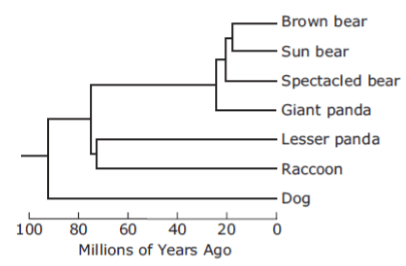
Based on this phylogenetic tree, which statement is true?
a)
Lesser pandas are more genetically similar to giant pandas than they are to raccoons
b)
Brown bears are more genetically similar to giant pandas than they are to sun bears
c)
Lesser pandas are more genetically similar to raccoons than they are to giant pandas
d)
The bear species are all more genetically similar to dogs than they are to giant pandas
15.

The yellow, blue, and read bubbles represent different phylogenies. How would you describe the yellow bubble?
a)
monophyletic
b)
paraphyletic
c)
polyphyletic
d)
anaphyletic
16.

Which protein has the fastest molecular clock?
a)
fibrinopeptides
b)
hemoglobin
c)
cytochrome C
d)
divergence
100 %

