
 Worksheets
Periodic Table
Total questions: 57
Worksheet time: 1hrs 2mins
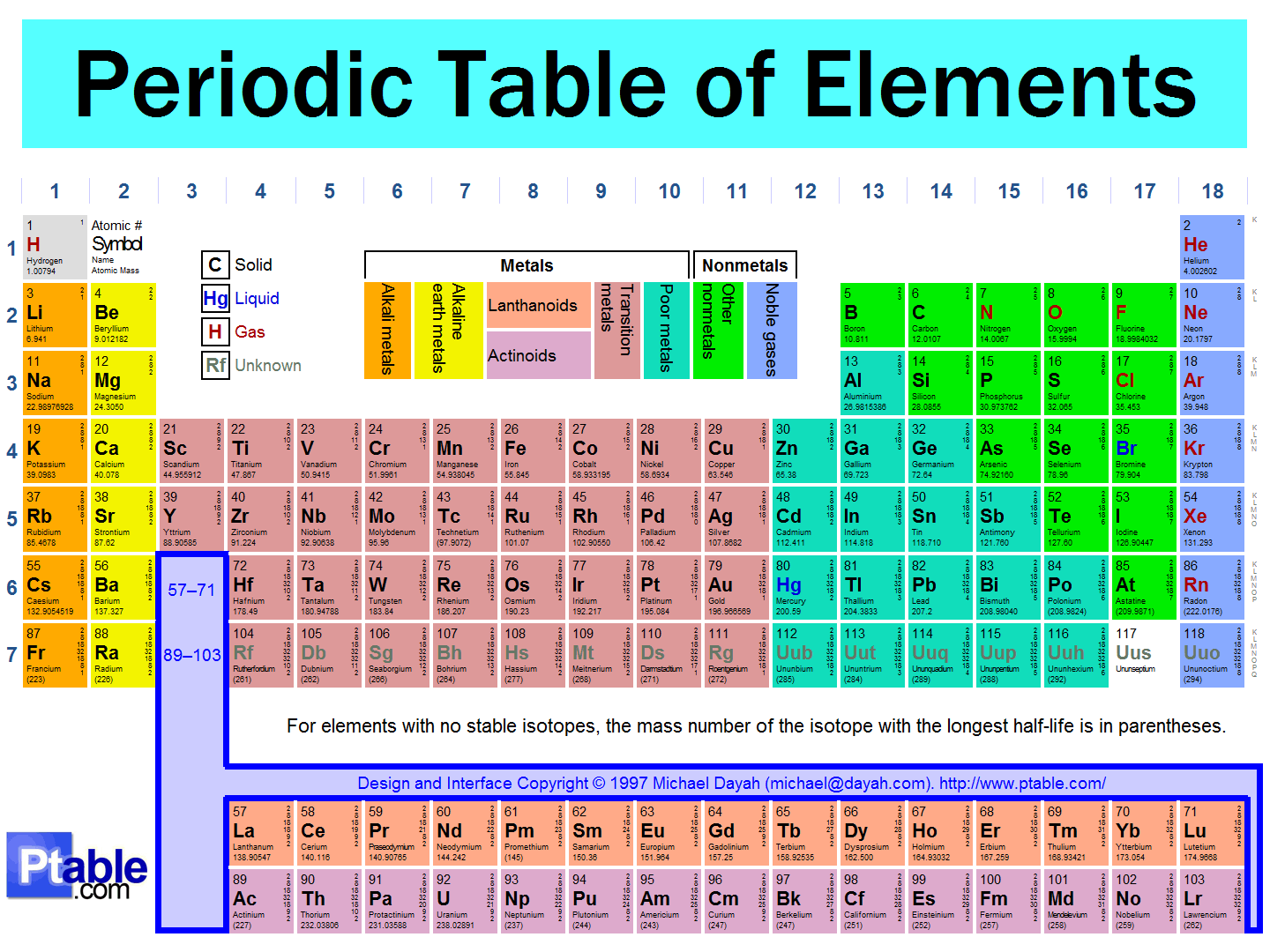
The vertical (up and down) columns in the Periodic Table are called
groups
towers
periods
atomic numbers


The groups of the periodic table tell us:
Who invented the Periodic Table?
Mendeleev
Bohr
Lewis
Democritus
As you move left to right on a row or period what happens?
Atomic number increases by 1
Electrons decrease
Number of shells decrease
Nothing
What happens to the number of shells as you move down a group?
They decrease by 1
They increase by 1
Nothing
The first energy shell can hold ______ electrons.
2
8
18
Mendeleev's genius was his ability to
predict elements that were not discovered yet
organize elements by their mass
had an element named after himself
organize elements by properties
Elements in the same group have __________
Similar Properties
Same number of shells
Similar Mass
The periodic table is a chart that organizes the elements based on their atomic properties. Elements in the periodic table are organized according to the periodic law. The periodic law states that chemical and physical properties of elements are periodic functions of their atomic numbers (the number of protons in the nucleus). As the atomic number of elements increases, different elements display similar characteristics at regular intervals.
Periodic law states that elements are arranged _______________________________________________________________.
in alphabetical order.
from largest to smallest.
as periodic functions of their atomic numbers.
there is no rhyme or reason.
In 1869, Dmitri Mendeleev developed the first periodic table, organizing the elements according to atomic weight. When he ordered the elements, he noticed that there were patterns of repeating properties. The modern periodic table sequences elements from left to right by atomic number.
This was the first person to organize a periodic table.
Neils Bohr
Dmitri Mendeleev
Democritus
Ernest Rutherford
Which elements are not metals?
Mg
Which two elements are in the same period?
Boron and Carbon
Potassium and Sodium
Lithium and Magnesium
Zinc and Nitrogen
Determine which atom is being described here: Shiny, has the properties of both metals and nonmetals, and has three valence electrons.
Tin (Sn)
Boron (B)
Germanium (Ge)
Antimony (Sb)
Which group is the most stable?
17
1
2
18
How many valence electrons makes most atoms stable (nonreactive)?
2
8
1
4
Poor conductor of heat and electricity is a property of ___________.
metals
nonmetals
metalloids
Using the periodic table, determine the name of the element that has 2 valence electrons and 6 energy levels.
Francium
Barium
Molybdenum
hydrogen
Elements in the same group have the same
Properties
Number of electrons
Number of protons
Nucleus

The elements that touch the zigzag line on the Periodic Table are called
metals
nonmetals
metalloids
gasses
How many valence electrons are in an element in group 15 in the periodic table?
5
15
7
8

The ______ are located on the left side of the zig-zag 'staircase' on the Periodic Table. (except for Hydrogen)
metals
non-metals
metalloids

The ___________ are located on the right side of the zig-zag 'staircase' on the Periodic Table (except for Hydrogen)
metals
non-metals
metalloids

The most ________ group of elements is group number 1 because they can easily give away their one valence electron to have a full valence shell or octet. Group 17 would be next because they can easily receive one electron to have an octet.
stable
reactive

If an element is in period number 4 you know it has 4 ______ _______.
valence electrons
protons
energy levels
atomic mass units

The most reactive group of non-metals is group ____.
1
2
17
18

The only stable group on the periodic table is group ____.
1
2
17
18

Choose ALL of the alkali metals (group 1) from the list below:
lithium
copper
mercury
potassium
sodium
What are the elements in group 2 of the periodic table called?
Alkali metals
Alkaline earth metals
Halogens
Noble gases

