

wayground logo

Free Printable Worksheets

Font size

S
M
L
XL
Worksheets

American Revolution

Total questions: 66

Worksheet time: 38mins
Name
Class
Date
1.
What is another name for British soldiers?
a)
Redcoats
b)
Patriots
c)
Minutemen
d)
Continental Soldiers
2.
"No ________ without representation"
a)
voting
b)
taxation
c)
rights
d)
liberty poles
3.
What was the purpose of the Boston Tea Party?
a)
to punish merchants for selling imported tea.
b)
to see who could throw a barrel further.
c)
to frame the Native Americans.
d)
to protest taxes
4.
Which side had more resources and training at the beginning of the war?
a)
British
b)
Colonists
5.
Who won the American Revolution?
a)
The British
b)
The American Colonists
6.
What country joined the colonists to help them win the war?
a)
Germany
b)
France
c)
Netherlands
d)
Africa
7.

Why were the French willing to help the colonists in their fight against Britain?

a)

The French wanted to gain control of the thirteen colonies themselves.

b)

The colonists were willing to pay the French for all of their services.

c)

There were strong hostilities between the French and the British.

d)

The colonists had a lot to teach the French soldiers and generals.

8.

How did the colonist protest against the tea tax?

a)

Dressed up like Native Americans

b)

Boston Massacre

c)

Didn't pay the tax on the East India Tea

d)

Dumped tea into Boston harbor

9.

This type of American Colonist was in support of the British parliament.

a)

A patriot

b)

A loyalist

c)

A Yes man

d)

Neutral

10.

This type of colonist was ready for rebellion and the fight for independence.

a)

British

b)

Loyalist

c)

Patriot

d)

Neutral

11.

What does this political poster represent?

a)

The Colonies needed to be united

b)

Colonies need to be independent

c)

Serpents can grow back together

d)

Ben Franklin didn't know why he made this

12.

Life, Liberty and the pursuit of happiness are?

a)

Bill of Rights

b)

Freedom to Live

c)

Will Smiths movie

d)

Unalienable Rights

13.

Why were the Colonist forbidden to go west of the Appalachian mountains

a)

Border Lands

b)

Manifest Destiny

c)

Proclamation line of 1763

14.

Declaration of Independence was created July 4th of what year?

(a)  

15.

The Declaration of Independence has 27 grievances against King George III. What is a grievance?

a)

reasons for the "break-up" (a complaint)

b)

a last ditch effort to get back together (last chance)

c)

reasons why the colonies like King George (a positive review)

d)

peace treaty between US and England

16.

Mercantilism allows trade between

a)

all free countries

b)

only countries who sign agreement

c)

only between a Mother Country and a colony

d)

colonies to other colonies

17.

What was a reaction to the French and Indian War?

a)

taxation increase only in southern colonies

b)

taxation increase in Boston only

c)

taxation increase in 13 colonies

d)

taxation decrease in 13 colonies

18.
What was the immediate effect due to the passing of the Stamp Act in 1765?
a)
Colonists sought military support from France.
b)
Colonists organized boycotts of British goods.
c)
Colonists signed the Declaration of Independence.
d)
Colonists dumped tea into the Boston Harbor
19.
The Sugar Act, Quartering Act, and the Stamp Act all contributed to the start of the Revolutionary War by....
a)
Restricting trade with American Indians
b)
Imposing regulations on colonial agriculture
c)
Angered colonists who believed that civil liberties had been violated
d)
Punishing colonists for resisting the authority of Parliament
20.
Who did the Continental Congress commission as Commander in Chief?
a)
Benedict Arnold
b)
Alexander Hamilton
c)
John Hancock
d)
George Washington
21.
What was one result of the Treaty of Paris in 1783?
a)
Great Britain recognized thee United States as an independent country.
b)
Competing Seminole and Spanish claims in West Florida were resolved.
c)
The British Navy agreed to stop pressing American sailors into service
d)
British territory in eastern Canada was ceded to France.
22.
Which battle brought the French into the Revolutionary War on the side of the Americans?
a)
Saratoga
b)
Concord
c)
Trenton
d)
Yorktown
23.
"America may boast that she has accomplished what no power before her ever did, contending with Britain--Captured two of their celebrated Generals and each an Army of thousands of veteran Troops to support them."
-- Abigail Adams, letter to John Adams, December 9, 1781
Which of the following is Abigail Adams referring to?
a)
The American victory at the battle of Yorktown
b)
The negotiation of the Treaty of Paris by American diplomats.
c)
The bravery of American soldiers at Valley Forge
d)
The arrival off French aid after the Battle of Saratoga
24.
What as the name of the political body that represented Americans and challenged British control?
a)
Coercive Acts
b)
Continental Congress
c)
Sons of Liberty
d)
Suffolk Resolves
25.
Thomas Jefferson drew on the ideas of which English philosopher when writing the Declaration of Independence?
a)
George Mason
b)
George Stout
c)
John Adams
d)
John Locke
26.
Where were the first armed conflicts of the American Revolution?
a)
Yorktown
b)
Saratoga
c)
Lexington and Concord
d)
Bunker Hill
27.
What was the name of the British king during the American Revolution?
a)
Charles III
b)
George III
c)
William III
d)
James III
28.
This American victory was the turning point in the war.
a)
Saratoga
b)
Yorktown
c)
Bunker Hill
d)
Lexington and Concord
29.
Surrounded by French and Continental armies, a large British army surrendered here.
a)
Saratoga
b)
Yorktown
c)
Bunker Hill
d)
Lexington and Concord
30.
This member of the Continental Congress helped gain French support for American independence.
a)
Thomas Jefferson
b)
Benjamin Franklin
c)
Patrick Henry
d)
John Adams
31.
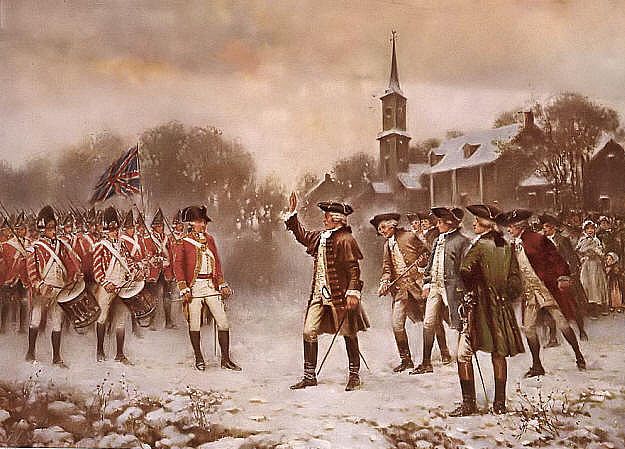
What event is depicted in this image?
a)
Boston Massacre
b)
Boston Tea Party
c)
Battle of Bunker Hill
d)
Lexington and Concord
32.
This patriot made a daring ride to warn colonists that British soldiers were approaching.
a)
Patrick Henry
b)
Paul Revere
c)
Phillis Wheatley
d)
Samuel Adams
33.
Which one of these is not an advantage that helped the American patriots defeat Great Britain.
a)
defense of their own land, principles and beliefs
b)
support from France
c)
superior numbers of soldiers and greater experience
d)
strong leadership from men like George Washington
34.
What battle was the "shot hear round the world?"
a)
Lexington and Concord
b)
Saratoga
c)
Bunker Hill
d)
Cowpens
35.
What was Molly Pitcher known for?
a)
Protesting war
b)
designing weapons
c)
taking men water
d)
a spy
36.
Which part of the Declaration means everyone should be treated equally?
a)
All men are created equal
b)
everyone can be free
c)
the people's rights are protected
37.
Why did they write the Declaration of Independence?
a)
colonies were now independent of Britain
b)
declare they were going to have a war
c)
ask for help paying for taxes
38.
Thomas Paine wrote a pamphlet called
a)
Common Sense
b)
Common Nonsense
c)
Everyday Stuff
39.
How did France help win the war?
a)
Send ships, supplies, and soldiers
b)
Send food
c)
They didn't help
40.
Which 2 battles were won by the British?
a)
Charleston & Bunker Hill
b)
Charleston & Cowpens
c)
Bunker Hill & Saratoga
41.
Which battles were won by the COLONISTS?
a)
Saratoga, Lexington and Concord, and Yorktown
b)
Charleston, Cowpens, and Yorktown
c)
Yorktown, Bunker Hill, and Charleston
42.

Where did the British General Cornwallis surrender to Colonial troops ending the war?

a)

Battle of Yorktown

b)

Battle of Saratoga

c)

Battles of Lexington and Concord

d)

Battle of Ticonderoga

43.

Who led the Continental Army?

a)

Abraham LIncoln

b)

Patrick Henry

c)

Benjamin Franklin

d)

George Washington

44.

What advantages did the colonial militia have over the British? (Choose all correct answers.)

a)

They knew the geography better.

b)

They had strong leaders.

c)

They had more money and weapons.

d)

They were determined to win their freedom.

45.

What was the name of the Patriot Army?

a)

US Army

b)

Continental Army

c)

British Army

d)

Privateer Army

46.

Which of the following was a weakness of the Continental (Patriot) Army?

a)

had little money

b)

had only a small number of people to serve

c)

had no, little navy

d)

All of the above

47.

What was a Hessian?

a)

German soldier fighting for the British

b)

French soldier fighting for the Patriots

c)

Spanish soldier fighting for the Patriots

d)

African American soldier fighting for the British

48.

What agreement officially ended the American Revolution?

a)

Treaty of Paris

b)

Treaty of Ghent

c)

Treaty of Versailles

d)

Treaty of Washington

49.

Which was NOT a major military strategy of the Americans?

a)

form alliances

b)

attrition

c)

blockades

d)

guerilla warfare

50.

What is a blockade?

a)

surrounding an area to prevent people and goods through

b)

providing financial and military support

c)

agreement to work together

d)

wearing down of an enemy over time

51.

Warfare tactic used by the Patriots

a)

linear tactics

b)

Napoleanic tactics

c)

guerilla warfare

d)

total warfare

52.

What does ratify mean?

a)

to move away from

b)

to form an agreement to work together

c)

to wear down

d)

to make official

53.

Who wrote the Declaration of Independence?

a)

Thomas Jefferson

b)

John Adams

c)

Benjamin Franklin

d)

George Washington

54.

Jefferson's political ideas were influenced by the ______________________, a movement that emphasized science and reason as guides to help see the world more clearly.

a)

Enlightenment

b)

Scientific Revolution

c)

Great Awakening

d)

French Revolution

55.

American intellectual, inventor, and politician was sent to France to ask for military aid and a loan during the American Revolution

a)

Thomas Jefferson

b)

Benjamin Franklin

c)

George Washington

d)

John Adams

56.

After the Revolution, each state set up its own_____

a)

restaurant

b)

government

c)

library

57.

What year was the Declaration of Independence written?

a)

1776

b)

1876

c)

1976

58.

When you give up something you want in order to come to an agreement with someone, you _________

a)

rule

b)

trade

c)

compromise

59.

What does the phrase, "no taxation without representation" mean?

a)

Taxes paid for the war against France and the colonists did not support the war

b)

Colonists did not feel the King had the right to tax them

c)

Colonists did not like the taxes because they felt like Great Britain was bullying them

d)

Colonists felt taxes were unfair because they lacked representation in government

60.

What was the purpose of the Sugar Act, Quartering Act, and Stamp Act?

a)

To promote trade between the colonies and other European countries.

b)

To penalize the colonists for acts of rebellion committed against British rule.

c)

To raise revenue needed for improving roads and building canals in the colonies.

d)

To get colonists to pay some of the costs resulting from the French and Indian War

61.

How did the passage of the Stamp Act contribute to the outbreak of the American Revolutionary War?

a)

It raised the price of French goods shipped into the colonies.

b)

It influenced the colonists rebellion against British taxation.

c)

It restricted colonial trade with foreign countries.

d)

It limited the power of colonial legislatures.

62.
Cause or Effect: The British expecting the colonists to pay for their defense against the Native Americans.
a)
Cause
b)
Effect
63.
Cause or Effect: The Intolerable Acts.
a)
Cause
b)
Effect
64.
This is a graph that shows the number of slaves in each state directly after the American Revolution. What conclusion can be drawn from this graph?
a)
All states had banned slavery after the American Revolution.
b)
Northern states were more dependent upon slave labor than southern states.
c)
Southern states were more dependent upon slave labor than northern states.
d)
All states were equally dependent on slave labor.
65.
Which statement about the role of women in the new nation is true?
a)
Women cared for their families and homes but were not allowed a voice in government.
b)
Northern states allowed women to vote, but southern states did not.
c)
Other than being allowed to vote, women had the same rights as men.
d)
Women could attend college and take jobs in some businesses, but they paid higher taxes.
66.
What was the most common role women took on during the Revolutionary War?
a)
They dressed as men and fought in the army.
b)
They served as spies and nurses for the British army.
c)
They took care of homes and children while the men were fighting.
d)
They fought in battles alongside their husbands.
