wayground logo

Free Printable Worksheets

NEW

Font size

S
M
L
XL
Worksheets

Population review

Total questions: 45

Worksheet time: 22mins

Name
Class
Date
1.

What word describes a poor country with an economy based on farming?

a)

standard of living

b)

dependent population

c)

less developed nation

d)

more developed nation

2.

What word describes the very young and very old people in a population who depend on others for things like food, shelter, money, etc.?

a)

more developed nation

b)

dependent population

c)

less developed nation

d)

independent population

3.

What word describes a country with a well developed economy?

a)

more developed nation

b)

less developed nation

c)

independent population

d)

dependent population

4.

Lower birth rate

a)

More developed

b)

Less developed

5.

Less people working on farms

a)

More developed

b)

Less developed

6.

People don't typically live as long.

a)

More developed

b)

Less developed

7.

Lower death rates

a)

More developed

b)

Less developed

8.

Is this country Developed or Developing?

a)

Developed

b)

Developing

9.

How would you describe the population of this country?

a)

They are experiencing rapid population growth

b)

They are experiencing stable population growth

c)

They are experiencing negative population growth

10.

How would you describe the population of this country?

a)

They are experiencing stable population growth

b)

They are experiencing negative population growth

c)

They are experiencing rapid population growth

11.

How would you describe the population of this country?

a)

They are experiencing stable population growth

b)

They are experiencing rapid population growth

c)

They are experiencing negative population growth

12.

This country has ample access to healthcare and birth control.

a)

True

b)

False

13.

This country has ample access to healthcare and birth control.

a)

True

b)

False

14.

Describe the likely GDP of this country

a)

They have a high GDP

b)

They have a low GDP

c)

They are super rich

15.

This country has a low birth rate

a)

True

b)

False

16.

Describe the life expectancy of this country

a)

People live a long time

b)

People die early

c)

Men live longer than women

17.
How is natural population growth determined?
a)
birth rate minus death rate
b)
subtract last year’s population from this year’s population
c)
it depends on the stage of the demographic transition a country is in
18.
In which stage(s) of the demographic transition is there a high birth rate?
a)
Stage 3 only
b)
Both stages 1 & 2
c)
Stage 2 only
19.
In which stage of the demographic transition does a country experience the highest death rate?
a)
Stage 3 only
b)
Both stages 1 & 4
c)
Stage 2 only
d)
Stage 1
20.
In which stage of the demographic transition do countries experience the greatest population growth?
a)
Stage 4 only
b)
Stage 3 only
c)
Stage 2 only
d)
Stage 1 only
21.
Which of the following is a factor for a low birth rate?
a)
When children no longer contribute to the family’s economic survival.
b)
When most people are living in urban areas.
c)
When most of the population has access to medicine and/or health care.
d)
All of the above
22.

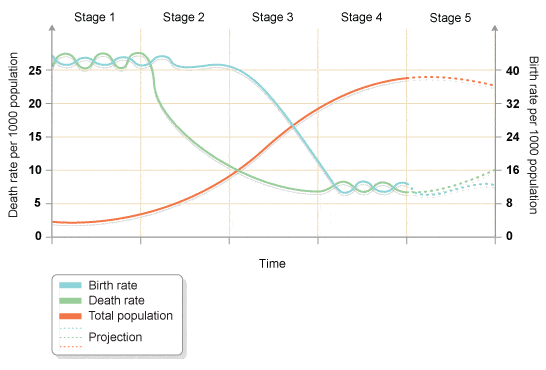
Death rates fall rapidly due to increased hygiene and medical advances during stage

a)

1

b)

2

c)

3

d)

4

23.

Which correctly describes the term demographic transition?

a)

The transition from low birth rates and death rates to high birth rates and death rates as a country develops.

b)

The transition from high birth rates and death rates to low birth rates and death rates as a country develops.

c)

The transition from high birth rates to low death rates as a country develops.

d)

The transition from low birth rates to high death rates as a country develops.

24.

VOCAB: The average number of children a female member of a population has during her lifetime

a)

total fertility rate

b)

replacement fertility rate

c)

growth rate

d)

death rate

25.
The most populous country in the world
a)
China
b)
India
c)
US
d)
Brazil
26.
For every 1,000 babies born in Mozambique this year, nearly 150 of them will die before they reach their 1st birthday. The rate of 150 deaths per 1,000 births is known as the:
a)
crude death rate.
b)
crude birth rate.
c)
total fertility rate.
d)
infant mortality rate.
27.
A characteristic of stage Three of the DTM shows?
   
a)
High birth and death rates
b)
Low death and high birth rates
c)
Declining birth and death rates 
d)
High death and low birth rates
28.
A characteristic of stage one of the DTM shows
    
a)
High birth and death rates
b)
Low death and high birth rates
c)
Low birth and death rates
d)
High death and low birth rates
29.
A characteristic of stage four of the DTM shows
   
a)
High birth and death rates
b)
Low death and high birth rates
c)
Low birth and death rates
d)
High death and low birth rates
30.
A pyramid looks like an upside down triangle, what stage does this represent?
a)
2
b)
3
c)
4
d)
5
31.

Countries in this level of economic development have most of their people living in rural areas.

a)

More Developed

b)

Newly Industrialized

c)

Less Developed

32.

Malthusian Theory claims that

a)

population grows arithmetically while food supply grows geometrically

b)

population grows geometrically while food supply grows arithmetically

c)

population and food supply grow at the same route

d)

populations will adapt and find new food sources

33.
In comparing Malthus's theory to actual world food production and population growth during the past half-century, the principal difference is that:
a)
actual food production has been much higher than Malthus predicted.
b)
actual population growth has been much higher than Malthus predicted.
c)
Malthus's theory predicted much higher population growth than has actually occurred.
d)
population increased geometrically while food production increased arithmetically.
34.
Which of the following best describe government's reaction to low fertility rates in stages 4 & 5?
a)
Pro-natalist policy
b)
Anti-natalist policy
35.
What is the name of Stage 1 of the Epidemiologic Transition Model?
a)
Delayed Degenerative Diseases
b)
Pestilence & Famine
c)
Degenerative Diseases
d)
Receding Pandemics
36.
What is the name of Stage 2 of the Epidemiologic Transition Model?
a)
Delayed Degenerative Diseases
b)
Pestilence & Famine
c)
Degenerative Diseases
d)
Receding Pandemics
37.
What is the name of Stage 2 of the Epidemiologic Transition Model?
a)
Delayed Degenerative Diseases
b)
Pestilence & Famine
c)
Degenerative Diseases
d)
Receding Pandemics
38.
What is the name of Stage 4 of the Epidemiologic Transition Model?
a)
Delayed Degenerative Diseases
b)
Pestilence & Famine
c)
Degenerative Diseases
d)
Receding Pandemics
39.
From the description/examples listed below, which correctly describes Stage 1 of the Epidemiologic Transition Model?
a)
Cardiovascular disease/cancer
b)
Through medicine, disease spreads more slowly
c)
Improved Sanitation, nutrition
d)
Black Plague
40.
From the description/examples listed below, which correctly describes Stage 2 of the Epidemiologic Transition Model?
a)
Cardiovascular disease/cancer
b)
Through medicine, disease spreads more slowly
c)
Improved Sanitation, nutrition
d)
Black Plague
41.
From the description/examples listed below, which correctly describes Stage 3 of the Epidemiologic Transition Model?
a)
Cardiovascular disease/cancer
b)
Through medicine, disease spreads more slowly
c)
Improved Sanitation, nutrition
d)
Black Plague
42.
Dr. John Snow and his famous water pumps map showed the spread of which disease in London during the 1850s?
a)
HIV
b)
Bird Flu
c)
Cholera
d)
Tuberculosis
43.
The branch of medical science concerned with the incidence, distribution, and control of diseases that affect large numbers of people is ____________________.
a)
Epidemiology
b)
Optometry
c)
Cardiology
d)
Pandemiology
44.
Why are developing countries more susceptible to the spread of infectious diseases?
a)
Lower socio-economic status
b)
Unstable government
c)
Lack of healthcare/ education
d)
All of the above
45.
Where in the world is HIV/AIDS most prevalent (most common)? 
a)
Europe
b)
Southeast Asia
c)
United States
d)
Sub-Saharan Africa