wayground logo

Free Printable Worksheets

NEW

Font size

S
M
L
XL
Worksheets

Plants & Photosynthesis

Total questions: 21

Worksheet time: 11mins
Name
Class
Date
1.
Opening that allows gas exchange, BUT results in water loss
a)
Stomata
b)
Leaves
c)
Roots
d)
Vascular tissue
2.
How are photosynthesis and cellular respiration related?
a)
They have opposite equations
b)
they have the same equation
c)
they both produce carbon dioxide
d)
they both produce oxygen
3.

Openings at the bottom of a leaf

a)

Stoma

b)

Guard Cells

c)

Filament

4.
What organelle in the leaves of plants capture light energy from the sun to complete photosynthesis?
a)
Chloroplasts
b)
Mitochondria
c)
Nucleus
d)
Ribosomes
5.
The waxy, waterproof layer that covers most leaves is called the what?
a)
spore
b)
cuticle
c)
seed coat
d)
xylem
6.
Gases pass in and out of a leaf through the what?
a)
vascular tissue
b)
mouth hole
c)
stomata
d)
cell wall
7.
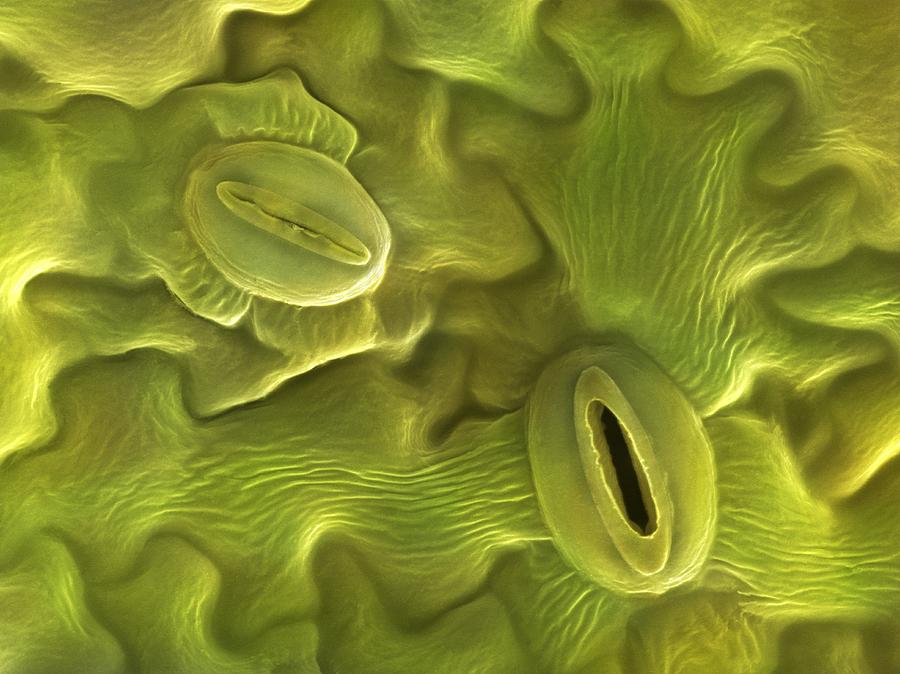
Stomata
a)
tiny holes in the leaves of a plant that allow gases to enter or leave the plant
b)
living things
c)
a plant part that carries out photosynthesis to make food for the plant
d)
the process in which plants use energy from the sun to make their own food
8.
____________ cells open and close the stomata
a)
palisade
b)
guard
c)
xylem
d)
epidermis
9.
What are the products of photosynthesis?
a)
water and carbon dioxide
b)
oxygen and glucose
c)
oxygen and carbon dioxide
d)
oxygen and water
10.
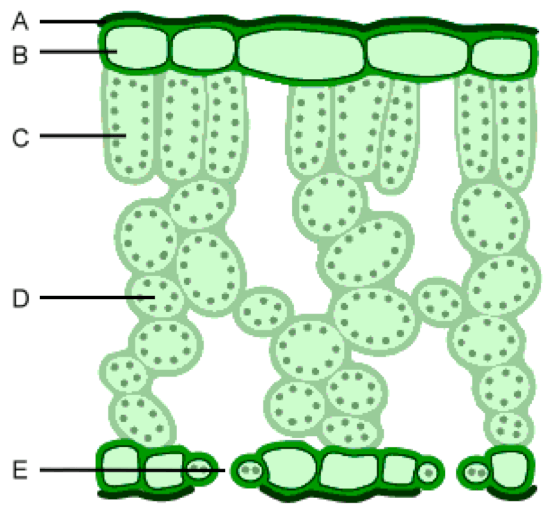
What is E pointing to?
a)
waxy cuticle
b)
stomata
c)
upper epidermis
d)
cuticle
11.
What is C pointing to?
a)
lower epidermis
b)
cuticle
c)
palisade layer
d)
spongy layer
12.
The leaf has a shiny, waxy cuticle around it to
a)
increase the rate of photosynthesis
b)
attract more light
c)
control water loss
d)
stop carbon dioxide and oxygen gases escaping
13.
Most of the chloroplast cells are found in the
a)
upper epidermis
b)
pallisade mesophyll layer
c)
lower epidermis
d)
stomata
14.
Plants need to take in oxygen gas for respiration
a)
only at night 
b)
only during the day
c)
both during the day & the night
15.

What DON'T plants use glucose for?

a)

making cellulose

b)

respiration

c)

making amino acids

d)

photosynthesis

e)

making cellulose

16.

What colour does iodine go if starch is present

a)

orange

b)

purple

c)

black

d)

red

17.

What do you boil the leaf in to kill it and remove the waxy cuticle?

a)

water

b)

ethanol

c)

water + sodium hydrogen carbonate

d)

chlorophyll

18.

What do you boil the leaf in to remove the chlorophyll?

a)

water

b)

ethanol

c)

water + sodium hydrogen carbonate

d)

chlorophyll

19.

Which areas of the leaf should go black with iodine?

a)

green bits

b)

white bits

c)

both

d)

neither

20.

Why must you turn off the bunsen burner before getting the ethanol?

a)

because ethanol boils at a higher temperature than water

b)

because ethanol boils at a lower temperature than water

c)

because ethanol is flammable

d)

because ethanol is corrosive

21.

what is required for photosynthesis?

a)

light, oxygen and chlorophyll

b)

light, chlorophyll and heat

c)

chlorophyll, light and the correct temperature

d)

chlorophyll, the correct temperature and oxygen