wayground logo

Free Printable Worksheets

Font size

S
M
L
XL
Worksheets

Slavery and Civil War Review - LIFT

Total questions: 70

Worksheet time: 42mins

Name
Class
Date
1.
The 3/5 Compromise settled the argument of--
a)
Representation in the Senate
b)
How slaves should be counted for representation
c)
How states should be represented
d)
Borders of states
2.
Before the 3/5 Compromise, Northern states wanted slaves to count for--
a)
Taxes
b)
Population
3.
Before the 3/5 Compromise, Southern states wanted slaves to count for--
a)
Taxes
b)
Population
4.
The Great Compromise and the 3/5 Compromise were both resolved by the Delegates of the--
a)
House of Burgesses
b)
Continental Congress
c)
Parliament
d)
Constitutional Convention
5.
What did the southern states want?
a)
Slaves to count as population
b)
Slaves to become free.
c)
Slaves to not count as population
d)
To get rid of slaves in the north.
6.
What did the northern states want?
a)
Slaves to count for the state population
b)
To have more slaves.
c)
Slaves to not count for the state population
d)
For each slave to count for two votes.
7.

Who invented the Cotton Gin?

a)

George Harrison

b)

Eli Whitney

c)

Thomas Singleton

d)

Matthew Pershing

8.

What did the Cotton Gin do?

a)

It picked cotton a lot faster than a person could.

b)

It sowed cotton seeds a lot faster than a person could.

c)

It spun cotton into thread a lot faster than a person could.

d)

It removed the seeds from cotton a lot faster than a person could

9.

Which states benefited the most from the Cotton Gin?

a)

The northern states.

b)

The southern states.

c)

The states that had the most factories.

d)

The states along the western coast.

10.

Before 1794, cotton seeds were separated from the fiber by hand and it took many hours to make a pound of lint (cotton fiber with the seeds removed). Therefore, cotton cloth was...

a)

...cheap and popular.

b)

... too expensive for many Americans.

c)

... not even invented yet.

d)

none of these

11.

Because the cotton gin made it possible to clean more cotton in a shorter amount of time, cotton cloth became…

a)

... more expensive and unpopular.

b)

...easier to transport.

c)

...harder to transport

d)

...cheaper and more popular.

12.

Unfortunately, many Southerners thought it made economic sense to have enslaved people tend their cotton because...

a)

...cotton was a labor intensive crop.

b)

... one overseer could supervise many field workers.

c)

none of these

d)

both of these

13.

Ultimately, the cotton gin resulted in...

a)

...a slight increase in the number of slaves in the U.S.

b)

... an enormous increase in the number of slaves in the U.S.

c)

...a slight decrease in the number of slaves in the U.S.

d)

... an enormous decrease in the number of slaves in the U.S.

14.

Slavery was devastating because...

a)

...people were physically and sexually abused.

b)

... families were torn apart.

c)

... it was dehumanizing.

d)

all of these

15.
Many slaves worked on large farms called ______.
a)
plantations
b)
villages
16.

This enslaved person’s journey from Africa to the Americas across the Atlantic Ocean on a slave-trading ship.

a)

Middle Passage

b)

Triangular trade

c)

Slave trade

d)

Journey

17.

If a mother was a slave, her child was:

a)

Free for life

b)

A slave for life

c)

A slave for a short time

d)

Free for a short time

18.
Why did Southerners who did not own slaves support slavery?
a)
They feared the power of the slaveholders.
b)
They believed they would be able to own slaves someday.
c)
They knew that the Southern economy depended on slave labor.
d)
They understood that the Constitution did not ban slavery in the South.
19.
What did Harriet Tubman’s work with the Underground Railroad involve?
a)
As a freed slave, she led others to take a stand against slave owners.
b)
As a freed slave, she bought slaves and then gave them their freedom.
c)
As an escaped slave, she guided slaves from the South to freedom.
d)
As an escaped slave, she opened a school for those who traveled to Canada.
20.
A complete end to slavery
a)
abolition
b)
abolitionist
c)
emancipation
d)
dehumanization
21.
How did cotton relate to slavery?
a)
The desire to grow cotton led to increased slavery
b)
It did not relate to slavery
c)
All slaves were required to grow cotton
d)
Cotton was traded for slaves in Africa
22.
What was the main job of an overseer?
a)
To evaluate the price of slaves
b)
to supervise the work of slaves
c)
to teach slaves to use new tools
d)
to help them escape
23.
Slaves were forced to work on plantations which grew...
a)
Cotton, sugar and coffee
b)
Coffee, bananas and tea
c)
Tea, sugar and coffee
d)
Wool, Sugar and coffee
24.
Who resisted slavery by organizing a violent rebellion?
a)
Nat Turner
b)
Edward Covey
c)
Sojourner Truth
d)
Frederick Douglass
25.
How did Southern states respond to slave rebellions?
a)
They gave slaves some freedom.
b)
They began to understand that slavery was wrong.
c)
They passed even stricter slave codes.
d)
They refused to take slaves back when they were captured.
26.

How could a slave owner make money? (List 4 different ways)

a)

Grow and sell finished cotton.

b)

Breed and Sell slaves

c)

Lease slaves to poorer farmers

d)

Sell land

e)

Sell Cotton Gins

27.

What privileges did slaves have? (when they were given) Name 3 different ones.

a)

Religion

b)

Family (Marriage)

c)

Overseer

d)

Freedom

e)

Plantation Owner

28.

What privileges did slaves have? (when they were given) Name 3 different ones.

a)

House

b)

Food

c)

Clothing

d)

Freedom

e)

Slave Catcher

29.

What two places were relatively safe for a slave and became the places education and rebellious ideas happened?

a)

Church – religious ceremonies

b)

Their personal shelters

c)

Fields

d)

Schools

e)

Swamps

30.

This person was a punisher, a manipulator, and had to have the ability to be cruel. He worked best when he created fear… an unpredictable, random fear. If production was down, it was the _____ responsibility. If slaves ran away, it was also the responsibility of the ___________.

(a)  

31.

What was the purpose behind the Missouri Compromise?

a)

Started the Civil War

b)

Keep a legislative balance in the Senate. An equal number of free and slave states.The Missouri Compromise admitted Missouri as a slave state and Maine as a free state, and prohibited slavery in territory that later became Kansas and Nebraska.

c)

Ended the Civil War

d)

Ended slavery

e)

Helped to elect President Lincoln

32.

What does “popular sovereignty” mean?

a)

The most popular state would choose the President.

b)

The most popular person would become mayor.

c)

The popular vote would choose the President.

d)

The population of that state would choose their free/slave status.

33.
a)
Economic Effects of the Civil War on the South
b)
Social Effects of the Civial War on the North
c)
Political Effects of the Civil War on the South
d)
How Slavery Effected the South
34.
Which of the following statements most accurately represents the abolitionist movement?
a)
Most southerners were abolitionists. 
b)
Abolitionists typically used violence to discourage slavery
c)
Abolitionists greatly influenced the actions of the national government. 
d)
The work of abolitionists kept the issue of slavery alive throughout the nation to fight for the end of slavery. 
35.
How did the South respond to the election of abraham Lincoln? 
a)
Eleven states seceded from the Union.
b)
Slave territories formed the Confederacy. 
c)
The South began preparing for a long and bloody war.
d)
The South elected Stephen Douglas president of the Confederacy. 
36.
How did the Civil War affect the physical environment of the nation?
a)
Both the North and South were devastated. 
b)
Entire cities and plantations were destroyed in the South. 
c)
Thousands of acres of farmland were ruined in the North. 
d)
The South was effecgted very little since only a few battles were fought there. 
37.
What was the name of the line that separated the North and the south? 
a)
The Grey Line
b)
The Rebel Line
c)
The Union Line
d)
The Mason Dixon Line
38.
Harriet Tubman was an escaped slave who became one of the most successful "conductors" of the Underground Railroad. What was the Underground Railroad? 
a)
It was an underground train system
b)
It was a chain of homes that offered assistance to slaves who were fleeing to the North. 
c)
It was a railroad system that only operated in the North. 
d)
It was a chain of homes that helped owners find the return slaves because of the Fugitive Slave Laws.
39.
a)
Reasons northern states seceded from the Union
b)
The start of the Civil War
c)
Reasons Abraham Lincoln was elected as President
d)
Reasons southern states seceded from the Union
40.
Which statement is an example of the effects of geography on the economy of the South?
a)
Rocky soil and a shorter growing season made it difficult to grow cash crops
b)
Plentiful lumber and natural harbors led to shipbuilding and commerce.
c)
Fertile soil and a temperate slimate supported the growing of cash crops.
d)
Swift flowing rivers supplied water power for factories. 
41.
I am the place General Lee surrendered to General Grant to end the Civil War. Who am I? 
a)
Harper's Fairy
b)
Appomattox Courthouse
c)
Thomas Jefferson's Home
d)
The White House
42.
I am the battle that was the turning point in the Civil War for the Union. Who am I? 
a)
Battle of Fort Sumter
b)
Battle of Appomattox Courthouse
c)
Battle of Gettysburg
d)
Battle of Harper's Ferry
43.
I robbed an arsenal at Harper's Ferry to give guns to slaves, but I was caught and hung. Who am I? 
a)
John Brown 
b)
Harriet Beecher Stowe
c)
William Lloyd Garrison
d)
Fredrick Douglas
44.
I wrote Uncle Tom's Cabin which convinces others to fight against slavery. Who am I?
a)
John Brown 
b)
Harriet Beecher Stowe
c)
William Lloyd Garrison
d)
Fredrick Douglas
45.
I was an escaped slave who worked to end slavery by giving speeches and writing books. Who am i?
a)
Sojourner Truth 
b)
Harriet Beecher Stowe
c)
William Lloyd Garrison
d)
Fredrick Douglas
46.
What was the first battle of the Civil War?
a)
Bullrun
b)
Fort Sumter
c)
Shiloh
d)
Concord
47.
What speech did Lincoln give to dedicate the first National Cemetery?
a)
Gettysburg Address
b)
Emancipation Proclamation
c)
Inaugural Address
d)
I Have A Dream
48.
What state was the first to secede from the Union?
a)
North Carolina
b)
South Carolina
c)
Maryland
d)
Georgia
49.
Clara Barton created the _______ Cross?
a)
Star
b)
Yellow
c)
Stained Glass
d)
Red
50.

Which law, which greatly angered Abolitionists, made helping runaway slaves in the North illegal?

a)

Nebraska Act

b)

Underground Railroad Act

c)

Fugitive Slave Act

d)

Missouri Compromise

51.

The South was known for

a)

urbanization

b)

slavery

c)

fishing

d)

poor land for farming

52.

The cotton gin made slavery more

a)

useful

b)

important in the South

c)

important in the North

d)

scarce

53.

Lincoln’s main goal was to preserve

a)

the Union

b)

slavery

c)

the Confederacy

d)

Southern way of life

54.

What was the first major land battle during the Civil War?

a)

Battle at Lexington

b)

Battle Royale

c)

Battle of the Alamo

d)

The First Battle of Bull Run

55.

The Emancipation Proclamation freed the slaves

a)

in the Confederate States

b)

in the Union

c)

in Europe

d)

in Mexico

56.

Describe where most Southerners lived by the mid-1850's

a)

cities and large towns

b)

farms, plantations and small towns

57.

Which state was added as a Free state in the Missouri Compromise?

a)

Texas

b)

Maine

c)

Missouri

d)

California

58.

What was the result of Northerners and Southerners going to Kansas to vote?

a)

Oregon entered as a free state.

b)

Violence erupted all over the Kansas Territory.

c)

Nebraska was split into Kansas and Nebraska.

d)

Ohio became a slave state.

59.

Why were Northerners outraged at the Supreme Court's decision in the Dred Scott Case?

a)

The believed it would solve many problems.

b)

They agreed with the decision.

c)

The Court ruled in favor of Dred Scott.

d)

The Court said African Americans had no rights.

60.

Who was the main leader of the Confederate Army?

a)

Robert E. Lee

b)

Ulysses S. Grant

61.

Who was the main leader of the Union Army?

a)

Robert E. Lee

b)

Ulysses S. Grant

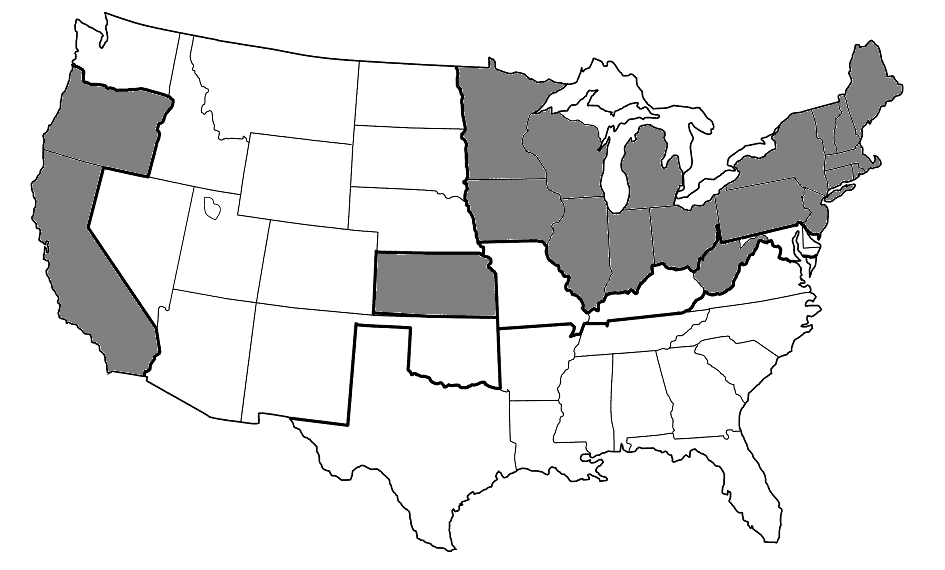
62.

Which map shows the Union?

a)
b)
c)
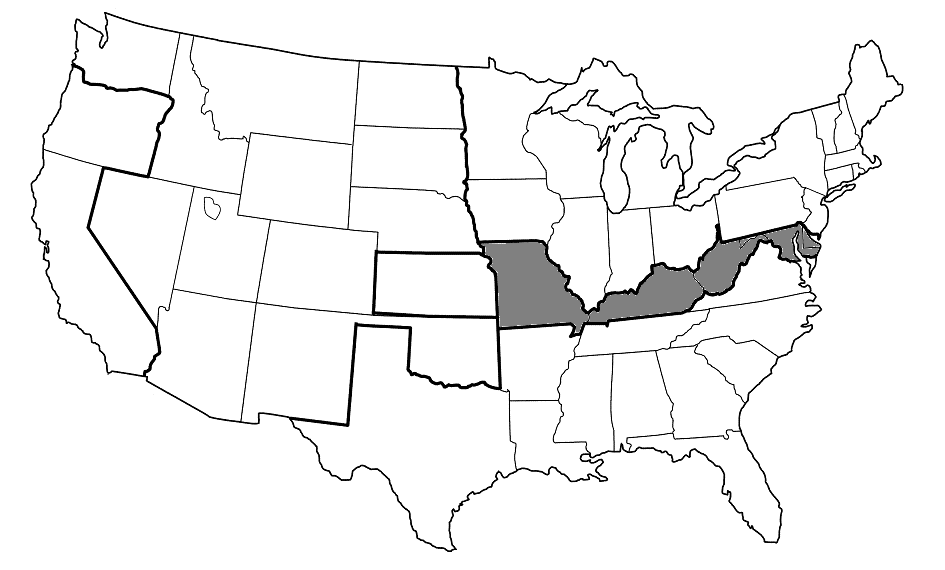
63.

Which map shows the Union Border States?

a)
b)
c)
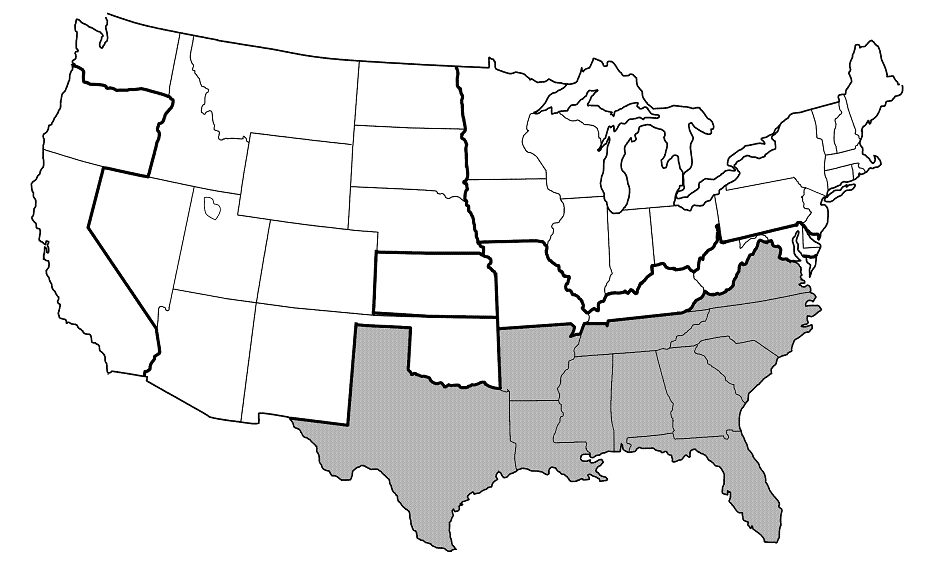
64.

Which map shows the Confederate States?

a)
b)
c)
65.

What state is F?

a)

Georgia

b)

Arkansas

c)

Mississippi

d)

Alabama

66.

What state is G?

a)

Florida

b)

Tennessee

c)

Georgia

d)

Arkansas

67.

What state is H?

a)

South Carolina

b)

Tennessee

c)

Florida

d)

North Carolina

68.

What state is I?

a)

North Carolina

b)

South Carolina

c)

Florida

d)

Virginia

69.

What state is J?

a)

Virginia

b)

South Carolina

c)

North Carolina

d)

Tennessee

70.
The ___ was a part of the Constitution which said African American slaves could only be counted as 3/5 of a person for Congressional representative purposes.
a)
Supremacy Clause
b)
3/4 Compromise
c)
3/5 Compromise
d)
All of the above