wayground logo

Free Printable Worksheets

NEW

Font size

S
M
L
XL
Worksheets

Matter Test Review

Total questions: 45

Worksheet time: 23mins

Name
Class
Date
1.

Anything that has mass and takes up space is __.

a)

matter

b)

chemistry

c)

a compound

d)

a chemical

2.

Look at a Periodic Table and look up Neon, Atomic Number 10.


How many protons does an atom of Neon contain?

a)

10

b)

20

c)

15

d)

30

3.

The basic building block of all matter is __

a)

an element

b)

an atom

c)

a compound

d)

a mixture

4.

How many elements are on a periodic table?

a)

1000

b)

100

c)

50

d)

over 100

5.
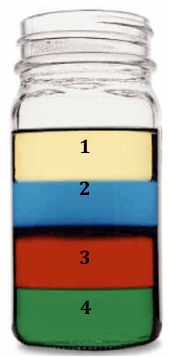
Put the liquids in order from most dense to least dense?
a)
4, 3, 2, 1
b)
1, 2, 3, 4
c)
3, 4, 2, 1, 
d)
4, 3, 1, 2
6.

Two or more elements chemically combined together to form __.

a)

mixture

b)

solution

c)

compounds

d)

another element

7.

What orbits (moves around) the nucleus of an atom?

a)

protons

b)

nuetrons

c)

electrons

d)

nucleus

8.

A substance that can NOT be broken down into another substance is __.

a)

a mixture

b)

a compound

c)

a molecule

d)

an element

9.

The amount of space something takes up.

a)

mass

b)

density

c)

volume

d)

temperature

10.

Anything that has mass and takes up space.

a)

weight

b)

properties

c)

matter

d)

mass

11.
Which box has a higher density?  
a)
Box A
b)
Box B
c)
cannot be determined
d)
they are the same
12.

Characteristics used to describe matter.

a)

weight

b)

properties

c)

matter

d)

mass

13.

The amount of matter in something.

a)

weight

b)

properties

c)

matter

d)

mass

14.

A substance with a definite volume, but no definite shape; this substance takes the shape of its container.

a)

solid

b)

liquid

c)

gas

15.

The particles are far apart and move very quickly.

a)

solid

b)

liquid

c)

gas

16.

A substance that does not have a definite shape or volume.

a)

solid

b)

liquid

c)

gas

17.

Mass divided by volume.

a)

mass

b)

density

c)

volume

d)

temperature

18.

The particles vibrate and are tightly packed together.

a)

solid

b)

liquid

c)

gas

19.
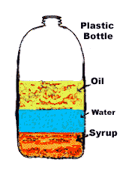
By looking at the picture, what do we know about the density of the water in the bottle?
a)
It is more dense than oil and less dense than syrup.
b)
It is more dense than both oil and syrup.
c)
It is less dense than both oil and syrup. 
d)
It is more dense than the plastic bottle.
20.

A substance with a definite shape and a definite volume.

a)

solid

b)

liquid

c)

gas

21.

The particles slide by each other.

a)

solid

b)

liquid

c)

gas

22.

slicing bread

a)

chemical change

b)

physical change

23.

baking a pie

a)

chemical change

b)

physical change

24.

evaporating water

a)

chemical change

b)

physical change

25.

shredding paper

a)

chemical change

b)

physical change

26.

bicycle rusting

a)

chemical change

b)

physical change

27.

chopping wood

a)

chemical change

b)

physical change

28.

digesting food

a)

chemical change

b)

physical change

29.

rotting strawberries

a)

chemical change

b)

physical change

30.

bacteria decomposing leaves

a)

chemical change

b)

physical change

31.
At higher temperatures
a)
particles in an object have less energy
b)
particles in an object move faster
c)
a gas contracts
32.
Something that takes up space and has mass.
a)
volume
b)
matter
c)
mass
d)
density
33.

A state of matter that has a definite volume and shape.

a)

solid

b)

liquid

c)

gas

d)

matter

34.
What can causes ice to transform from a solid to a liquid?
a)
The air.
b)
The cold.
c)
Shape
d)
Heat
35.
The amount of matter in an object is its ________________.
a)
weight
b)
mass
c)
gram
d)
atom
36.
The process by which water changes to water vapor
a)
Evaporation
b)
Condensation
c)
Freezing
d)
Melting
37.
The process by which water vapor changes to liquid
a)
evaporation
b)
condensation
c)
freezing
d)
melting
38.

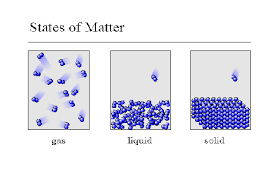
This diagram shows the spacing of particles for which state of matter?

a)

solid

b)

liquid

c)

gas

39.
Changing from liquid to a solid
a)
evaporation
b)
condensation
c)
freezing
d)
melting
40.
Changing from a solid to a liquid
a)
evaporation
b)
condensation
c)
freezing
d)
melting
41.
What forms on the outside of a cold bottle?
a)
condensation
b)
evaporation
c)
solid
42.
Water that has turned into ice is a
a)
liquid
b)
gas
c)
solid
d)
melting
43.
Which of the following statements is true?
a)
oil floats on water because oil is less dense than water
b)
oil sinks in water because oil is less dense than water
c)
water floats on oil because water is more dense than oil
44.

This diagram shows the spacing of particles for which state of matter?

a)

solid

b)

liquid

c)

gas

45.
One of the small particles that make up matter
a)
Atom
b)
Gas
c)
Physical Property
d)
Mass