wayground logo

Free Printable Worksheets

Font size

S
M
L
XL
Worksheets

American Revolution

Total questions: 55

Worksheet time: 30mins
Name
Class
Date
1.
The Sons of Liberty were:
a)
the children of our Founding Fathers.
b)
a professional dance team.
c)
Patriots who protested taxes.
d)
the writers of the Declaration of the Independence.
2.
What is another name for British soldiers?
a)
Redcoats
b)
Patriots
c)
Minutemen
d)
Continental Soldiers
3.
What did we call colonists who did NOT want independence from England?
a)
Minutemen
b)
Traitors
c)
Militia
d)
Loyalists
4.
"No ________ without representation"
a)
voting
b)
taxation
c)
rights
d)
liberty poles
5.
What was the purpose of the Boston Tea Party?
a)
to punish merchants for selling imported tea.
b)
to see who could throw a barrel further.
c)
to frame the Native Americans.
d)
to protest taxes
6.
Who were the Minutemen?
a)
Patriots who were ready to fight at a minutes notice
b)
British soldiers who were ready to fight at a minutes notice
c)
Sons of Liberty who were ready to fight at a minutes notice
d)
Hessians who were ready to fight at a minutes notice
7.
Which side had more resources and training at the beginning of the war?
a)
British
b)
Colonists
8.
How many people died at the Boston Massacre?
a)
2
b)
6
c)
3
d)
5
9.
What country joined the colonists to help them win the war?
a)
Germany
b)
France
c)
Netherlands
d)
Africa
10.

Which person was killed in the Boston Massacre and later became a symbol of the Abolitionist movement?

a)

Peter Salam

b)

Patrick Henry

c)

Martha Washington

d)

Crispus Attucks

11.

Who was the monarch of Britain in the time leading up to and during the American Revolution?

a)

King James III

b)

King George III

c)

Queen Elizabeth II

d)

King Louis IV

12.

Which founding father held the role of lead military general during the American Revolutionary War?

a)

Paul Revire

b)

George Washington

c)

Thomas Jefferson

d)

Benjamin Franklin

13.

Which of the following was the main reason that American colonists opposed the Stamp Act of 1765?

a)

The act was taxation without representation.

b)

The act was passed by the king, not Parliament.

c)

The tax was a large amount of money.

d)

The tax was not imposed on the wealthy.

14.

What does this political poster represent?

a)

The Colonies needed to be united

b)

Colonies need to be independent

c)

Serpents can grow back together

d)

Ben Franklin didn't know why he made this

15.

The Olive Branch Petition, by John Dickinson, was written to

a)

start a war with England

b)

ask for more time to pay debt to England

c)

attempt peace with England

d)

attempt peace with Native Americans and the French

16.

The Declaration of Independence has 27 grievances against King George III. What is a grievance?

a)

reasons for the "break-up" (a complaint)

b)

a last ditch effort to get back together (last chance)

c)

reasons why the colonies like King George (a positive review)

d)

peace treaty between US and England

17.

Mercantilism allows trade between

a)

all free countries

b)

only countries who sign agreement

c)

only between a Mother Country and a colony

d)

colonies to other colonies

18.
Life, Liberty and the pursuit of happiness were...
a)
Unalienable rights
b)
Bill of Rights
c)
Freedom to live
d)
Will Smith movie
19.
Great Britain recognized the United States as an independent country through the: 
a)
Treaty of Paris 1763
b)
Declaration of Independence 1776
c)
Treaty of Paris 1783
d)
Articles of Confederation
20.
What was the immediate effect due to the passing of the Stamp Act in 1765?
a)
Colonists sought military support from France.
b)
Colonists organized boycotts of British goods.
c)
Colonists signed the Declaration of Independence.
d)
Colonists dumped tea into the Boston Harbor
21.
The American colonists were dissatisfied with the---
a)
Political debates that took place at the Albany Convention.
b)
Interference of Great Britain in the slave trade
c)
Economic consequences of the Great Awakening
d)
Economic policies imposed by Great Britain following the French and Indian War
22.
British colonists objected to the Proclamation of 1763 because they--
a)
Feared it would provoke attacks from American Indians
b)
Did not want to share control of the fur trade with France
c)
Resented the limits it imposed on westward expansion
d)
Wanted to be able to trade freely with foreign nations
23.
Which battle brought the French into the Revolutionary War on the side of the Americans?
a)
Saratoga
b)
Concord
c)
Trenton
d)
Yorktown
24.
"America may boast that she has accomplished what no power before her ever did, contending with Britain--Captured two of their celebrated Generals and each an Army of thousands of veteran Troops to support them."
-- Abigail Adams, letter to John Adams, December 9, 1781
Which of the following is Abigail Adams referring to?
a)
The American victory at the battle of Yorktown
b)
The negotiation of the Treaty of Paris by American diplomats.
c)
The bravery of American soldiers at Valley Forge
d)
The arrival off French aid after the Battle of Saratoga
25.
Which excerpt from the Declaration of Independence best explains why colonists were unhappy about their lack of representation in the British parliament?
a)
"He has refused to pass other laws for the accommodation of large districts of people"
b)
"For imposing Taxes on us without our Consent"
c)
He has refused his Assent to Laws, the most wholesome and necessary for thee public good."
d)
"For transporting us beyond Seas to be tried for pretended offences."
26.
Thomas Jefferson drew on the ideas of which English philosopher when writing the Declaration of Independence?
a)
George Mason
b)
George Stout
c)
John Adams
d)
John Locke
27.
Who was the volunteer from France who became Washington’s trusted aide?
a)
Benjamin Franklin
b)
Francis Marion
c)
Marquis de Lafeyette
d)
Thomas Pain
28.
Where was the Loyalist strength the strongest?
a)
In New England
b)
In New York
c)
In the Carolinas and Georgia
d)
In the Ohio River Valley
29.
Where were the first armed conflicts of the American Revolution?
a)
Yorktown
b)
Saratoga
c)
Lexington and Concord
d)
Bunker Hill
30.
Who was the major author of the Declaration of Independence?
a)
Benjamin Franklin
b)
John Adams
c)
Thomas Jefferson
d)
Patrick Henry
31.
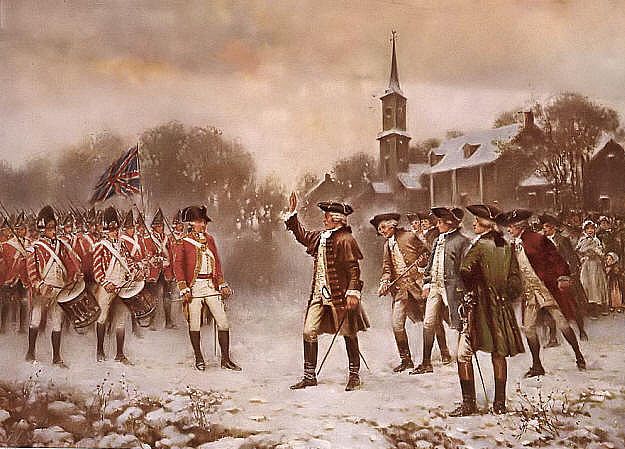
What event is depicted in this image?
a)
Boston Massacre
b)
Boston Tea Party
c)
Battle of Bunker Hill
d)
Lexington and Concord
32.
This patriot made a daring ride to warn colonists that British soldiers were approaching.
a)
Patrick Henry
b)
Paul Revere
c)
Phillis Wheatley
d)
Samuel Adams
33.
Which one of these is not an advantage that helped the American patriots defeat Great Britain.
a)
defense of their own land, principles and beliefs
b)
support from France
c)
superior numbers of soldiers and greater experience
d)
strong leadership from men like George Washington
34.
The U.S. was founded on July 4, 1776, by the approval of this document.
a)
the Treaty of Paris
b)
the Constitution
c)
the Declaration of Independence
d)
the Virginia Charter
35.

The Declaration of Independence states that all people have a natural right to

a)

free speech.

b)

a trial by jury.

c)

the pursuit of happiness.

d)

worship as they choose.

36.

Which battle convinced the French to become America's ally during the revolution?

a)

Lexington and Concord

b)

Yorktown

c)

Saratoga

d)

Bunker Hill

37.

The last major battle of the American Revolution was _

a)

Saratoga.

b)

Yorktown.

c)

Trenton.

d)

Princeton.

38.
After the Treaty of Paris 1783, what was the new natural boundary of the United States?
a)
Appalachian Moutains
b)
Ohio River Valley
c)
Mississippi River
d)
Great Lakes
39.
What contribution did Mercy Otis Warren make to the American Revolution?
a)
She was not a factor because women were not important during this Era
b)
She dressed as a Son of Liberty and participated in the Boston Tea Party
c)
Told her husband John Adams to "Remember the Ladies"
d)
Used propaganda in her essays, plays and poems to encourage patriotism
40.
What are your 3 Unalienable Rights, as expressed by Thomas Jefferson?
a)
Peace, Love and Joy
b)
Life, Liberty, and Property
c)
Life, Leadership and Pursuit of Happiness
d)
Life, Liberty and Pursuit of Happiness
41.
Which group is in the correct order?
a)
Yorktown, Valley Forge, Saratoga, Lexington and Concord
b)
Lexington/Concord, Saratoga, Valley Forge, and Yorktown
c)
Lexington/Concord, Valley Forge, Saratoga, and Yorktown
d)
Valley Forge, Yorktown, Lexington/Concord, and Saratoga
42.

Where did the British General Cornwallis surrender to Colonial troops ending the war?

a)

Battle of Yorktown

b)

Battle of Saratoga

c)

Battles of Lexington and Concord

d)

Battle of Ticonderoga

43.

Where were the first shots of the American Revolution fired?

a)

Battle of Saratoga

b)

Battle of Yorktown

c)

Battles of Lexington and Concord

d)

Battle of Bunker Hill

44.

What advantages did the colonial militia have over the British? (Choose all correct answers.)

a)

They knew the geography better.

b)

They had strong leaders.

c)

They had more money and weapons.

d)

They were determined to win their freedom.

45.

Why did British General Cornwallis surrender at the Battle of Yorktown?

a)

His troops ran out of ammunition.

b)

His army was trapped and had no way to escape by land or sea.

c)

His troops ran out of food and other supplies.

d)

His army decided they were ready to quit and go home to Britain.

46.

What was a mercenary?

a)

person who did not take sides during the war

b)

spy

c)

voluntary soldier

d)

soldier hired to serve in a foreign army

47.

After the Battle at Saratoga, who pledged foreign aid to the Americans?

a)

Spain

b)

France

c)

Canada

d)

Germany

48.

What is the historical significance of the Battle of Bunker Hill?

a)

Patriot win that sealed an alliance with France

b)

Battle proved the war would not be an easy win for the British

c)

Last major battle of the war

d)

Turning point of the war

49.

What is a blockade?

a)

surrounding an area to prevent people and goods through

b)

providing financial and military support

c)

agreement to work together

d)

wearing down of an enemy over time

50.

Pamphlet written by Thomas Paine, spoke about the colonies becoming independent from Great Britain.

a)

Common Sense

b)

Declaration of Independence

c)

Olive Branch Petition

d)

Treaty of Paris (1783)

51.

The Patriots knew that if they could gain control of Breed’s Hill, they could use cannons to fire down on the British in Boston. The Patriots lost the battle but successfully killed many British soldiers.

a)

Battle of Lexington

b)

Battle of Concord

c)

Battle of Trenton

d)

Battle of Bunker's Hill

52.

Who wrote the Declaration of Independence?

a)

Thomas Jefferson

b)

John Adams

c)

Benjamin Franklin

d)

George Washington

53.

The Battles of ____________________ and __________________ sparked the Revolutionary War.

a)

Lexington; Concord

b)

Concord; Bunker's Hill

c)

Lexington; Saratoga

d)

Concord; Camden

54.

Jefferson's political ideas were influenced by the ______________________, a movement that emphasized science and reason as guides to help see the world more clearly.

a)

Enlightenment

b)

Scientific Revolution

c)

Great Awakening

d)

French Revolution

55.

American intellectual, inventor, and politician was sent to France to ask for military aid and a loan during the American Revolution

a)

Thomas Jefferson

b)

Benjamin Franklin

c)

George Washington

d)

John Adams