wayground logo

Free Printable Worksheets

Font size

S
M
L
XL
Worksheets

Unit III Test - Practice Questions

Total questions: 81

Worksheet time: 1hrs 27mins

Name
Class
Date
1.
Which is the name of the kind of solid substance formed in this figure?  
a)
aqueous 
b)
precipitate
c)
acid
d)
synthesis 
2.
Provides evidence that a chemical reaction has occurred. 
a)
dissolving 
b)
melting
c)
formation of a gas
d)
bending
3.
The Law of Conservation of Mass states
a)
that matter exists in all states and reacts the same
b)
that matter can only be changed into new substances by introducing a catalyst
c)
that matter exists in the same state throughout any chemical change
d)
that matter cannot be created or destroyed and that the mass of the products must equal the mass of the reactants
4.
How many Al atoms are in this compound?         4Al2O3
a)
2
b)
8
c)
6
d)
4
5.
a copper penny turning greenish after a few years.
a)
Chemical Change
b)
Physical Change
6.
a copper penny turning greenish after a few years.
a)
Chemical Change
b)
Physical Change
7.

How many Carbons are present on the reactant side?

a)

1

b)

2

c)

3

d)

4

8.

How many Hydrogens are on the product side of this chemical equation?

a)

1

b)

2

c)

3

d)

4

9.

How many Oxygens are on the product side of this chemical equation?

a)

1

b)

2

c)

3

d)

4

10.

In a chemical reaction, if the reactants are heated, the reaction usually happens

a)

slower

b)

faster

c)

at the same rate

d)

in a smaller volume

11.
What is decomposition?
a)
putting substances together
b)
breaking substances apart
c)
element replacing another element in a compoud
d)
burning of a subtance
12.
3Ca + 2AlCl3 --> 3CaCl2 + 2Al
a)
Synthesis
b)
Decomposition
c)
Single Displacement
d)
Double Displacement
13.
One reactant into several products.
a)
Decomposition
b)
Synthesis
c)
Combustion
d)
Single Replacement
14.
Two Reactants and One Product
a)
Decomposition
b)
Synthesis
c)
Combustion
d)
Single Replacement
15.
What type a reaction is taking place in this picture?
a)
Synthesis
b)
Decomposition
c)
Single Replacement
d)
Double Replacement
16.
4Si   + S8   -->   2Si2S4
a)
Synthesis
b)
Decomposition
c)
Single Displacement
d)
Double Displacement
17.
Which of the following is the general formula for a decomposition reaction?
a)
A + B  → AB
b)
AB → A + B
c)
AB + C → AC + B
d)
AB + CD → AC + BD
18.
When balancing equations a ____ can be placed to the left of a formula of a substance to make the equations balanced
a)
charge
b)
subscript
c)
random number
d)
coefficient
19.
What coefficient should be used to make the following equation balanced?
N2+O2--> _NO 
a)
1
b)
2
c)
3
d)
4
20.
Balance this equation:
 __Li + __Cl2 -> __LiCl
a)
2Li + Cl2 -> 4LiCl2
b)
2Li + Cl2 -> LiCl2
c)
2Li +  Cl2 -> 2LiCl
21.
PbCl2 + AgNO3 ---> Pb(NO3)2 + AgCl 
a)
Synthesis
b)
Decomposition
c)
Single Replacement
d)
Double Replacement
22.
NH3 + HCl ---> NH4Cl 
a)
Synthesis
b)
Decomposition
c)
Single Replacement
d)
Double Replacement
23.
Which chemical reaction takes place when 2 substances react to form a single product?
a)
Decomposition
b)
Double Replacement
c)
Single Replacement
d)
Synthesis
24.
At the end of chemical reactions, what is the total mass of the reactants compared to the total mass of the products?
a)
the product is doubled
b)
the product is half the mass of the reactants
c)
the mass is the same
d)
the mass changes depending on the reaction
25.
This pictures simulates what type of reaction?
a)
Synthesis
b)
Decomposition
c)
Single Replacement
d)
Double Replacement
26.
A(n) ______ is a substance with a pH less than 7
a)
Acid
b)
Alkaline
c)
Base
d)
Buffer
27.
A(n) _______ is a substance with a pH greater than 7.
a)
Base
b)
Acid
c)
Buffer
d)
Water
28.
A solution with a pH of 3.6 would be...
a)
Acid
b)
Base
c)
Neutral
d)
Acid and Base
29.
A solution with a pH of 8.6 would be...
a)
Acid
b)
Base
c)
Neutral
d)
Acid and Base
30.
According to the pH range which substance is more acidic than lemon juice
a)
Hydrochloric acid
b)
cabbage
c)
milk
31.
Bleach is a strong base, what is the pH level of bleach?
a)
13
b)
14
c)
1
d)
2
32.

Which of the following is the strongest acid?

a)

1

b)

5

c)

3

d)

8

33.

Which of the following is the strongest base?

a)

4

b)

14

c)

7

d)

15

34.
Which of these is a property of metals?
a)
It's malleable
b)
It can't conduct electricity
c)
They are used in food
d)
It's very brittle
35.
Which of these grouping of elements could have the characteristic of brittle?
a)
Metal
b)
Nonmetal
36.
Which of the following is a good conductor of heat?
a)
Metal
b)
Nonmetal
c)
Metalloid
37.
Which elements are found on the left to middle of The Periodic Table? 
a)
Metals
b)
Nonmetals
c)
Metalloids
d)
Candles
38.
All of the following would classify an element as a metal except?
a)
Dull
b)
Luster
c)
Malleable
d)
Hard
39.

The elements located to the left of the stair-step

a)

Metals

b)

Nonmetals

c)

Metalloids

d)

Gases

40.

periods on the periodic table tell you

a)

the number of valence electrons

b)

the number of protons

c)

the number of energy levels

d)

the total number of subatomic particles in the element

41.

groups on the periodic table tell you

a)

the number of energy levels (rings)

b)

the number of protons

c)

the elements identity

d)

the number of valence electrons

42.

periods on the periodic table go what direction

a)

side to side

b)

up and down

c)

on a diagonal staircase

d)

both up and down and side to side

43.

groups on the periodic table go in what direction

a)

side to side

b)

up and down

c)

both up and down and side to side

d)

diagonal on a staircase

44.

what period would this element be in?

a)

6

b)

8

c)

3

d)

16

45.

what is this element?

a)

Lithium

b)

Beryllium

c)

Boron

d)

Helium

46.

what is this element and how many valence electrons does it have?

a)

Nitrogen, 7

b)

Boron, 5

c)

Boron, 3

d)

Nitrogen, 5

47.
Which of these is not a noble gas?
a)
Helium
b)
Argon
c)
Nitrogen
d)
Krypton
48.
Where are the nonmetals located on the periodic table?
a)
top left corner
b)
bottom left corner
c)
top right corner
d)
bottom left corner
49.

What is an anion's charge?

a)

positive

b)

negative

c)

neutral

d)

depends on the element's charge

50.

What is a cation's charge?

a)

positive

b)

negative

c)

neutral

d)

depends on the element

51.
What is the formula for aluminum fluoride?
a)
AlF
b)
Al2F3
c)
AlF3
d)
Al3F2
52.

LiBr is called

a)

lithium bromine

b)

lithium (I) bromine

c)

lithium bromide

d)

lithuim (I) bromide

53.
The chemical formula for an ionic compound of potassium and oxygen is
a)
KO.
b)
K2O.
c)
K2O2.
d)
KO2.
54.
A (g) after a molecule in a chemical equation signifies:
a)
the substance is grounded
b)
the substance is a gas
c)
the substance is aqueous
d)
the substance is found in a gnome
55.

How many carbon atoms are there in a single molecule of CH3CH2Br?

a)

1

b)

5

c)

3

d)

2

56.

How many total elements are there in a molecule of CH3CH2OH?

a)

6

b)

3

c)

9

d)

18

57.

How many nitrogen atoms are there in a single molecule of AgNO3?

a)

5

b)

1

c)

3

d)

0

58.

How many nitrogen atoms are there in a single molecule of AgNO3?

a)

5

b)

1

c)

3

d)

0

59.

What is the formula for potassium fluoride?

a)

KF2

b)

K2F

c)

KF

d)

K2F2

60.

What is the name of the compound N2O3?

a)

Sodium dioxide

b)

Dinitrogen trioxide

c)

Dinitrogen oxide

d)

Nitrous oxide

61.

oxygen dichloride

a)

OF2

b)

PCl5

c)

OCl2

d)

BrCl5

62.

Which subatomic particle has a positive charge?

a)

proton

b)

neutron

c)

electron

d)

nucleus

63.

Determine the charge for an ion that has 33 protons, 36 electrons, and 38 neutrons.

a)

+3

b)

-3

c)

+5

d)

-5

64.

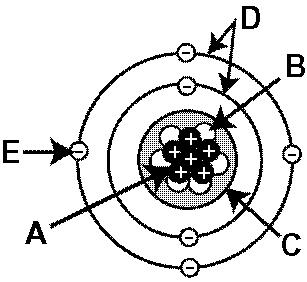
In the atom diagram shown, A is pointing to the darker particles, these are known as

a)

electrons

b)

protons

c)

neutrons

d)

the nucleus

65.
Which of the following is described as the basic unit of matter?
a)
Element
b)
Atom
c)
Molecule
d)
Compound
66.
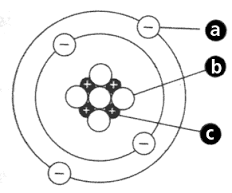
B and C are found in the ______ of an atom.
a)
electron cloud
b)
Space
c)
Nucleus
d)
Outside
67.
Color, shape, texture, and size are _____________ properties of matter.
a)
chemical
b)
liquid
c)
physical
d)
solid
68.

The atomic number of an element is 15. To which group in the periodic table does it belong?

a)

2

b)

3

c)

4

d)

5

69.

The image above shows

a)

covalent bonding

b)

ionic bonding

c)

metallic bonding

70.

Metals like to ___________ electrons to become stable

a)

lose

b)

gain

c)

share

71.

Which is the charge that results when oxygen becomes an ion?

a)

+3

b)

+2

c)

-2

d)

-3

72.

An atom becomes _______ when it loses electrons.

a)

Positive

b)

Negative

c)

Neutral

d)

Invisible

73.

An electron is

a)

positively charged

b)

neutral

c)

negatively charged

74.
The ________________ tells you how many energy levels are used in an element.
a)
group number
b)
atom
c)
protons
d)
period number
75.

PCl5 + ___ H2O → ___ HCl + H3PO4

a)

4, 5

b)

1, 6

c)

3, 8

d)

2,2

76.

__ Al + __ FeO → Al2O2 + __ Fe

a)

1, 1, 2

b)

2,1,2

c)

2, 2, 2

d)

2,4,2

77.
 Mg  +  ___ HCl  →   MgCl2  +   H2
a)
1
b)
2
c)
3
d)
4
78.
Which problem is balanced?
a)
PbO2 + 2H2
b)
SO2 + H20 --> H2SO4
c)
2Na + 2H2O --> 2NaOH + H2
79.
Balance this equation.
_SnO+_H2-->_Sn +_H2O
a)
1,1,2,1
b)
1,2,1,1
c)
1,2,1,2
d)
1,2,2,1
80.
Balance this equation.
_CF+ _Br-- _CBr+ _F2
a)
2,1,2,1
b)
1,2,2,1
c)
1,2,1,2
d)
2,2,2,2
81.
Is the equation balanced?: 2H2O + O2 --> 4MgO + 3Fe
a)
Yes
b)
No