Wayground logo

Free Printable Worksheets

Font size

S
M
L
XL
Worksheets

1st quarter review

Total questions: 62

Worksheet time: 3hrs 51mins

Name
Class
Date
1.
A __________ includes all living and non-living things in an environment. 
a)
population
b)
niche
c)
abitotic
d)
ecosystem
2.
_______ are consumers that eat only meat.
a)
Herbivore
b)
Omnivore
c)
Carnivore
3.
________ are consumers that eat plants and meat.
a)
Herbivore
b)
Omnivore
c)
Carnivore
4.
Which organism make their own food through the process of photosynthesis? 
a)
decomposer
b)
consumer
c)
herbivore
d)
producer 
5.
Which describes a decomposer?
a)
an organism that eats only plants
b)
an organism that makes its own food
c)
an organism that breaks down dead matter
d)
an organism that recieves energy from the sun
6.
What are interconnected food chains called?
a)
consumers
b)
predators
c)
food web
7.
All the members of one species that live within an area of an ecosystem is a?
a)
population
b)
community
c)
niche
8.
Which organism do the owl and the weasel compete for in the food web?
a)
Hawk
b)
Spider
c)
Grasshopper
d)
Shrew
9.
Which are abiotic factors?
a)
fish
b)
humans
c)
rocks
d)
cats
10.
The following is an example of what type of feedback loop?
a)
Negative Feedback Loop
b)
Neutral Feedback Loop
c)
Positive Feedback Loop
d)
Animal Feedback Loop
11.
The following is an example of what type of feedback loop?
a)
Negative Feedback Loop
b)
Neutral Feedback Loop
c)
Positive Feedback Loop
d)
Global Warming Feedback Loop
12.
Rising global temperatures cause snow and ice to melt faster, thus create darker surfaces that will absorb more heat. Identify this type of feedback.
a)
positive feedback
b)
negative feedback
13.
A rise in temperatures can cause more evaporation and clouds. These clouds will, in turn, reflect more incoming radiation. Identify this type of feedback 
a)
positive feedback
b)
negative feedback
14.
What is a trophic level?
a)
Each level represented within a food chain or web.
b)
Levels of ecosystems that the world is divided into.
c)
Different levels of nutrients present within an organism.
d)
The levels of sunlight an autotroph needs to survive. 
15.
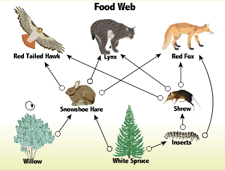
What may happen if the snowshoe hare was removed from the food web pictured?
a)
The insects in the habitat would increase.
b)
The shrew population would decrease due to being only hawk food source.
c)
The willow tree population would decrease.
d)
Foxes would dies due to no food source. 
16.
The rabbit in this food web would be considered a:
a)
Decomposer
b)
Producer
c)
Secondary Consumer
d)
Primary Consumer
17.
The fox in this food web would be considered a:
a)
Tertiary Consumer
b)
Producer
c)
Secondary Consumer
d)
Primary Consumer
18.
The mouse in this food web would be considered a:
a)
Primary Consumer
b)
Producer
c)
Tertiary Consumer
d)
Secondary Consumer
19.
An organism that gets energy from breaking down dead organisms, non-living material or waste
a)
producer
b)
consumer
c)
decomposer
d)
autotroph
20.
What is the name for the organism that eats the primary consumer?
a)
secondary consumer
b)
tertiary consumer
c)
producer
d)
decomposer
21.
Organisms that break down dead plants & animals and release nitrogen back into atmosphere...
a)
bacteria
b)
plants
c)
animals
d)
producers
22.
Photosynthesis
a)
absorbs CO2
b)
releases CO2
23.
Respiration
a)
absorbs CO2
b)
releases CO2
24.
Organisms use nitrogen to form
a)
carbohydrates and lipids
b)
proteins and lipids
c)
lipids and nucleic acids
d)
proteins and nucleic acids
25.

All of the interacting species within a particular ecosystem

a)

Population

b)

Biome

c)

Organism

d)

Community

26.

An organism that feeds on dead or decaying plant or animal remains

a)

Detritivore

b)

Decomposer

c)

Producer

d)

Consumer

27.
Mrs. Bush was driving and accidentally hit a squirrel. A vulture noticed this and swooped down to eat the dead squirrel. The vulture is an example of a _______. 
a)
producer
b)
scavenger
c)
parasite
d)
decomposer
28.
The role of an organism in its environment.
a)
habitat
b)
niche
c)
community
d)
species
29.

When the availability of food, water,space and shelter become less than what populations need, they are called..

a)

carrying capacity

b)

limiting factor

c)

exponential growth

d)

population density

30.

These animals are not picky about what they eat or where they live

a)

Keystone Species

b)

Specialists

c)

Endemic Species

d)

Generalists

31.

These animals have specific diet and climate requirements

a)

Extinct

b)

Generalists

c)

Specialists

d)

Endangered

32.

These animals might be in trouble if their habitat changes (choose all that apply)

a)

Generalists

b)

Endemic Species

c)

Keystone Species

d)

Indicator Species

e)

Specialists

33.

Which type of species is most affected by environmental changes?

a)

keystone

b)

indicator

c)

generalist

d)

r-selected

34.
What term describes the positive benefits that wildlife or ecosystems provides to people?
a)
ecosystem services
b)
ecosystem
c)
biodiversity
35.
Using resources in such a way that we continue living in a developed world, but at the same time we protect the environment. This is the definition of:
a)
Suspensability
b)
Ecology
c)
Sustainability
d)
Ecological precautions
36.

Define environmental science

a)

study of life

b)

study of ecosystems

c)

study of interactions

d)

study of matter

37.

Which of these is not an environmental service?

a)

supporting

b)

regulating

c)

cultural

d)

preservation

38.

Creation of land that cannot be used to grow crops

a)

deforestation

b)

desertification

c)

drought

39.

Which environmental service represents how resources are naturally controlled?

a)

supporting

b)

cultural

c)

regulating

d)

collecting

40.
Which has the least negative impact on wildlife habitat?
a)
agriculture
b)
development
c)
deforestation
d)
recreation
41.

Which ecosystem service includes using nature for its beauty, spirituality value, and recreation?

a)

cultural

b)

providing

c)

regulating

d)

supportying

42.

How are supporting and regulating services different?

a)

supporting makes other resources available

b)

regulating controls the production of resources

c)

supporting aides the production of resources

d)

supporting controls temperature

43.

What is biodiversity?

a)

All the same species living in one area

b)

the variability among organisms

c)

all the endangered species in one area

44.

Negative feedback loops try to maintain

a)

equilibrium

b)

chaos

c)

precession

d)

change

45.
What is the name for the organism that eats the primary consumer?
a)
secondary consumer
b)
tertiary consumer
c)
producer
d)
decomposer
46.

Plants get the nitrogen they need from...

a)

the atmosphere

b)

the soil

c)

nitrogen fixing bacteria

d)

parasitic relationships

47.
What cycles through the environment in the hydrologic cycle?
a)
Carbon
b)
Nitrogen
c)
Hydrogen and Oxygen
d)
Sunlight
48.
Organisms that feed on both living producers and other consumers.
a)
Carnivores
b)
Omnivores
c)
Herbivores
d)
Detritivores
49.
Some shrimp and crab live and capture food from within the tentacles of giant anemones. 
a)
Parasitism
b)
Commensalism
c)
Mutualism
50.
A pearlfish spends the day inside the alimentary tract, or intestines, of a sea cucumber. The fish emerges from the sea cucumber at night to feed on small crustaceans. The pearlfish gets a safe place to live. The sea cucumber does not gain anything from the relationship, nor is it harmed. 
a)
Mutualism
b)
Commensalism
c)
Parasitism
51.
A boxer crab carries a pair of small anemones in its chelipeds, or claws. When approached by a predator, the crab waves the stinging tentacles of the anemones to deter the predator. The anemones benefit from the small particles of food dropped by the crab during feeding. 
a)
Commensalism
b)
Mutualism
c)
Parasitism
52.
Corals feed off the byproducts of a microscopic algae living within their own tissue,called zooxanthellae. The photosynthetic activity of the algae is vital to the survival of the coral animals, which use the energy to extract calcium from the seawater and build their calcareous skeletons. The zooxanthellae are protected by the hard coral and obtain plant nutrients from the coral. 
a)
Mutualism
b)
Commensalism
c)
Parasitism
53.
A tapeworm needs to eat food that is already digested, so it lives in the intestines of a dogfish shark and derives nourishment from the shark. As a result of the tape worm infestation, the shark is weakened and more vulnerable to disease and predation. 
a)
Parasitism
b)
Commensalism
c)
Mutualism
54.

Aphids are tiny insects that live on and eat the leaves of plants, removing vital nutrients from the plants.

a)

Predation

b)

Parasitism

c)

Commensalism

d)

Mutualism

55.

Match the following

a)
1.

Parasitism

b)
2.

Commensalism

c)
3.

Mutualism

56.
Which is an example of intraspecific competition
a)
2 types of bacteria competing for food
b)
Big horn sheep competing for mates
c)
Trees in the rain forest competing for light
d)
Lions and leopards competing for food 
57.
A keystone species has...
a)
big impact on ecosystem, big population
b)
small impact on ecosystem, small population
c)
big impact on ecosystem, small population
d)
None of these
58.

Which of the following examples could be considered an “invasive species?”

a)

An oxpecker eats the bugs and parasites off a zebra.

b)

Clownfish live amid the tentacles of the anemones which protects them from predators.

c)

A hearty kudzu vine overtakes competing plants, leaving only itself.

d)

Mites will attach to wasps, flies or beetles for transportation.

59.

The place where an organism lives in order to obtain its food, water, shelter and other things needed for survival is called a ---

a)

Niche.

b)

Habitat.

c)

Home.

d)

Ecosystem.

60.

unique to a defined geographic location (not found anywhere else):

a)

biodiversity hotspot

b)

endemic organism

c)

endangered species

d)

threatened species

61.

Which type of species helps to maintain balance when conditions worsen?

a)

keystone

b)

indicator

c)

endemic

d)

invasive

62.

Which of these represents adaptations of prey only?

a)

spikes

b)

odor

c)

camouflage

d)

mimicry

e)

playing dead