
 Worksheets
AP Mid-Term Quizizz
Total questions: 98
Worksheet time: 58mins
If a place has great connections to other places, has dominant political, transportation, and economic structures, it is said to have a high degree of ________.
Location
Place
Landscape
Connectivity
Though few people have visited Antarctica , most have some sense, an image in their mind's eye, of what that continent is like. What is this called?
Sense of place
Perceptions of place
Movement
Human Environment Interaction
What are the physical and human features of a location?
perception
place
perspective
landscapes

The population pyramid shown is most likely which country?
Nigeria
China
Germany
Japan

The Population Pyramid shown is most likely which country?
Canada
Japan
Zimbabwea
Algeria
How many countries today are in Stage one of the Demographic transition model?
53 (some countries in Asia and Sub Saharan Africa)
22 (some countries in Asia and Sub Saharan Africa)
3 (Somalia, Bangladesh, and Afghanistan)
0
Which country is the best example of a country in stage 5 of the demographic transition model?
Japan
North Korea
China
Vietnam
What did Thomas Malthus believe?
The World population would be limited by the amount of food we can produce
The World population would be limited by total land resources
The World population would be limited by technological high marks
The World population would be limited by cultural appropriation
What is the #1 reason for migration?
Better Economic opportunity
Escaping violence
Reunion with family
desire to expand business networks
Which of the following is NOT a Pronatalist policy?
Free Birth Control
Free child care
Free College tuition
Free parenting classes
Which of the following BEST fits an example of Chain Migration?
John moves from London to New York and moves in with his best friend
Steve moves from California to Nevada and moves in with his girlfriend
Laura moves from China to Chicago and lives with her sister
Julie moves from China to New York and lives with four of her old high school friends
Which country has the highest Physiological density?
USA
Turkey
Argentina
Egypt
What is the amount of average children needed for a population to achieve ZPG?
2.1 per woman
1 per woman
3 per woman
2.5 per woman
Total # of deaths in a year for every 1,000 people alive in a society
Crude Death Rate
Crude Birth Rate
Doubling Time
Life Expectancy
When the people of an area exceed the capability of their environment to support them
Carrying Capacity
Armageddon
Climate Change
Overpopulation
% of population growth in a year, computed as CBR minus CDR
Dependency Ratio
Total Fertility Rate
Natural Increase Rate
Crude Birth Rate
Total # of deaths in a year of infants under 1 year of age for every 1,000 live births in a society
Crude Death Rate
Infant Mortality Rate
Crude Birth Date
Dependency Ratio
Average # of children a woman will have in her lifetime
Total Fertility Rate
Crude Birth Rate
Maternal Birth Rate
Ecumene
Bar graph that shows age and sex of population
population hexagon
population pyramid
population pentagon
population graph
Number of workers divided by the # of people 65+
Dependency Ratio
Elderly Support Ratio
Dependency Support Ratio
Old People Measure
Country that will surpass China's population
India
Japan
USA
Mexico
Events that can change population.
war
famine
natural disasters
all are correct
There is a preference for boys over girls in countries like China and India.
True
False
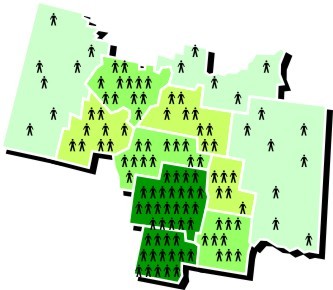
Modern-day geographers who hold the view that that a mass starvation event is inevitable would be labeled as...
MacCormackites
Proponents of Ester Boserup's Theory
Neo-Malthusians
Ravensteinians

On the Demographic Transition Model, which stage(s) is/are characterized by HIGH death rates, High BIRTH RATES, but LOW populations.
Stage 1
Stage 2
Stage 3
Stages 4 and 5

This country most likely is in which stage of the Demographic Transition Model?
stage 1
stage 2
stage 3
stage 5

When women in developing countries become educated...
The death rate increases
the country enters stage 5 of the Epidemiological Transition Model
the agricultural density increases
Fertility rates decrease
How do I find the arithmetic density of a country?
(Birth rate - Death rate) + Net migration rate
Birth Rate - Death Rate)
Total Population/Total land area
Total land area/Total population
Which DTM stage is NOT seen in the world today?
1
2
3
4
The study of population is
survivorship
demography
age structure
migration
land that can be used to grow crops
least-developed countries
demography
arable land
infrastructure
Between 1880 and 1930 human population doubled due to
the Industrial Revolution
a combination of high birth rates and lowered death rates.
improvements in societal infrastructure and services.
All of the above
Even if a country reduces its birth rate and maintains replacement-level fertility, its population will still continue to grow for several decades because of
lower death rates
increased income.
population momentum
better health care.
increased life expectancy.
Using the rule of 70, a population growing at 10% would double in
7 years
10 years
17 years
15 years
not enough information to tell
Physiological population density differs from arithmetic population density in that physiological density
examines only the population of cities, while arithmetic density includes the population of cities and rural areas
is a measure of how density is perceived, while arithmetic density is a measure of specific density
explains density in terms of people per arable square land unit, while arithmetic density explains density in terms of people per total square land unit
explains the density of a single housing unit while arithmetic density explains the density of a group of houses
is the number of people per housing unit, while arithmetic density is the number of people per square mile
Physiological population density is viewed as a superior measure of population density for which of the following reasons?
It is more reflective of population pressure on arable land.
It yields the average population density.
It is more reflective of the world’s largest population concentrations.
It measures the average by dividing total land area by total number of people.
It best reflects the percentage of a country’s population that is urbanized.

The world’s two most-populous countries are on which continent?
North America
Europe
Asia
South America
Africa
Today in the U.S., most interregional migration occurs...
from suburban to rural
from rural to urban
from suburban to urban
interregional migration is static
Identify the push factor.
Land values increase in Arizone due to a newly discovered source of copper
A drought causes massive crop failures in the western parts of India
North American universities offer scholarships to students in LDCs
More farmland is made available by the government
Cyclical migration applies to...
chain migrants
asylum seekers
guest workers
quota limits
Johann is planning to move to South Africa to pursue an opportunity to become a highly respected biology researcher. As he prepares to move, he learns that South Africa has cut off immigration from his home nation of Denmark. This would be an example of...
step migration
chain migration
intervening oppurtunity
intervening obstacle
refugee status
A civil war has broken out in the nation of Zambia. Many people have left their homes to avoid the fighting without actually leaving Zambia itself. These people are referred to as...
Refugees
Immigrants
Internally displaced persons
Emigrants
none of the above
The Atlantic Slave Trade is a clear example of which of the following?
internally displaced persons
forced migration
voluntary migration
step migration
chain migration
Keith really wanted to enjoy the sun. He moved from Boston to Virginia Beach, then to Orlando.
counter migration
step migration
gender patterns
short distances/distance-decay
Which of Ravenstien's Law's applies:
As Juan and his family moved from Puerto Rico to Florida, his cousins moved back to Puerto Rico.
step migration
counter migration
youth
rural to urban
Which of Ravenstien's Law's applies:
Ajani's family couldn't support themselves anymore selling their vegetables at the market and decided to move to Lagos, Nigeria's biggest city.
rural to urban
gender patterns
step migration
short distances/distance decay
Which of Ravenstien's Law's applies:
Susette went to UGA for college so she was only a few hours away from home.
step migration
rural to urban
counter migration
short distances/distance decay
Which of Ravenstien's Law's applies:
Angelica decided to move to Chicago after graduating college to be a mechanic.
gender patterns
rural to urban
short distances/distance decay
youth

_______ push and pull factors are the most common reason global migration patterns reflect movement from LDCs to MDCs.
Economic
Social
Political
Environmental


Due in part to its proximity to Latin America, most Mexicans Immigrants have settled in the southwestern major cities such as L.A. This is consistent with which of the following
Zelinsky's Model of Migration
Gravity Model of Migration
Sauer's Model of Migration
Malthus' Model of Migration

Most migrants to the US from 1890-1914 came from?
India and China
Southern and Eastern Europe
Spain and Portugal
japan and Korea
In the early 21st century, what continent are most refugees located on?
North America
Australia
Asia
Africa

