Wayground logo

Free Printable Worksheets

Font size

S
M
L
XL
Worksheets

Cellular Transport

Total questions: 34

Worksheet time: 28mins

Name
Class
Date
1.
Moving from areas of LOW concentration to areas of HIGH concentration is called?
a)
Passive Transport
b)
Active Transport
c)
Diffusion
d)
Osmosis
2.
If the question asks about Osmosis, I will look for an answer about?
a)
Particles
b)
Salt
c)
Sugar
d)
Water
3.
When moving particles AGAINST their concentration gradient, this is called?
a)
Passive Transport
b)
Osmosis
c)
Active Transport
d)
Facilitated Diffusion
4.
If the question asks about something being PUMPED, I will look for an answer about?
a)
Passive Transport
b)
Active Transport
c)
Facilitated Diffusion
d)
Osmosis
5.
My cells are in an Isotonic solution, and are in a constant internal environment.  What is this called?
a)
Homeostasis
b)
Respiration
c)
Evolution
d)
Diffusion
6.
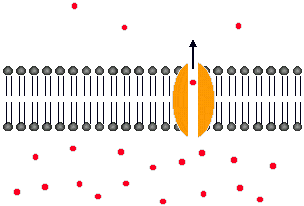
A solute traveling DOWN its concentration gradient using a protein channel does this by ________ diffusion.
a)
Facilitated
b)
Active
c)
Osmosis
d)
Endocytosis
7.
Which way is the water moving in this cell?
a)
The water level will increase on the right side
b)
The water level will increase on the left side
c)
The water level on both sides will increase
d)
The water level on both sides will decrease
8.
What is the diffusion of water through a selectively permeable membrane?
a)
active transport
b)
osmotic pressure
c)
facilitated diffusion
d)
osmosis
9.
The current model of the plasma membrane is called the
a)
hydrophobic layer
b)
transport bilayer
c)
phosphoproteins
d)
fluid mosaic model
10.
What is the function of cholesterol materials in the cell membrane?
a)
make the membrane thicker
b)
make the membrane more porous
c)
connect the proteins together
d)
make the membrane more stable
11.
Placing a cell in an isotonic solution causes the cell to
a)
shrink
b)
swell
c)
stay the same
12.
Placing a cell containing 10% salt  into a solution containing 15% salt will cause the cell to
a)
shrink
b)
 swell
c)
stay the same
13.
Placing a cell containing 10% salt into a solution containing 7% salt will cause the cell to 
a)
shrink
b)
swell
c)
stay the same
14.

What type of transport is pictured here?

a)

exocytosis

b)

endocytosis

c)

facilitated diffusion

d)

diffusion

15.

What type of transport is pictured here?

a)

endocytosis

b)

exocytosis

c)

facilitated diffusion

d)

osmosis

16.

What are the two main macromolecules in a cell membrane?

a)

carbohydrates & lipids

b)

lipids & proteins

c)

proteins & carbohydrates

d)

nucleic acids & lipids

17.

What is the polarity of the different parts of the cell membrane?

a)

the heads are nonpolar; the tails are polar

b)

the heads are polar; the tails are nonpolar

c)

the heads and tails are nonpolar

d)

the heads and tails are polar

18.

Why is the cell membrane selectively permeable?

a)

large, polar molecules can pass easily

b)

small, nonpolar molecules pass easily

c)

there is a doorman that lets molecules cross

d)

only water can cross the cell membrane

19.

What gas can easily move through the cell membrane?

a)

CO2

b)

NO2

c)

CO

d)

NaCHO

20.

Give three examples of passive transport.

a)

diffusion, osmosis, phagocytosis

b)

facilitated diffusion, molecular pumps, osmosis

c)

osmosis, facilitated diffusion, diffusion

d)

exocytosis, molecular pumps, pinocytosis

21.

High concentration of water.

a)

hypertonic

b)

isotonic

c)

hypotonic

22.
What organelle makes the energy needed to perform active transport?
a)
chloroplast
b)
mitochondria
c)
Active transport does not require energy
d)
nucleus
23.
Movement of particles through the cell membrane from high to low concentrations
a)
diffusion
b)
photosynthesis
c)
mitochondria
d)
active transport
24.
Against the concentration gradient
low to high uses energy/ATP
a)
facilitated diffusion
b)
osmosis
c)
active transport
d)
diffusion
25.
Particles are too large to enter the membrane.
Need help from channel proteins. No energy required.
a)
active transport
b)
passive transport
c)
facilitated diffusion
d)
osmosis
26.
Particles move from high concentrations to low concentrations.
Doesn't need energy
a)
passive transport
b)
facilitated transport
c)
active transport
d)
exocytosis
27.
Osmosis is the movement of 
a)
water from low to high concentration
b)
particles from low to high concentration
c)
water from high to low concentration
d)
particles from high to low concentration
28.
What is another term for "selectively permeable"?
a)
porous
b)
completely permeable
c)
permanent
d)
semipermeable
29.
The function of the plasma membrane is....
a)
to regulate what enters and leaves the cell.
b)
fight bacteria and viruses that enter the cell.
c)
provide rigid support and protection to the cell.
d)
make sure each cell can move
30.
The cell below is in a _________ solution.
a)
Hypotonic
b)
Hypertonic
c)
Isotonic
31.
In the picture to the right, which area(s) represent(s) the hydrophobic part of the phospholipid membrane?
a)
Structure A
b)
Structure B
c)
Structures A & B
d)
Neither structure A or B
32.
Examine the diagram below. The process illustrated by the neurotransmitter leaving the sending neuron is called
a)
endocytosis
b)
exocytosis
c)
passive transport
d)
active transport
33.

Movement of oxygen and carbon dioxide across the plasma membrane with the concentration gradient would be and example of ________

a)

Endocytosis

b)

Exocytosis

c)

facilitated diffusion

d)

simple diffusion

34.
what type of solution causes the blood cells to swell and burst.
a)
hypotonic solution
b)
hypertonic solution
c)
isotonic solution
d)
active transport