wayground logo

Free Printable Worksheets

Font size

S
M
L
XL
Worksheets

1st Nine Weeks Biology Review

Total questions: 51

Worksheet time: 49mins

Name
Class
Date
1.

What is a function of carbohydrates?

a)

To provide energy to living organisms

b)

The provide the structure in muscles

c)

Providing insulation

d)

Storing your genetic information

2.

What biomolecules are NOT used for energy (two answers, choose both before continuing)?

a)

Carbohydrates

b)

Lipids

c)

Proteins

d)

Nucleic acids

3.

What is the best definition of the function of nucleic acids?

a)

They contain defense mechanisms against bacteria

b)

They contain the information that makes you and makes you different from every other living thing

c)

They are used as the structural components of the body (muscles and organs)

d)

They create the cell membrane

4.

Which of the following is a characteristic of protein?

a)

Made up of amino acids and regulate cellular processes

b)

Fats, oils, and waxes

c)

Complex carbohydrates known as starches

d)

DNA and RNA

5.

Which biomolecule makes up cell membranes?

a)

Protein

b)

Carbohydrate

c)

Lipid

d)

Nucleic acid

6.
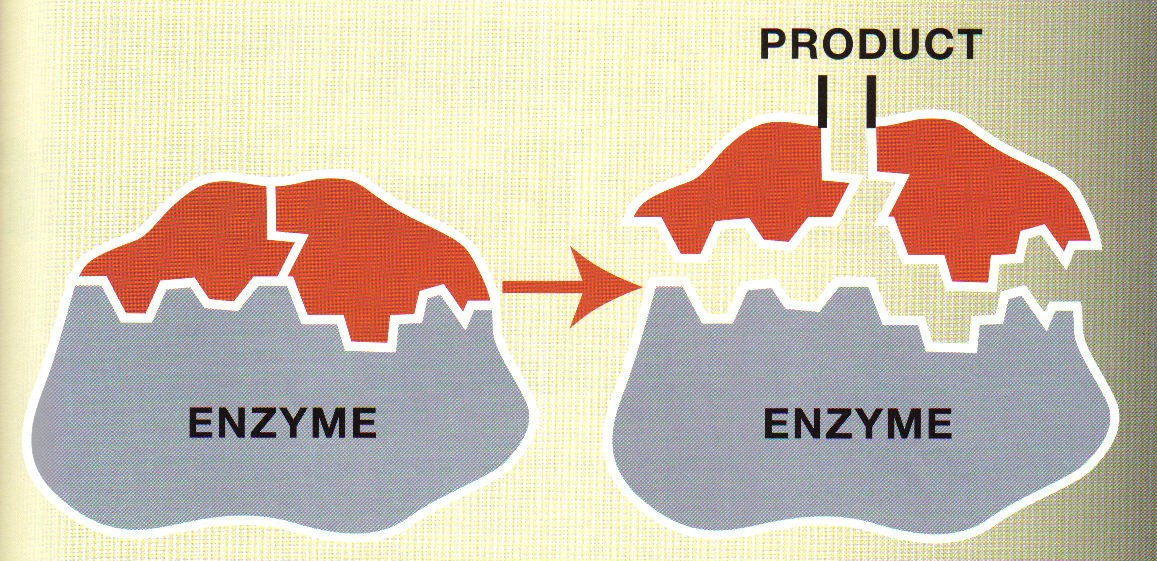
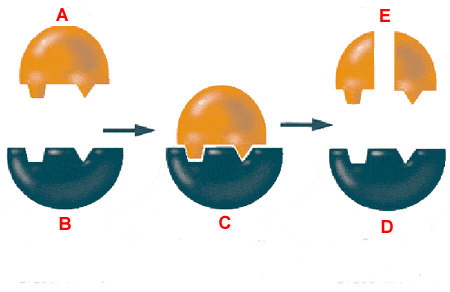
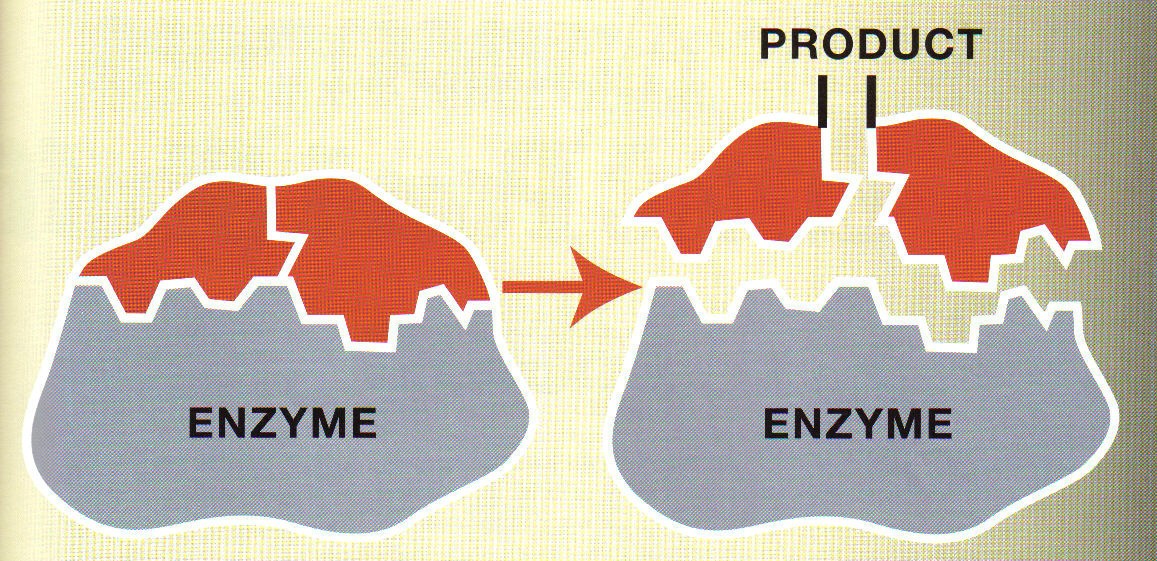
The area that the substrate fits into on the enzyme is called the:
a)
Active Site
b)
Allosteric Site
c)
DiSulphide Bridge
d)
β-Pleated Sheet
7.
Enzymes catalyze reactions by ___________ Activation Energy.
a)
Increasing
b)
Decreasing
8.
Enzymes speed up reaction rates by changing:
a)
Activation Energy
b)
pH
c)
Hydrogen Bonds
d)
Kinetic Energy
9.
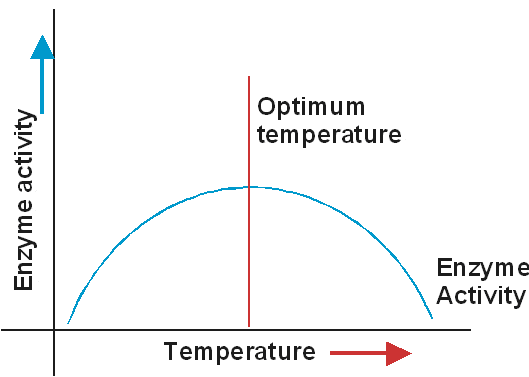
At high temperatures enzyme activity declines because of:
a)
Denaturation
b)
Decreased Kinetic Motion
c)
Increased H-Bonding
d)
Dissociation of Ionic Compounds
10.
Which of the following conclusions can be drawn from this graph?
a)
The optimum pH of the enzyme is 6.6.
b)
The optimum pH of the enzyme is 5.8
c)
The enzyme’s activity increases as pH increases 5.0 to 9.0
d)
The enzyme’s activity is greater around pH of 8.0 .
11.
The graph shows how enzymes affect reactions in cells. Which statement best summarizes the information shown in the graph?
a)
Enzymes increase the energy of the reactants.
b)
Enzymes decrease the energy level of the products.
c)
Enzyme decrease the activation energy of the reaction.
d)
Enzymes reverse the direction of the reaction.
12.
Which of these is most likely an enzyme?  (Based on the suffix)
a)
Sucrose
b)
Saccharide
c)
Fructose
d)
Amylase
13.
What factors affect an enzyme's reaction rate?
a)
temperature 
b)
pH
c)
substrate concentration
d)
all of these
14.

single celled organism that lacks a nucleus

a)

bacteria

b)

cell wall

c)

flagellum

d)

endospore

15.

a long, whip-like structure that helps a cell to move.

a)

pasteurization

b)

bacteria

c)

flagellum

d)

endospore

16.
The outer covering of a bacteria cell is called the
a)
flagella
b)
cytoplasm
c)
cell wall 
17.
Bacteria are only found in dirty places
a)
True
b)
False
18.

Are larger in size

a)

Viruses

b)

Bacteria

c)

Both viruses and bacteria

19.

Contain a caspid containing DNA or RNA

a)

Viruses

b)

Bacteria

c)

Both viruses and bacteria

20.

A vaccine makes people immune to a disease by causing their bodies to make

a)

bacteria

b)

virus-fighting antibodies

c)

antibiotics

d)

more protective cells

21.

Bacteria reproduce when each cell divides into

a)

two identical cells

b)

two different cells

c)

five identical cells

d)

five different cells

22.

A virus becomes active when it...

a)

is in the open air

b)

enters water

c)

enters a living cell

d)

wakes up in the morning

23.

Which type of cell is this?

a)

Prokaryote

b)

Eukaryote

24.
What type of cell has a nucleus? 
a)
eukaryotic
b)
prokaryotic 
25.
Which is true of prokaryotic and eukaryotic cells?
a)
Prokaryotic cells are larger than eukaryotic cells.
b)
Eukaryotic cells do not have nuclei, and prokaryotic cells do have nuclei.
c)
Prokaryotic cells lack membrane-bound organelles, and eukaryotic cells contain membrane-bound organelles.
d)
Eukaryotic cells are simpler than prokaryotic cells.
26.
This is a picture of:
a)
Prokaryote
b)
Eukaryote
27.
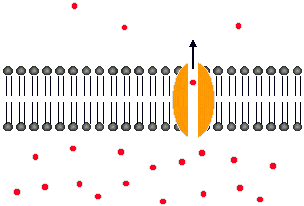
Moving from areas of LOW concentration to areas of HIGH concentration is called?
a)
Passive Transport
b)
Active Transport
c)
Diffusion
d)
Osmosis
28.
My cells are Shriveled!    What state are my cells in?
a)
Hypertonic
b)
Hypotonic
c)
Isotonic
d)
Diffusion 
29.
When moving particles AGAINST their concentration gradient, this is called?
a)
Passive Transport
b)
Osmosis
c)
Active Transport
d)
Facilitated Diffusion
30.
If the question asks about Osmosis, I will look for an answer about?
a)
Particles
b)
Salt
c)
Sugar
d)
Water
31.
Allows certain molecules or ions to pass through it by diffusion and doesn't allow others.
a)
protein
b)
semi-permeable membrane
c)
isotonic
d)
homeostasis
32.
Particles are too large to enter the membrane.
Need help from channel proteins. No energy required.
a)
active transport
b)
passive transport
c)
facilitated diffusion
d)
osmosis
33.
Engulfs large molecules and moves them inside the membrane.
Uses energy.
a)
exocytosis
b)
endocytosis
c)
protein channel 
d)
diffusion
34.
____ is the molecule that provides energy for active transport.
a)
DNA
b)
ADP
c)
ATP
d)
RNA
35.
Equal concentration of water. 
cell will stay the same
a)
hypotonic
b)
hypertonic
c)
isotonic
36.
Low concentration of water.
Cell will shrink
a)
hypotonic
b)
hypertonic
c)
isotonic
37.
On the diagram below, indicating the direction of osmosis (water)
a)
Into the cell
b)
Outside the cell
c)
Remain the same inside and outside the cell
d)
Remain the same outside, but not inside
38.
Sac within the cytoplasm that is full of fluid; plants have one large; stores food, water, etc.
a)
vacuole
b)
cell wall
c)
lysosome
d)
ribosome
39.
Consists of a jellylike substance that contains many organelles.
a)
ribosomes
b)
cytoplasm
c)
chloroplasts
d)
cell wall
40.
I make proteins for the cell. What am I?
a)
ribosome
b)
mitochondria
c)
chloroplast
d)
lysosome
41.
I store water in both plant and animal cells. What am I?
a)
cytoplasm
b)
ribosomes
c)
vacuole
d)
lysosomes
42.
Which part of the cell is often called "the brain of the cell"?
a)
nuclear membrane
b)
endoplasmic reticulum
c)
nucleus
d)
ribosomes
43.
What is the name of the structure shown in the diagram where cellular respiration takes place?
a)
Chloroplast
b)
Mitochondrion
c)
Nucleus
d)
Vacuole
44.
What is the name of the genetic material that is inside the nucleus?
a)
ER
b)
ATP
c)
YOLO
d)
DNA
45.

Which type of mutation occurs when there is an addition or removal of a base?

a)

missense mutation

b)

nonsense mutation

c)

frameshift mutation

d)

point mutation

46.

What type of mutation is shown in the diagram?

a)

Point mutation - missense

b)

Frameshift Mutation - deletion

c)

Frameshift Mutation - addition

d)

Point mutation - nonsense

47.

Occurs when the DNA change does not alter the amino acid sequence of the polypeptide.

a)

Frameshift Mutation

b)

Insertion

c)

Missense mutation

d)

Silent Mutation

48.

TRUE or FALSE. The removal of one base to the DNA sequence might lead to a change on the succeeding (next) codon.

a)

True

b)

False

49.
Which of the following would result in a frameshift mutation?
a)
Insertions only
b)
Substitution only
c)
Deletion only
d)
Insertions and Deletions
50.
When there is one less base on the mRNA strand than the DNA strand it is a _________ mutation
a)
missense
b)
nonsense
c)
deletion
d)
insertion
51.
What do we call DNA replication since new DNA has 1 parent strand and 1 new strand?
a)
Conservative 
b)
Semiconservative 
c)
Dispersive