
 Worksheets
End of 1st Six Weeks Test Economics 2020-2021
Total questions: 52
Worksheet time: 49mins
The opportunity cost of a good is
its price in dollars and cents.
the best alternative given up
the price of alternative goods foregone.
none of the other options
If an economy is producing at a point inside its production possibility curve, then
consumption is greater than production.
productive resources are not used to their full potential.
production of capital goods is inadequate.
it cannot benefit by specialisation and trade.
When "wants are greater than the resources available to satisfy them," it is called...
Scarcity
Needs
Opportunity Cost
None of these answers
Which one of the following is an opportunity cost?
You stay out late and your parents ground you.
You run a red light and you get a ticket.
You choose to give up math to study for history.
In a softball game, you miss the ball and strike out.
Tom was shopping for a car. He has looked at a Ford, Honda, Toyota, and Dodge. After a lot of debate, he narrowed it down to either the Ford or the Honda. He selected the Ford, because he liked the interior a little better. What was his opportunity cost?
Ford
Honda
Toyota
Dodge
What is the definition of opportunity cost?
The chance that you will lose your money.
The money you spend to buy something.
All of the choices you could have made but didn't
The next best alternative that you give up

A capital resource is:
Gifts of nature
A person who risks their own time and money to start a business
Money that is left over after paying operating costs
Man made things that help make a good or service
What is an Entrepreneur?
A person who risks their own time and money to start a business by putting land, labor, and capital together.
The money a business makes from selling their goods and services
Revenue
Profit
When people can't have everything they want due to limited resources, this is:
Scarcity
Entrepreneur
Profit
Consumer
An implicit opportunity cost of attending college is:
tuition
books
living expenses
income from forgone employment
living expenses
The basic economic problem of all economies is essentially one of deciding how to make the best use of
A: unlimited resources to satisfy unlimited wants
B: limited resources to satisfy unlimited wants
C: unlimited resources to satisfy limited wants
D: limited resources to satisfy limited wants
E: limited resources to provide public goods
The study of the decisions of individual units in the economy is known as
macroeconomics
ceteris paribus study
microeconomics
the study of incentives
the study of captial
The branch of economics that deals with the analysis of the whole economy is called
macroeconomics
ceteris paribus study
microeconomics
the study of incentives
marginal analysis

What is Capitalism?
An economic system where the government controls business
An economic system where the means of production are privately owned and operated for profit!
An economic system in which the people have limited rights
An economic system in which most property and resources, such as factories or farms, are publicly owned or controlled.
The government or groups of workers might control resources but the profits are divided among the people.
Capitalism
Communism
Socialism
Mixed Economy
The United States is an example of what economic systems?
Capitalism
Socialism
Traditional
Communism
One justification for government regulation of a monopoly is that the unregulated monopoly...
charges a price higher than a competitive market price.
earns a normal profit
sells too much of the product.has an elastic demand curve
has an elastic demand curve
In which market structure do many producers sell products that are identical to one another?
monopoly
monopolistic competition
pure competition
oligopoly
Using your knowledge of the Greek prefix mono-, explain what the following statement means:
There is currently a monopoly in the widget industry.
Many companies are competing in the production of widgets.
Only one company now controls production of widgets.
Sales of widgets are currently skyrocketing.
Sales of widgets globally are plummeting.
A company wants to make sedans, sports cars, and vans in its factory, but does not have the capability to produce all three types of vehicles. What is the trade-off called if the company makes only sports cars?
A. monopoly
B. slowdown
C. opportunity cost
D. capital resource
monopoly
slowdown
opportunity cost
capital resource
Which scenario is an example of a monopoly?
A local water company is the sole provider of water for a small town.
A farmer produces green beans for sale at a farmers’ market.
A small number of cereal companies produce most of the cereal on the market.
A dry cleaner specializes in environmentally friendly cleaning methods.
Use the list below to answer the question.
• The market is dominated by a few large firms.
• Companies sell identical goods.
• Producers face high barriers to enter the industry.
Which type of market structure is described by this list?
monopoly
pure competition
monopolistic competition
oligopoly
Which set of characteristics describes an oligopoly market?
• many sellers
• no barriers to entry
• identical products
• many sellers
• few barriers to entry
• differentiated products
• few sellers
• many barriers to entry
• similar products
• one seller
• impossible to enter the industry
• unique product

Use the news headline to answer the question.
What does the author of the editorial most likely believe about the airline merger?
It will increase hiring by businesses.
It will reduce taxes paid by businesses.
It will provide more choices to consumers.
It will decrease services offered to consumers.
Which of the following best completes this list?
Major Factors That Influence a Market Economy
• Capital
• Unrestricted trade
• ______________
Contract law
Interest rates
Labor unions
Competition
Use the table below to answer the question.
Average Unit Price of Desktop and Notebook Computers
Year Desktop Notebooks
1992 $2550 $3700
1996 $2400 $3100
2000 $1550 $2300
2004 $1250 $1600
Which development resulted in the trend illustrated in this table?
Implementation of technology enabled more effective safety regulations.
Increased competition encouraged innovation and price reductions.
Innovations in production contributed to a reduced demand for skilled labor.
Government contracts promoted higher levels of production and consumption.
Sam Walton founded Wal-Mart in 1962. He bought large quantities of goods and sold them at discounted prices with a focus on customer service. Walton opened stores all over the world.
What was one effect of this business model?
Imported goods increased in quality and price.
Federal agencies implemented antitrust legislation.
Individual retailers had difficulty competing.
Governments increased control of trade and industry.
These characteristics describe a market that is guided by
• Means of production are privately owned
• Quality and product availability are high
• Prices on merchandise are low
a strict set of regulatory laws
the practice of free competition
a scarcity of natural resources
the demands of organized labor
Which factor most contributed to improved cell phone technology in recent years?
government regulations
competition among companies
increase in stock offerings
abundant natural resources
Over the last few decades, television programming in the United States has become available through a number of services such as cable, satellite, and the Internet. How does this trend demonstrate an effect of the free enterprise system?
Higher capital costs have resulted in more investment opportunities.
Increased government regulation has led to higher prices.
Increased market competition has resulted in more choices for consumers.
Stronger copyright laws have limited access to new shows.
Joe was shopping for a truck. He has looked at similarly priced Ford, Chevrolet, Toyota, and Ram models. After a lot of thought, he narrowed it down to either the Ford or the Chevrolet. He selected the Ford because he liked the interior a little better.
What was his opportunity
cost?
Ford
Chevrolet
Toyota
Ram
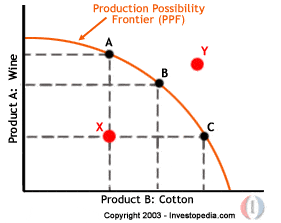
What is the production possibilities curve?
a graph that shows how much an economy can produce between 2 goods
how much money something is
entrepreneurship
land, labor, and capital
If a point lies on the curve this means the company is being efficient. If a point lies inside the curve, this tells the company what?
They are being over efficient
They are not efficient
It is impossible
None of the above

The opportunity cost of shifting production from "Point E" to "Point C" would be:
30 cans of cola
30 chocolate bars
70 cans of soda
20 chocolate bars

