
 Worksheets
CRM 1.4: Human Populations Review
Total questions: 19
Worksheet time: 14mins
When the environment has reached its human carrying capacity, which of the following
conclusions can be made?
Growth and immigration rate is equal to death and emigration rate.
Growth and immigration rate is less than death and emigration rate.
Growth and immigration rate is greater than death and emigration rate.
Growth and immigration rate is exponential to death and emigration rate.
What does the term carrying capacity describe?
The maximum number of birth rates for a population.
The ability of a population to accept new immigrants.
The ratio of birth rates to death rates in a population.
The population size that the environment can sustain.
If a population grows larger than its environmental carrying capacity, then
death rate may rise.
death rate may fall significantly.
birth rate may rise significantly.
immigration rate may increase.

Which correctly describes the term demographic transition?
The transition from low birth rates and death rates to high birth rates and death rates as a country develops.
The transition from high birth rates and death rates to low birth rates and death rates as a country develops.
The transition from high birth rates to low death rates as a country develops.
The transition from low birth rates to high death rates as a country develops.
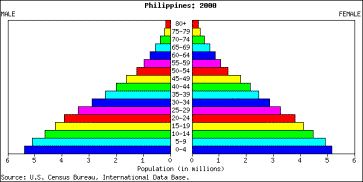

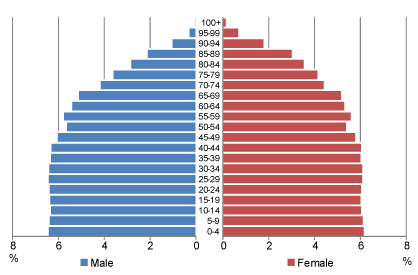
Which of the following is true of human demographic trends?
In preindustrial societies, birth rates are low and the population grows rapidly.
When the average number of children born to each woman falls, the total population always increases.
When birth rates and death rates are both high, the population grows slowly, if at all.
Death rates rise in the third stage of the demographic transition.

Using Figure 5–6, describe the type of growth Mexico is experiencing.
Mexico is experiencing a rapid growth rate because there are more children than adults.
Mexico is experiencing no growth because people are living longer.
Mexico is experiencing slowed growth because there are fewer adults.
Mexico is experiencing a rapid decline because there are more children than adults.

How can population growth lead to more pollution?
Too many people breathing causes too much carbon dioxide to enter the atmosphere
The body heat generated by billions of people leads to an increase in global warming
More people being born means more paper is needed to print birth certificates
All people produce waste, so more people equals more waste
Human activities and natural events can have a large effect on populations, biodiversity and ecosystem processes. How does the growth of the human population into rural areas affect the
environmental quality of the native ecosystem?
Human population growth produces new resources that benefit the native ecosystems.
Human population growth in rural areas help organisms evolve in order to survive in
harsher urban environments.
Human population growth in rural areas creates additional waste that is put back into the
environment and lowers environmental quality.
Human population growth in rural areas creates additional living areas for humans to
populate, which would increase the value of the land.

Based on the demographic transition model above, what stage of development would a country
be in that is experiencing a stable increase?
Stage 1
Stage 2
Stage 3
Stage 4

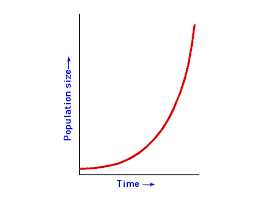
The graph below shows changes in human population numbers over time.
Which of the following statements would predict a consequence of these changes?
An increase in biosphere stability.
A decrease in the availability of natural resources.
An increase in the numbers and kinds of organisms worldwide.
A decrease in deforestation due to technological improvements.
Many factory farms dump animal waste products into neighboring streams, rivers and lakes.
How might this affect the health of the people living in these areas?
The water will clean the waste products, therefore it does not affect them.
The smell from the waste products deter people from living in the surrounding area.
The farmers clean the waste products before it is put into the environment, therefore it will
not affect them.
The waste products enter the drinking water and other parts of the environment, which
could cause people in the surrounding areas to become sick.
The United States depends on its forests in many ways. Forests provide environmental, social
and economic benefits to many people around the globe. They help filter drinking water, provide timber for building homes, habitats for a diverse array of plants and animals, supply oxygen, moderate temperatures and store atmospheric carbon. The health of a forest plays a role in maintaining human health. Which of the following statements supports the idea that human health benefits from a healthy forest?
Forests provide timber for building homes.
Forests provide habitats for plants and animals.
Forests add oxygen to the atmosphere through decomposition.
Forests filter carbon dioxide and oxygen through photosynthesis to allow for clean air to breathe.
The United States depends on its forests in many ways. Forests provide environmental, social
and economic benefits to many people around the globe. They help filter drinking water, provide timber for building homes, habitats for a diverse array of plants and animals, supply oxygen, moderate temperatures and store atmospheric carbon. The health of a forest plays a role in maintaining human health. Which of the following statements supports the idea that human health benefits from a healthy forest?
Forests provide timber for building homes.
Forests provide habitats for plants and animals.
Forests add oxygen to the atmosphere through decomposition.
Forests filter carbon dioxide and oxygen through photosynthesis to allow for clean air to breathe.

