
 Worksheets
Moon and Sun Structure Quiz
Total questions: 50
Worksheet time: 47mins
The dark spots on the moon are called...
Highlands
Marias
Anorthosite Canyons
Craters
What characteristics do the moon and earth NOT share?
craters
oceans
rocks
mountains
The moon does not create its own __________, but reflects the light of the ___________.
phase, sun
light, sun
sun, phase
sun, light
____________are areas of gas on the sun that are cooler than the gas around them.
Solar Wind
Solar Flares
Sunspots
Core

What is the moon mostly made of?
Green Cheese
Hot gases
Lava
Rock
A satellite is defined as something that orbits a planet. How many NATURAL satellite(s) does Earth have?
Five
Sixteen
One
Three
Why do the craters and Maria that are on the moon still look the same?
No one has ever been to the moon to disturb them
There is no atmosphere or weather on the moon
The temperature is too cold to change them
There is so much gravity on the moon that pulls them
The Sun produces energy by fusing hydrogen atoms into helium atoms in the _____.
Radiative Zone
Convective Zone
Core
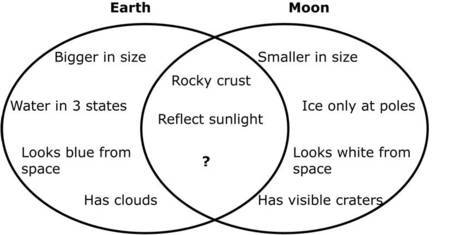
Which of the following characteristics could be placed in the center part of the diagram?


Which of these people was the first to set foot on the Moon?
Neil Armstrong
Jim Lovell
Luke Skywalker
Orville Wright
Which phenomenon does the Moon affect on Earth?
The seasons
Tree growth
Mountain erosion
The tides
During which phase of the Moon can we sometimes have solar eclipse?
New moon
Full moon
First quarter
Last quarter


Ancient solidified lava channels on the Moon's surface are called ___.
maria
canals
rilles
scarps

What was discovered about the far-side of the Moon when it was first mapped in 1959?
it was even more heavily cratered with no major maria
pyramids were first seen
the far-side was about the same as the near-side
there were very few mountains

What is meant by the Moon having a "synchronous orbit?"
its orbit matches that of Earth going around the Sun
both the Earth & Moon orbit each other
daylight hours are the same on both the Earth & Moon
the Moon's spin is equal to its revolution around the Earth


Scientists use models of the Sun to better understand how it works. The currently accepted model of the Sun indicates that it has a dense core surrounded by different layers. How is energy transferred from the core of the Sun to its outer layers?
Energy radiates outward from the core as visible light.
Energy is carried inward from the outer layers by convection.
Energy is radiated out from the core first, then carried to the outer layers by convection.
Energy is carried out from the core by convection first, then radiated to the outer layers.
Patrick wants to create a computer model of the Sun's rotation. Which of the following designs would be the most accurate?
He should show the Sun rotating at the same rate as Earth.
He should show the Sun rotating more rapidly at its equator than at its poles.
He should show the Sun rotating and revolving in exactly the same period of time.
He should show the interior and exterior of the Sun rotating at the same rate of speed.
Which statement describes sunspots?
Sunspots have a bright white appearance.
Sunspots occur in the radiation zone of the Sun.
Sunspots occur in areas of extremely low magnetic fields.
Sunspots have lower temperatures than their surroundings.
Scientists have modeled the behavior of the Sun for many years. Some models show how the Sun's magnetic field gets tangled up as the Sun rotates. These tangled magnetic fields can lift extra energy to the surface in an explosive event that releases solar material into space. Which solar event is explained by this model?
auroras
flares
prominences
sunspots
Although scientists are unable to explore the Sun’s layers directly with instruments, they can measure the change in the speeds of the surface layers and the temperature of those layers from Earth. Using this data, scientists have created models of the Sun and we now know that the sunspots that form on the surface are the areas of coolest temperature for this star. At the sunspots, temperatures are merely 3700 Kelvin (K). What does this indirect information about the Sun confirm?
The Sun has a structure similar to Earth's structure.
Storms form on the surface of the Sun, similar to the atmosphere of Earth.
The Sun's photosphere has properties of a solid, similar to the crust of Earth.
Convection occurs in parts of the Sun, similar to convection in the mantle of Earth.
An astronomer sets up her telescope to photograph the Sun during a total solar eclipse. This type of eclipse occurs when the Moon passes between the Sun and Earth. Which layer of the Sun can be viewed during a total solar eclipse?
convection zone
core
corona
sunspots
The level of activity on the Sun, measured by counting sunspots, increases and decreases over a(n) ________ cycle.
11 year
11 month
10 year
100 year

