
 Worksheets
Water Cycle and Nutrients
Total questions: 50
Worksheet time: 36mins
What cycle moves water around the environment?
Aquifer Cycle
Hydrologic Cycle
Nutrient Cycle
Lithospheric Cycle
Which cycle moves molecular matter around the environment?
Aquifer cycle
Hydrologic cycle
Nutrient cycle
Lithospheric cycle
Hail, sleet, and snow are all examples of:
Evaporation
Condensation
Transpiration
Precipitation
Which sphere is involved in the hydrologic cycle?
Atmosphere
Hydrosphere
Lithosphere
None of the above
Where does the majority of evaporation on the planet occur?
Over large continents
At the poles over the ice
At the equator over the ocean
At the equator over land
Evaporation changes water from a:
liquid to a gas
liquid to a solid
gas to a solid
gas to a liquid
Condensation changes water from a:
Liquid to a gas
Liquid to a solid
Gas to a solid
Gas to a liquid
What will happen if humidity levels are low?
Evaporation rates will increase.
Evaporation rates will decrease.
What will happen to the ocean over thousands of years?
It will become saltier.
It will become less salty.
It will not change in saltiness.
All of the above.
Clouds are a direct result of:
Evaporation
Condensation
Transpiration
Precipitation
Surfaces covered with asphalt or having steep gradients (like large hills) will result in:
Infiltration when it rains
Runoff when it rains
Condensation when it rains
Transpiration when it rains
Every aquifer has one thing in common:
They are all covered by a layer of impermeable rock.
They are all on top of a layer of impermeable rock.
They are all between layers of impermeable rock.
All of the above.
Whether it's over the course of a week or millions of years, all water eventually returns to
icebergs
an aquifer
the ocean
a lake
As water moves through underground rock and soil, it will most likely:
Get contaminated
Get cleaned
Stay the same quality
Which region of Georgia relies the most on groundwater for their drinking water?
Coastal Plain (Valdosta)
Piedmont (Athens)
Blue Ridge (Gainesville)
Valley and Ridge (Rome)
What will you see if you dig a hole down to the water table?
A table
Bedrock
Magma
Water
Where does Atlanta get most of its drinking water from?
Underground
Rainfall collectors
Pipes from the Gulf of Mexico
Chattahoochee River
Where do plants lose most of their water through transpiration?
Roots
Leaves
Stems
Flowers
What process do leaves require water for?
Photosynthesis
Respiration
Fermentation
Dialysis
Which nutrient is required to build every organic macromolecule used by living organisms?
Phosphorus
Carbon
Nitrogen
Oxygen
Where is nitrogen most commonly found in the environment?
Atmosphere
Hydrosphere
Lithosphere
All of the above
Which natural phenomenon can play a role in the nitrogen cycle?
Volcanoes
Lightning
Earthquakes
Tornadoes
Where do animals get the nitrogen they need?
From breathing
From eating
From drinking
From sleeping
Why is ATP important for life?
It is used as energy by cells.
It carries genetic information.
It fights infections.
It reproduces cells.
What important role do decomposers play in the carbon cycle?
They return CO2 to the air after breaking down animal waste.
They provide glucose for animals to eat after breaking down dead organisms.
They change CO2 into CH4 (methane).
All of the above.
What does burning fossil fuels add to the atmosphere?
Excess nitrogen
Excess oxygen
Excess carbon
Excess phosphorus
What percentage of the atmosphere is CO2?
80%
20%
10%
Less than 1%
What role does precipitation play in the phosphorus cycle?
It weathers rocks, releasing phosphate minerals.
It brings phosphorus from the atmosphere to the lithosphere.
It removes phosphorus from the cycle.
All of the above.
Where does most of the photosynthesis on the planet occur?
Rainforests
Deserts
Oceans
Atmosphere
Which process requires sunlight?
Photosynthesis
Respiration
Both A and B
Why do animals require oxygen?
To use as energy
To metabolize their food and make ATP
To transfer genetic material
To absorb sunlight and make CO2
Phosphorus is an important part of:
Sugar
DNA
Protein
All of the above
What is the best explanation for how carbon ends up at the bottom of the ocean?
There are more living things at the bottom of the ocean than at the top.
When living organisms die in the ocean, they fall to the bottom.
There are earthquakes and fissures producing carbon at the bottom.
Water with carbon dioxide in it is heavier, so it sinks.
Which cycle is most dependent on weather?
Hydrologic
Carbon
Nitrogen
Phosphorus
What is the term used when nutrients are converted into forms that most plants and animals can use?
bacteria
biogeochemical cycle
fixation
disruption
Nitrogen fixation is primarily carried out by
Humans
Plants
Bacteria
Animals get most of the nitrogen they need
from the process of denitrification
by consuming plants or other animals
directly from bacteria in the soil
The movements of energy and nutrients through living systems are different because:
Energy forms chemical compounds, and nutrients are lost as heat.
Energy flows in one direction, and nutrients recycle.
Nutrients flow in one direction, and energy recycles.
If a lake receives a large input of a limiting nutrient, which of these would happen first?
Algae begin to die and decomposers take over.
An algal bloom occurs.
The concentration of oxygen drops below the necessary level.
Why can't producers in some ecosystems create an unlimited supply of organic material?
One or more nutrients are in short supply.
The energy needed to create organic material is lost as heat.
The temperatures are too hot for photosynthesis.
Which of the following is true about phosphorus?
Phosphorus is found primarily in the atmosphere.
Phosphorus is released into the air when animals exhale carbon dioxide.
Phosphorus is an important component of RNA and DNA.
Aquatic ecosystems can receive a large input of a limiting nutrient from the runoff of heavily fertilized fields.
True
False; algae
False; bacteria

Which cycle is depicted in this diagram?
Nitrogen
Carbon
Phosphorus
Water
Oxygen

Which cycle is depicted in this diagram?
Nitrogen
Carbon
Phosphorus
Water
Oxygen

Which cycle is depicted in this diagram?
Nitrogen
Carbon
Phosphorus
Water
Oxygen
Organic materials, like coal and oil, are the remnants of dead or decayed matter from millions of years ago.
Diffusion
Decomposers
Detrivores
Fossil fuels
Denitrification

What is it called when plants give off water vapor as a waste product?
condensation
evaporation
sublimation
transpiration
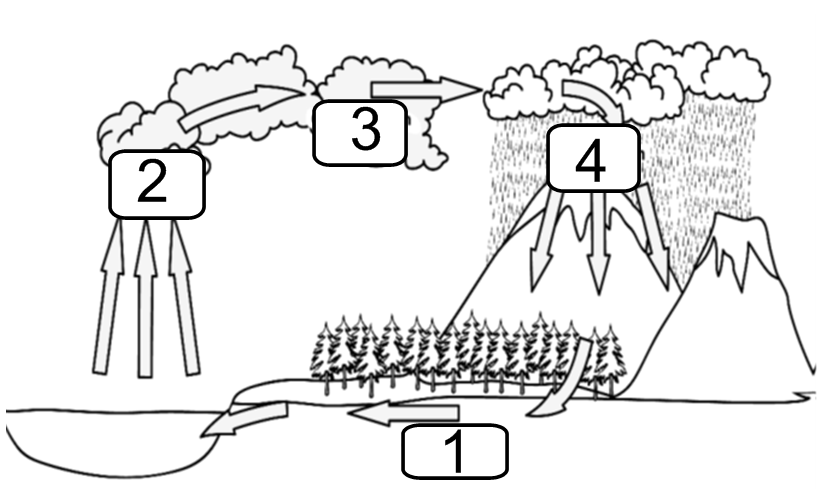
Which stage does the number 2 show in the diagram?
Condensation
Evaporation
Precipitation
Run off

Which stage does the number 3 show in the diagram?
condensation
evaporation
precipitation
run off
An underground layer of sand, gravel, or rock that stores and carries water is called?
Water table
Water cycle
Aquifer
Infiltration

