Wayground logo

Free Printable Worksheets

Font size

S
M
L
XL
Worksheets

Cell Membrane and Transport

Total questions: 48

Worksheet time: 3570secs

Name
Class
Date
1.
What is NOT TRUE about the cell membrane?
a)
It controls what enters and leaves the cell
b)
Semipermeable
c)
Phospholipid bilayer
d)
Contains digestive enzymes
2.
What does "bilayer" mean?
a)
one layer
b)
two layers
c)
laminated
d)
bilateral
3.
What is embedded in the phospholipid bilayer?
a)
Proteins
b)
Salt
c)
Water
d)
Worms
4.
What forms the channels and pumps in the phospholipid bilayer?
a)
Carbohydrates
b)
Proteins
c)
Hydrophilic heads 
d)
Lipids
5.
True or False:  Regulating what enters and leaves the cell helps the cell maintain homeostasis. 
a)
True
b)
False
6.
Hydrophilic means...
a)
water-loving
b)
water-fearing
c)
nonpolar
d)
lipid soluble
7.
Hydrophobic region of the cell membrane?
a)
E
b)
B
c)
C
d)
A 
8.
Hydrophilic portion of cell membrane?
a)
A
b)
C
c)
D
d)
E 
9.
What does a cell need to transport particles by active transport?
a)
Sun
b)
Wind
c)
Energy
d)
Channels
10.
What does the "fluid mosaic model" mean about the cell membrane?
a)
It can dissolve into fluid.
b)
The cell is mostly made of mosaic molecules.
c)
It looks like a flexible pattern made up of different parts.
d)
Somebody else should name these things.
11.
What is a bad description of the cell membrane?
a)
Selectively permeable
b)
Fluid Mosaic Model
c)
Solid Barrier
d)
Lipid Bilayer
12.
Osmosis uses a channel protein called AQUAPORIN.  What type of transport is this? *Think!
a)
Diffusion
b)
Facilitated Diffusion
c)
Active Transport
d)
Endocytosis
13.
What is one major difference between passive and active transport?
a)
Passive transport uses energy; active transport does not.
b)
Both types of transport use energy.
c)
Active transport uses energy; passive transport does not.
d)
No difference. They are both the same.
14.
Small, non-polar molecules like CO2 and O2 and NO can pass through the cell membrane using what type of transport?
a)
Diffusion
b)
Osmosis
c)
Facilitated Diffusion
d)
Endocytosis
15.
A phospholipid has 2 parts. What are they called? 
a)
Hydrophilic Head, Hydrophobic Tail 
b)
Hydrophobic Head, Hydrophilic Tail 
16.
Describes the arrangement of the cell membrane as bendable and made of many parts. 
a)
The Fluid Mosaic Model 
b)
The Major Mobility Model 
c)
The Crazy Cell Model
d)
The Maze Model
17.
Something is ___________ ____________
when some molecules can cross the membrane while others cannot. 
a)
Selectively (or Semi) Permeable 
b)
Totally Transparent
c)
Liquid Licorice 
d)
Heavily Patrolled 
18.
How does a cell maintain homeostasis?
a)
Regulates what enters and leaves the cell
b)
Flexibility
c)
Protective barrier
d)
Structure and support
19.
Which of the following is NOT part of the cell membrane?
a)
Lipids
b)
Carbs
c)
Proteins
d)
Nucleic Acids
20.
What is diffusion?
a)
when molecules move 
b)
when molecules move from a high concentration to a low.
c)
no movement 
d)
molecules move everywhere
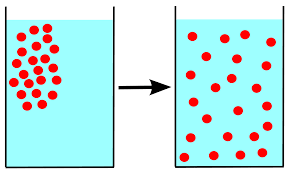
21.
The picture below is an example of _________________.
a)
osmosis
b)
isotonic
c)
diffusion
d)
active transport
22.
Osmosis is the movement of _____ across a membrane.
a)
food
b)
energy
c)
oxygen
d)
water
23.
When both inside and outside of a cell have the same amount of water it is said that the cell has reached a state of
a)
Osmosis
b)
Diffusion
c)
Equilibrium
24.
A person should never drink salty water because their cells would
a)
shrink
b)
expand
25.
If there is 5 percent water inside a cell and 5 percent water outside a cell
a)
more water will move inside the cell
b)
more water will move outside the cell
c)
There will be no movement of water cells
26.
Passive transport requires no
a)
concentration gradients
b)
osmosis
c)
motion
d)
energy
27.
An animal cell placed in a hypertonic (salty) solution will
a)
Shrink
b)
Swell
c)
Stay the same
28.
Ideally, your cells should be in a(n) _______ solution
a)
Hypertonic
b)
Hypotonic
c)
Isotonic
d)
Cola
29.

Where will the water go?

a)

Into the cell

b)

Out of the cell

c)

Equally in & out - it's isotonic

d)

There is no water

30.

A blood cell is placed into the jar, as seen. Where will the water go?

a)

Into the cell

b)

Out of the cell

c)

Equally in & out - it's isotonic

d)

The water is a lie

31.

HYPO means...

a)

Low

b)

High

c)

Equal

d)

Fat

32.

ISO means...

a)

Low

b)

A lot

c)

Equal

d)

Mammal

33.

Why can't you drink salt water?

a)

It's hypertonic to your cells

b)

It's hypotonic to your cells

c)

It's isotonic to your cells

d)

It's paratonic to your cells

34.
 An animal cell placed in a hypertonic (salty) solution will
a)
Stay the same
b)
Shrink- get smaller
c)
Swell- get bigger
35.
The picture  is an example of _________________.
a)
isotonic
b)
diffusion
c)
osmosis
d)
active transport
36.
In this given scenario, corn syrup is hypertonic to an egg with a dissolved shell. What will happen to the egg when it is place in corn syrup?
a)
It will stay the same.
b)
It will swell- get bigger.
c)
It will shrink- get smaller.
37.
If you looked at red blood cells under a microscope and saw the blood cells exploded, what would you say happened?
a)
The cells were placed in a hypotonic solution.
b)
the solution was isotonic.
c)
The solution was hypertonic.
38.
 If a cell containing 5% salt is placed into a glass of water with 20% salt, the water is _______ compared to the cell.
a)
hypertonic-
b)
hypotonic
c)
isotonic
39.
Both side of a selectively- permeable membrane are equal. The sides are ______.
a)
isotonic
b)
hypertonic
c)
hypotonic
40.

Optimal osmostic solution for plant cells.

a)

hypotonic

b)

isotonic

c)

hypertonic

d)

none

41.

Term for an animal cell in a hypotonic solution.

a)

crenation

b)

playsmolysis

c)

turgid

d)

wilted

42.

Term for an animal cell in a hypertonic solution.

a)

crenation

b)

plasmolysis

c)

turgid

d)

wilted

43.

Term for a plant cell in a hypotonic solution.

a)

crenation

b)

plasmolysis

c)

turgid

d)

wilted

44.

Term for a plant cell in a hypertonic solution.

a)

turgid

b)

wilted

c)

crenation

d)

plasmolysis

45.

After oral surgery, the dentist tells you to gargle with warm salt water. What type of solution does this represent?

a)

hypertonic

b)

hypotonic

c)

isotonic

46.

After oral surgery, the dentist tells you to gargle with warm salt water. What effect does this have on your cells?

a)

water leaves the cell and swelling decreases

b)

water enters the cells and they explode

c)

no effect

d)

it kills germs

47.

A salt water fish is placed in an aquarium of fresh water. What type of solution does this represent?

a)

hypotonic

b)

hypertonic

c)

isotonic

48.

A salt water fish is placed in an aquarium of fresh water. What effect will this have on the fish?

a)

water will exit the cells and they will shrivel

b)

water will enter the cells and they will eventually explode

c)

salt will enter the cells

d)

salt will exit the cells