
 Worksheets
Work Power Energy
Total questions: 62
Worksheet time: 55mins
This theorem states, "Whenever work is done, energy changes.
Work-Energy Theorem
Paul-Newman Theorem
Action-Reaction Theorem
Study-Now Theorem
Which statement illustrates work done?
A weightlifter holds a barbell above her head.
A teacher applies a force to a wall and becomes exhausted.
A rolling marble hits a note card and moves it across a table.
A waiter carries a tray full of meals across a dining room at a constant speed.

What is the energy possessed by the cart?
potential energy
kinetic energy
mostly potential
mostly kinetic

How will you describe the energy at Point A?
mostly potential energy
mostly kinetic energy
losing PE, gaining KE
losing KE, gaining PE
If you lift a box that is twice as heavy as your friend you are doing
the same amount of work.
two times more work than your friend.
half as much work as your friend.
Cannot be determined.
You push a crate with a force of 100 N for 5 meters. How much work did you do?
500 J
100 J
50 J
5 J

Work is done only if
a force is applied.
the force applied causes the object's motion.
an object is in motion.

If it took 9 seconds for the object to move 6 meters, what's the power?
81 W
27 W
3 W
6 W
On a force versus change in position graph, the area under the curve is a representation of:
force
position
KE
PE
Work
A waiter carries a tray full of meals above his head by one arm straight across the room at constant speed.

Which of these items is not part of the law of conservation of energy?
energy cannot be created
energy cannot be destroyed
energy can be transferred between forms
energy is destroyed by friction
Where is the kinetic energy of pendulum at its highest?
at the top of the swing
at the bottom of the swing
at 1/4 of the swing
at 3/4 of the swing
Two workers use 100 N of force to move a sofa 2 meters in 2 seconds. How much power is required?
100 watts
400 watts
104 watts
50 watts

Two equal mass marbles are at the top of a ramp. One marble falls to the ground off the back while the other rolls down the ramp. What is true about the marbles when they reach the ground?
The marble that rolled down the ramp is moving faster than the marble that fell.
The marble that fell down the back of the ramp is moving faster than the marble that rolled.
The marble that rolled down the ramp is not moving when it reaches the ground.
The two marbles are moving with the same speed.

Suppose a cart has a kinetic energy of 0.5 J. If you add enough mass to double the mass and make the cart go three times as fast, its kinetic energy is now ---.
6 J
3 J
18 J
9 J

A crane lifts an 8-m long steel girder weighing 2600 N up 15 m off the ground. The crane did ___ of work.
0 J
39000 J
20800 J
2600 J

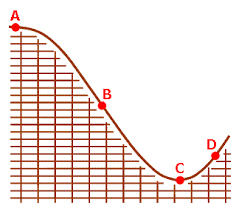
If there is no friction on this track, at which point would the coaster have the most kinetic energy?
A
B
C
D
A 40-kg person is climbing 3 m up a flight of stairs in 6 seconds. How much power did they exert climbing the stairs?
400 W
1200 W
200 W
120 W
If a 1300-kg car has been lifted so it has 19500 J of potential energy, it was lifted up ---.
1.5 m
150 m
15 m
0.67 m

A block slides down a ramp at constant speed of 6 m/s. Which force does a positive value of work?
Fn
Fg
Ff
Fa

Four students run up the stairs in the time shown. Which student has the largest power output?
A
B
C
D
A basketball that is dropped bounces back up to its original height. Pick the correct energy transformation from the point when it was dropped until it returns to the original height.
KE --> PE --> Elastic
PE --> KE --> Elastic --> KE --> PE
KE --> PE --> Elastic --> PE --> KE
Elastic --> PE --> KE --> Elastic
What is the power of the engine when the velocity of the car is v, mass m, acceleration a, and external resistance R
(R-ma)v
(R+ma)v
mav
Rv
What is the ratio of velocities of a nucleus that splits into two parts with radii 1:2
6:1
2:1
8:1
4:1
A force acting on an object does no work if
a machine is used to move the object.
the force does not cause the object to move.
the force is greater than the force of friction.
the object accelerates.
Which of the following statements is true according to the law of conservation of energy?
Energy cannot be created.
Energy cannot be destroyed.
Energy can be converted from one form to another.
all of these
Work can still be done even if there is no energy.
TRUE
FALSE
Work is a product of the force and displacement in the direction of force.
TRUE
FALSE
A force F at an angle θ above the horizontal is used to pull a heavy suitcase of weight mg a distance d along a level floor at constant velocity. The coefficient of friction between the floor and the suitcase is µ. The work done by the frictional force is:
– µFdcosθ
–Fdcosθ
–µmgd
–µmgdcosθ
A 2 kg ball is attached to a 0.80 m string and whirled in a horizontal circle at a constant speed of 6 m/s. The work done on the ball during each revolution is:
90J
72J
16J
0

A pendulum bob of mass m on a cord of length L is pulled sideways until the cord makes an angle θ with the vertical as shown in the figure to the right. The change in potential energy of the bob during the displacement is:
mgL(1–cos θ)
mgL(1–sin θ)
mgLsinθ
mgLcosθ
A softball player catches a ball of mass m, which is moving towards her with horizontal speed V. While bringing the ball to rest, her hand moved back a distance d. Assuming constant deceleration, the horizontal force exerted on the ball by the hand is:
2dmv2
dmv2
d2mv
dmv
A football is kicked off the ground a distance of 50 yards downfield. Neglecting air resistance, which of the following statements would be INCORRECT when the football reaches the highest point?
All of the balls original kinetic energy has been changed into potential energy.
The ball’s horizontal velocity is the same as when it left the kickers foot.
The ball will have been in the air one-half of its total flight time.
The vertical component of the velocity is equal to zero.
A fan blows the air and gives it kinetic energy. An hour after the fan has been turned off, what has happened to the kinetic energy of the air?
It disappears.
It turns into potential energy.
It turns into thermal energy.
It turns into sound energy.
Suppose a cart has a kinetic energy of 0.5 J. If you add enough mass to double the mass and make the cart go three times as fast, its kinetic energy is now ---.
6 J
3 J
18 J
9 J

A crane carries an 8-m long steel girder weighing 2600 N out 12 m to the end of the crane. The crane did ___ of work.
0 J
2600 J
20800 J
31200 J
Kinetic energy is associated with ---.
speed
position
direction
temperature

A block starts at rest at point P at the top of a ramp which is height h above the ground. The block slides down one side and up the other, stopping at a point less than h above the ground.
The block did not go as high on the other side because gravity pulls down.
The block did not go as high on the other side because potential energy always has to decrease.
The block did not go as high on the other side because work from friction made the mechanical energy less.
The situation as described is impossible to happen.
If there is no friction on this track, at which point would the coaster have the most kinetic energy?
A
B
C
D
How does conservation of energy explain why something that is falling should speed up?
It gains kinetic energy because it gains potential energy.
It loses kinetic energy because no work was done on it.
It gains kinetic energy because it loses potential energy.
It loses kinetic energy because the Earth gains potential energy.
A waiter carries a tray full of meals above his head by one arm straight across the room at constant speed.

