wayground logo

Free Printable Worksheets

NEW

Font size

S
M
L
XL
Worksheets

Chem Midterm Review

Total questions: 78

Worksheet time: 2hrs 23mins

Name
Class
Date
1.
5000 millimeters = ____ meters
a)
5
b)
50
c)
500
d)
25
2.
1800 milligrams = ___ grams
a)
1.8
b)
18
c)
180
d)
.18
3.

If I increase the amount of fertilizer a bean plant receives, the plant will grow taller.

a)

Hypothesis

b)

Theory

c)

Law

4.

How close a measurement is to the accepted value is called..

a)

Accuracy

b)

Precision

c)

Significant

d)

Estimate

5.
A set of data are all close to each other, and they are close to the actual value.  This set of data can be described as...
a)
accurate
b)
precise
c)
both precise and accurate
6.

What is the atomic number?

a)

the number of protons in the nucleus

b)

the number of protons and neutrons in the nucleus

c)

the number of neutrons in the nucleus

d)

the number of protons in the energy levels

7.

What is the mass number?

a)

the number of protons in the nucleus

b)

the number of protons and neutrons in the nucleus

c)

the number of neutrons in the nucleus

d)

the number of protons and electrons in the atom

8.

An atom has 10 protons, 15 neutrons and 10 electrons what is its mass number.

a)

20

b)

10

c)

35

d)

25

9.
If an atom has 12 positively charged subatomic particles, which of the following must it also have to be considered a neutral atom?
a)
12 neutrons
b)
12 electrons
c)
12 protons
d)
24 protons and neutrons
10.
How many neutrons does the isotope below have?     89 36Kr
a)
53
b)
36
c)
89
d)
125
11.
How many electrons are in an atom that has an atomic number of 34, an atomic mass of 74 and a charge of -2?
a)
34
b)
36
c)
2
d)
40
12.
If X is the symbol for an element, which of the following two symbols represent    isotopes of the same element?     I. 7735X  II. 7733X  III. 8137X  IV. 8135 X
a)
I and II
b)
III and IV
c)
I and IV
d)
I and III
13.

Anions are ions with a negative charge because they-

a)

gain electrons

b)

lose electrons

14.

Cations are ions with a positive charge because they-

a)

gain electrons

b)

lose electrons

15.
Which type of nuclear radiation is being emitted here?
a)
Alpha
b)
beta
c)
gamma 
d)
none
16.
If Gadolinium-150 goes through alpha decay, the resulting element has a new atomic mass of _____.
a)
150
b)
148
c)
146
17.
What is the symbol for an alpha particle?
a)
42He
b)
0-1e
c)
0+1 e
d)
10n
18.
Type of radiation that requires thick layers of concrete or lead in order to be stopped
a)
Gamma
b)
They are equal
c)
Beta
d)
Alpha
19.
The splitting of a nucleus into smaller nuclei is
a)
fusion
b)
fission
c)
decay
d)
gamma radiation
20.
Two or more nuclei combine to form one larger nucleus in the process of nuclear _____.
a)
Fusion
b)
Fission
c)
Tracing
d)
Decay
21.
If 10 mg of iodine 131 is given to a patient, how much is left after 24 days? The half-life of iodine-131 is 8 days.
a)
1.25mg
b)
1.25g
c)
10g
d)
10mg
22.
The half-life of strontium-90 is 25 years. How much strontium-90 will remain after 100 years if the initial amount is 4.0 g?
a)
3.0g
b)
0.25mg
c)
0.3g
d)
0.25g
23.
After 4 half-lives, 1g of a sample of Krypton-85 remains unchanged.  What was the original mass of the sample?
a)
16g
b)
32g
c)
0.0625g
d)
4g
24.
Which is the electron configuration for an oxygen atom?
a)
1s22s22p63s23p64s2
b)
1s22s22p4
c)
1s22s22p6
d)
1s22s22p63s23p6
25.
What atom matches this electron configuration?
1s2s2p3s2
a)
Neon
b)
Magnesium
c)
Aluminum
d)
Potassium
26.
What is the maximum number of electrons that an orbital can have?
a)
1 electron
b)
2 electrons
c)
3 electrons
d)
4 electrons
27.
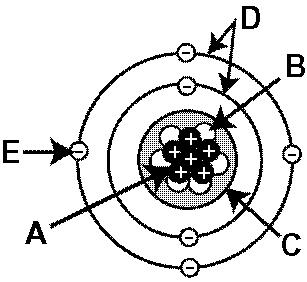
In the atom diagram shown, E is pointing to
a)
An electron
b)
a proton
c)
a neutron
d)
the nucleus
28.
Which of the following is found in the nucleus of an atom?
a)
electrons
b)
neutrons
c)
The center of an atom, composed of protons and neutrons
d)
molecules
29.

What quantities vary between isotopes of an element?

a)

protons, electrons, and atomic mass

b)

protons, electrons, and atomic number

c)

neutrons and electrons

d)

neutrons and atomic mass

30.
Which of the following will have a larger radius than Zinc?
a)
Gallium
b)
Aluminum
c)
Magnesium
d)
Strontium
31.
Which of the following will have a higher electronegativity than arsenic (As)?
a)
Carbon (C)
b)
Neon (Ne)
c)
Antimony (Sb)
d)
Germanium (Ge)
32.
Which atom has the largest atomic radius?
a)
potassium
b)
rubidium 
c)
francium
d)
cesium
33.
What is this element? 
1s22s22p63s23p6
4s23d104p6
a)
Argon
b)
Krypton
c)
Selenium
d)
Bromide
34.
What atom matches this electron configuration?
[Xe] 6s2 4f14 5d9
a)
Mercury
b)
Gold
c)
Platinum
d)
Thallium
35.
If an atom has 4 protons, how many valence electrons will it have?
a)
4
b)
6
c)
2
d)
0
36.
How many neutrons does the isotope below have?     89 36Kr
a)
53
b)
36
c)
89
d)
125
37.
24.1% of all the isotopes of a an element have a mass of 75.23 amu, 48.7% have a mass of 74.61 amu, and 27.2% have a mass of 75.20 amu.
What is the average mass of this element?
a)
74.92 amu
b)
24.97 amu
c)
75.01 amu
d)
74.51 amu
38.
What is the charge on the calcium ion?
a)
1+
b)
2+
c)
2-
d)
1-
39.
Which is a transition metal?
a)
cesium
b)
iron
c)
helium
d)
tellurium
40.
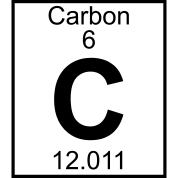
What does the 6 represent?
a)
atomic mass
b)
atomic number
c)
element name
d)
chemical symbol 
41.
What does 12.011 represent?
a)
atomic mass
b)
atomic number
c)
element name
d)
chemical symbol 
42.
What element is will have the most similar physical and chemical properties to the element Lithium (Li)?
a)
Sodium (Na)
b)
Magnesium (Mg)
c)
Beryllium (Be)
d)
Calcium (Ca)
43.
Groups on the periodic table are __________.
a)
Horizontal Rows
b)
Vertical Columns
44.
Periods on the periodic table are __________.
a)
Horizontal Rows
b)
Vertical Columns
45.

Which color on the image of the periodic table corresponds with the halogens.

a)

red

b)

black

c)

blue

d)

orange

46.

Which color on the image of the periodic table corresponds with the lanthanides.

a)

red

b)

black

c)

blue

d)

orange

47.

Which of the following elements is a non-metal in group 14?

a)

Carbon (C)

b)

Silicon (Si)

c)

Tin (Sn)

d)

Lead (Pb)

48.

Which pair of elements would most likely have similar properties?

a)

Calcium (Ca) and cobalt (Co)

b)

sodium (Na) and chlorine (Cl)

c)

boron (B) and phosphorus (P)

d)

oxygen (O) and sulfur (S)

49.

Which two elements are in the same period?

a)

boron (B) and lithium (Li)

b)

beryllium (Be) and calcium (Ca)

c)

phosphorus (P) and oxygen(O)

d)

boron (B) and phosphorus (P)

50.

Metals are located on the

________ side of the

Periodic Table.

a)

ZIG-ZAG

b)

LEFT

c)

RIGHT

d)

BOTTOM

51.
_______________ is the process by which unstable atoms emit radiation until they become stable.
a)
Radiation
b)
Chemical Reaction
c)
Radioactive Decay
d)
Isotopes
52.
What type of decay is shown here
a)
alpha decay
b)
beta decay
c)
gamma decay
53.
a)
2
b)
8
c)
3
d)
13
54.
Valence electrons are the...
a)
Innermost electrons
b)
Middle electrons
c)
Outermost electrons
d)
Any electrons
55.

USE THE PERIODIC TABLE

How many valence electrons does sodium have?

a)

1

b)

2

c)

3

d)

4

56.

USE THE PERIODIC TABLE

How many valence electrons does Phosphorus have?

a)

31

b)

5

c)

15

d)

4

57.
Which has the LONGEST wavelength and, therefore, the lowest frequency/energy
a)
Gamma Rays
b)
Radio Waves
c)
Visible Light
d)
Infrared rays
58.
Which has the SHORTEST wavelength and, therefore, the highest frequency/most energy
a)
Radio waves
b)
Ultraviolet Rays
c)
Gamma Rays
d)
X-rays
59.
A wave with a large wavelength will have a ______ frequency and _____ energy
a)
high, low
b)
high, high
c)
low, high
d)
low, low
60.
What is a photon?
a)
When radiation burst through electric waves
b)
The emission of electrons from a metal caused by light striking the metal
c)
The rate at which a waves energy flows through a given unit of area.
d)
packets of electromagnetic energy
61.
What happens to the energy of a photon as the frequency of the wave increases? 
a)
The energy increases
b)
The energy decreases
c)
The energy stays the same 
62.
For an electron to change from ground state to an excited stated it must...
a)
Absorb energy
b)
Release energy
63.

True or False: The ground state is the highest energy state of an atom.

a)

True

b)

False

64.

If an electron moves from n = 5 to n = 3, what type of light is emitted?

a)

ultraviolet light

b)

blue visible light

c)

violet visible light

d)

infrared light

65.
Diagram below shows
a)
Emission spectrum
b)
Absorption spectrum
c)
Line emission spectrum
d)
Line absorption spectrum
66.
Line emission spectrum shown below happens when
a)
Electron transition from lower to higher energy level.
b)
Electron transition from higher to lower energy level.
c)
Electron exist in fixed energy states
d)
Electron transition between different energy levels.
67.

Which model of the atom said that electrons circle the nucleus in orbits of a fixed radius?

a)

Bohr's model

b)

Thomson's plum pudding

c)

Rutherford's nuclear model

d)

Both Thomson's and Rutherford's model

68.

A particle of light is called a...

a)

Photoelectron

b)

Photon

c)

Proton

d)

Electron

69.
Absorption of energy by an electron results in 
a)
it moving from the ground to an excited state
b)
it moving from an excited to the ground state
c)
the emission of a photon
d)
it moving from an excited to the ground state and the emission of a photon
70.

The color of emitted light with the LONGEST wavelength is

a)

violet

b)

green

c)

red

d)

indigo

71.

The color of emitted light with the SHORTEST wavelength is

a)

violet

b)

green

c)

red

d)

indigo

72.
The wave-particle duality of light describes light as...
a)
a wave only
b)
a particle only
c)
both a wave and a particle
d)
neither a wave nor a particle
73.

Light is emitted when electrons ...

a)

return from high energy state to low energy state

b)

jump from low energy state to high energy state

c)

either of these

d)

none of these

74.

When atoms _____________ energy, their electrons move to higher energy levels. These electrons _____________ energy by emitting light when they return to lower energy levels.

a)

lose, absorb

b)

absorb, lose

c)

lose, lose

d)

absorb, absorb

75.
What gases are in the unknown mixture?
a)
Gas B & Gas D
b)
Gas C & Gas B
c)
Gas A & Gas D
d)
Gas D & Gas C
76.

What is the lowest most stable energy level?

a)

ground state

b)

high state

c)

lowest energy level

d)

Atomic Emission Spectrum

77.
What types of particles are found in the cloud surrounding the atom's nucleus?
a)
Positively charged particles and negatively charged particles
b)
Negatively charged particles only
c)
Neutral particles and positively charged particles
d)
Positively charged particles only
78.

Diagram below shows

a)

Continuous spectrum

b)

Absorption spectrum

c)

Emission Line spectrum

d)

Absorption Line spectrum