wayground logo

Free Printable Worksheets

Font size

S
M
L
XL
Worksheets

Science 8: Unit 2 Final Practice

Total questions: 70

Worksheet time: 1hrs 8mins

Name
Class
Date
1.

To change from one state of matter to another state of matter is called?

a)

phase change

b)

potential change

c)

kinetic change

d)

thermal change

2.

How much space particles take up is called?

a)

Density

b)

Volume

c)

Mass

d)

Weight

3.

How close together particles are is called?

a)

Mass

b)

Weight

c)

Vibrate

d)

Density

4.

Mass is _______________.

a)

how much matter is in a object

b)

a measurement

c)

how had gravity pulls on an object

d)

how much volume is in an object

5.
At higher temperatures
a)
particles in an object have less energy
b)
particles in an object move faster
c)
a gas contracts
6.
A gas
a)
has a definite shape but no definite volume
b)
has a definite volume but no definite shape
c)
has fast-moving particles
7.
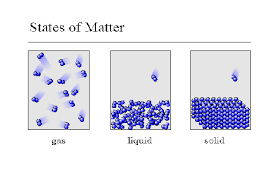
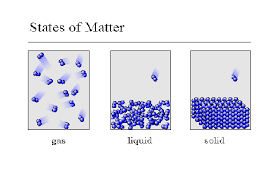
Which state of matter has a definite shape?
a)
solid
b)
liquid
c)
gas
8.

What is happening when my ice cream changes from a solid to a liquid?

a)

freezing

b)

melting

c)

burning

9.

Particles in a ______________________ move quickly and are far apart.

a)

gas

b)

solid

c)

liquid

10.

Particles of a liquid

a)

are tightly packed together and stay in a fixed position.

b)

are free to move around one another but still touch.

11.

The slower the particles in a substance move,

a)

the colder it is.

b)

the warmer it is.

c)

the more energy it has.

12.
The temperature of a substance increases as___.
a)
the substance expands
b)
the average kinetic energy of its particles increases
c)
the substance's volume increases
d)
the substance's mass increases
13.

Definite shape and definite volume

a)

Solid

b)

Liquid

c)

Gas

14.

According to the Kinetic Molecular Theory a liquid's (SELECT ALL THAT APPLY)

a)

particles are held close together by intermolecular forces

b)

particles are in constant motion

c)

particles are vibrating in place and closely packed

d)

particles are not moving

15.

Water is "sticky" because...

a)

of cohesion.

b)

of adhesion.

c)

of the attraction between the positively charged hydrogen atoms and the negatively charged oxygen atom.

d)

of capillary action.

16.

Why does ice float on liquid water?

a)

Ice does not float on liquid water.

b)

It has a higher density than liquid water.

c)

It floats because it has lower density than liquid water.

d)

adhesion and cohesion

17.

Which of the following is not a physical property of gases?

a)

absence of definite volume

b)

large density

c)

high compressibility

d)

fluidity

18.

Phase of matter where particles are held in place by intermolecular forces

a)

Plasma

b)

Solid

c)

Liquid

d)

Gas

19.

Phase of matter where particles move around each other while being slightly attracted to each other through intermolecular forces

a)

Plasma

b)

Solid

c)

Liquid

d)

Gas

20.

Pressure is caused by:

a)

Gas molecules colliding with surfaces

b)

Gas molecules reacting with each other

c)

Gas molecules colliding with each other

d)

Gravity

21.

In this phase of matter, particles do NOT stop moving. Instead they vibrate in place

a)

Plasma

b)

Solid

c)

Liquid

d)

Gas

22.
He developed the planetary model of the atom.
a)
Rutherford
b)
Bohr
c)
Chadwick
d)
Dalton
23.
James Chadwick discovered the ________.
a)
proton
b)
neutron
c)
electron
d)
nucleus
24.

Subatomic particles with a negative charge

a)

Electrons

b)

Neutrons

c)

Protons

d)

Quarks

25.
Subatomic particles that are neutral in charge
a)
Neutrons
b)
Protons
c)
Nucleus 
d)
Electrons
26.
Subatomic particles with a positive charge
a)
neutrons
b)
atomic mass
c)
protons
d)
isotopes
27.
A tiny but very dense, positively charged portion of the atom that holds most of the atomic mass
a)
Electron Shells
b)
Orbitals
c)
Electron Cloud
d)
Nucleus
28.
The scientist responsible for "discovering" the nucleus is:
a)
Bohr
b)
Rutherford
c)
Schroedinger
d)
Einstein
29.

What is the basic particle that makes up an element?

a)

Atom

b)

Cell

30.

Which of the following is not true about a pool of water and a piece of ice

a)

They have different chemical properties

b)

They have the same composition

c)

They have different states of matter

d)

They have different physical properties.

31.

The ability of iron to rust is a(n) ________ property.

a)

Chemical

b)

Physical

32.

A substance can be classified by its _____ properties, which are properties that can be observed without changing it into another substance.

a)

Physical

b)

Chemical

33.

Characteristics used to describe matter are called _________.

a)

Both physical and chemical properties

b)

Physical properties

c)

Chemical Properties

d)

Neither physical and chemical properties

34.

A(n) ______________________ is a kind of matter that has more than one specific composition within it.

a)

homogenous mixture

b)

compound

c)

state

d)

heterogenous mixture

35.

What does WHMIS stand for ?

a)

Workplace hazardous materials information system

b)

walking ham matter information system

c)

work help math information system

d)

welch hungry materials in snacks

e)

information helping hands matter system

36.

What safety Symbol is this?

a)

Flamable

b)

Oxidizing

c)

No Open Flame

d)

Explosion

37.

The following symbol is for ...

a)

Biohazardous materials

b)

Compressed gas

c)

Corrosion

d)

Dangerously reactive material

38.
What does this GHS symbol means?
a)
Radioactive
b)
Carcinogenicity/ Aspiration Hazard
c)
Acute Toxicity
d)
Explosive
39.
Which of these symbols means: Explosion or reactivity hazard?
a)
Top right
b)
Top left
c)
Bottom right
d)
Bottom left
40.
A chemical reaction is balanced when
a)
both sides have the same elements
b)
Both sides have the same  number of atoms
c)
Same subscripts
d)
Same coefficients
41.
If reaction starts with 20g of reactants it should produce 
a)
a total of 40g of products
b)
a total of 10g of products
c)
a total of 80 g of products
d)
a total of 20g of products
42.
In a reaction A + B ----> C,  reactant A has 5g and product  C has 9g. How many grams does reactant B should have? 
a)
4g
b)
5g
c)
9g
d)
14g
43.
What will weigh more when a chemical change is complete?  The reactants before the chemical reaction, or the product after the reaction is complete?
a)
They both will weigh the same
b)
The product always weighs more than the reactant
c)
The reactant will weigh more than the product
d)
They both will loose mass after the reaction
44.
Properties that describe how a substance looks, feels, state of matter, etc. are?
a)
Chemical properties
b)
Physical properties
45.
What does a chemical change result in?
a)
A phase change in the substance (ex. liquid to solid)
b)
A change in texture of the substance.
c)
A change in the way atoms are bonded to each other.
d)
A change in the way atoms are arranged in space.
46.
A statue damaged by acid rain is a chemical change.
a)
True
b)
False
47.
A baby gaining weight is an example of a _________ change.
a)
Chemical
b)
Physical
c)
Both
48.
Does the following represent a chemical or physical change?
a)
Chemical
b)
Physical
c)
Both
49.

A piece of tin has a mass of 16.52 g and a volume of 2.26 cm3. What is the density of tin?

Hint: density = mass/volume

a)

7.3 g/cm3

b)

37.3 g/cm3

c)

7.3 cm3/g

d)

37.3 cm3/g

50.
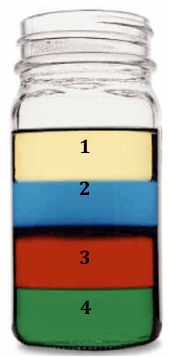
Put the liquids in order from most dense to least dense?
a)
4, 3, 2, 1
b)
1, 2, 3, 4
c)
3, 4, 2, 1, 
d)
4, 3, 1, 2
51.
Why do objects sink or float in H2O
a)
Because their densities are higher or lower than compared to water
b)
Because their densities are using gravity to pull down
c)
Because their densities are heavier or lighter
d)
Because their mass and volumes are equal 
52.
Mercury is a metal that is liquid at room temperature and has a density of 13.5 g/cm3.  Which of these metals would sink below the mercury if dropped into a container of mercury?
a)
gold (density=19.3 g/cm3)
b)
lead (density=11.4 g/cm3)
c)
iron (density=7.9g/cm3)
d)
aluminum (density=2.7g/cm3)
53.
This variable in an experiment is the one being changed by the scientist. 
a)
dependent variable
b)
independent variable
c)
data
d)
control group
54.
If you increase the amount of spinach you eat, then you will increase the iron in your blood. 
What's the dependent variable?
a)
increase the amount of iron in your blood
b)
spinach you eat
55.
Will a construction paper air plane fly faster than an airplane made from notebook paper? Choose the best hypothesis.
a)
If I make a paper airplane from notebook paper, then it will fly faster than construction paper.
b)
Yes.
c)
No.
d)
I think the construction paper air plane will fly faster.
56.
If I ride my bike to school instead of walking, then I will get to school faster. What is the dependent variable?
a)
True
b)
How fast you get to school
c)
Riding a bike or walking
d)
False
57.
This is the group that we will compare our experimental group to. This group stays "normal."
a)
Control Group
b)
Experimental Group
c)
 Normal Group
d)
Weird Group
58.
True or False: Your hypothesis can never be wrong.
a)
True
b)
False
59.
In a controlled experiment, how many variables can be worked with at a time? 
a)
one
b)
none
c)
two or more
d)
how ever many makes sense.
60.
John Dalton stated:
a)
elements are made of atoms
b)
atoms of a given element are identical
c)
atoms cannot be subdivided, created, nor destroyed
d)
all of the above
61.
What does the nucleus of an atom contain?
a)
Electrons and neutrons
b)
Protons and neutrons
c)
Neutrinos and positrons
d)
DNA and RN
62.
True or False: The majority of an atom is made up of empty space
a)
True
b)
False
63.

Which of the following shows the correct order of Atomic Theory Timeline

a)

Rutherford, Bohr, Dalton, Democritus, Thomson

b)

Bohr, Democritus, Thomson, Rutherford, Dalton

c)

Dalton, Thomson, Rutherford, Bohr, Democritus

d)

Democritus, Dalton, Thomson, Rutherford, Bohr

64.

Which Scientist created this model

a)

Democritus

b)

Chadwick

c)

Bohr

d)

Rutherford

65.

Rutherford experimented with ____

a)

Gold foil and alpha particles

b)

Cathode rays and alpha particles

c)

electron and alpha particles

d)

gold foil and cathode rays

66.

What combination of quarks make up a proton?

a)

up, up, down

b)

down, down, up

c)

top, top, bottom

d)

strange, top, up

67.

What combination of quarks makes up a neutron?

a)

up, up, down

b)

down, down, up

c)

top, top, bottom

d)

strange, charm, top

68.

An electron is an example of a lepton. What categorizes a particle as being a lepton?

a)

Leptons are not influenced by the strong force (no strong interactions).

b)

Leptons are not influenced by electromagnetic force (no E&M interactions).

c)

Leptons are not influenced by the weak force.

d)

Leptons are made of quarks.

69.

What is the most famous lepton?

a)

muon

b)

up quark

c)

proton

d)

electron

70.

What exchange particle is responsible for the strong interaction?

a)

gluon

b)

photon

c)

Z-Boson

d)

Higgs Boson