Wayground logo

Free Printable Worksheets

Font size

S
M
L
XL
Worksheets

ATOMIC THEORY

Total questions: 65

Worksheet time: 3600secs

Name
Class
Date
1.

Subatomic particles with a negative charge

a)

Electrons

b)

Neutrons

c)

Protons

d)

Quarks

2.
subatomic particles found on the outermost shell & responsible for the atom's reactivity
a)
neutrons
b)
valence electrons
c)
isotopes
d)
ions
3.
Subatomic particles with a positive charge
a)
neutrons
b)
atomic mass
c)
protons
d)
isotopes
4.
The smallest particle of an element that shows all the properties of that element.
a)
Subatomic Particles
b)
Atom
c)
Quarks
d)
Gluons
5.
Where electrons are likely to be found as they travel around the nucleus
a)
Nucleus
b)
Electron Cloud
c)
Within a Proton
d)
Within a Neutron
6.
A tiny but very dense, positively charged portion of the atom that holds most of the atomic mass
a)
Electron Shells
b)
Orbitals
c)
Electron Cloud
d)
Nucleus
7.
Discovered the nucleus of the atom through the Gold Foil Experiment
a)
Rutherford
b)
Chadwick
c)
Thomson
d)
Dalton
8.
Proposed the Modern Electron Cloud Model of the atom
a)
Schrodinger & Heisenberg
b)
Dalton
c)
Chadwick
d)
Rutherford
9.
Discovered the electron within the atom
a)
Thomson
b)
Chadwick 
c)
Schrodinger & Heisenberg
d)
Dalton
10.
Created the Planetary Model of the atom
a)
Bohr
b)
Dalton
c)
Rutherford
d)
Chadwick
11.
Discovered the neutron within the atom
a)
Democritus
b)
Thomson
c)
Rutherford
d)
Chadwick
12.
Believed that atoms of the same element are identical to each other
a)
Bohr
b)
Rutherford
c)
Dalton
d)
Thomson
13.
Calculation used to find the number of neutrons in an atom
a)
Atomic Mass - Atomic Number
b)
Atomic Number - Atomic Mass
c)
Atomic Mass - Electrons
d)
none of these
14.
In an atom, electrons move in definite orbits around the nucleus.
a)
Thomson
b)
Rutherford
c)
Bohr
d)
Democritus
15.
What scientist is best known for his "Plum Pudding" model of the atom?
a)
J.J. Thomson
b)
Ernest Rutherford
c)
John Dalton
d)
Democritus
16.
What contribution did John Dalton make to atomic theory? 
a)
He discovered that every atom was positively charged. 
b)
He discovered that every element consisted of one type of atom that couldn't be divided. 
c)
He discovered that atoms had nuclei. 
d)
He discovered that atoms could be divided into smaller parts. 
17.
Place the following scientists in order, from earliest to latest: 
Rutherford, Dalton, Bohr, Thomson
a)
Dalton, Rutherford, Bohr, Thomson
b)
Thomson, Dalton, Rutherford, Bohr
c)
Dalton, Thomson, Rutherford, Bohr
d)
Bohr, Dalton, Rutherford, Thomson
18.
Rutherford's gold foil experiment provided evidence that...
a)
negative and positive charges are spread evenly throughout the atom.
b)
alpha particles have a positive charge.
c)
gold is not a dense as previously thought.
d)
there is a dense positively charged nucleus at the center of an atom.
19.
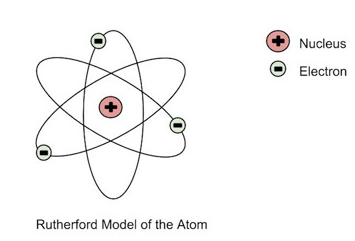
Who came up with the model of an atom pictured?
a)
J.J. Thompson
b)
Ernest Rutherford
c)
Neils Bohr
d)
James Chadwick
20.
The first person to propose a theory about an atom called the Atomos Theory was
a)
Democritus
b)
Rutherford
c)
Dalton
d)
Aristotle
21.
Who discovered the nucleus using the gold foil experiment?
a)
Democritus
b)
Robert Millikan
c)
James Chadwick
d)
Ernest Rutherford
22.
He discovered the electron using cathode ray tube experiment.
a)
Joseph Thomson
b)
John Dalton
c)
Ernest Rutherford
d)
Robert Millikan
23.
Who's model is this? 
a)
Millikan
b)
Rutherford
c)
Thomson
d)
Bohr
24.
Which scientist developed the atomic theory?
a)
JJ Thomson
b)
Ernest Rutherford
c)
John Dalton
d)
James Chadwick
25.
The Billiard Ball is the nickname for ________ theory.
a)
Dalton
b)
Neils Bohr
c)
JJ Thomson
d)
Ernest Rutherford
26.
What does this image represent?
a)
Billiard Ball Model
b)
Plum Pudding
c)
Gold Foil
d)
Solar System Model
27.
The Gold Foil experiment was done by __________.
a)
Chadwick
b)
Bohr
c)
Rutherford
d)
Thomson
28.
John Dalton stated:
a)
elements are made of atoms
b)
atoms of a given element are identical
c)
atoms cannot be subdivided, created, nor destroyed
d)
all of the above
29.
The scientist responsible for "discovering" the nucleus is:
a)
Bohr
b)
Rutherford
c)
Schroedinger
d)
Einstein
30.
The nucleus of an atom can be described as:
a)
spacious and negatively charged
b)
dense and positively charged
c)
spacious and positively charged
d)
dense and negatively charged
31.

How did Rutherford discover the nucleus?

a)

Cathode tube ray experiment

b)

Gold Foil Experiment

c)

Planetary Model

d)

Plum Pudding Model

32.
What does the nucleus of an atom contain?
a)
Electrons and neutrons
b)
Protons and neutrons
c)
Neutrinos and positrons
d)
DNA and RN
33.
True or False: The majority of an atom is made up of empty space
a)
True
b)
False
34.
What scientist is best known for his "Plum Pudding" model of the atom?
a)
J.J. Thomson
b)
Ernest Rutherford
c)
John Dalton
d)
Democritus
35.
What was the name of the model pictured behind this question?
a)
Oatmeal Model
b)
Rutherford Model
c)
Bohr Model
d)
Plumb Pudding Model
36.
What particle resides in the nucleus and has no charge?
a)
Proton
b)
Neutron
c)
Electron
d)
Crouton
37.
How did Rutherford describe the nucleus?
a)
Tiny
b)
Dense
c)
Positively Charged
d)
all of the above
38.
Which subatomic particle has a negative charge in the atom?
a)
proton
b)
neutron
c)
electron
d)
quark
39.
Most of the mass in an atom is made up of _____________________?
a)
protons and electrons
b)
protons and neutrons
c)
neutrons and electrons
d)
electrons and quarks
40.
The atomic number represents the identity of the ________________.
a)
mass of the atom
b)
element
c)
electrons
d)
isotopes
41.
What is the electrical charge of a proton?
a)
1+
b)
1-
c)
neutral
d)
2-
42.
Electrons have virtually no mass (weight).
a)
True
b)
False
43.
Which is an electron?
a)
A
b)
B
c)
C
44.
Which is a proton?
a)
A
b)
B
c)
C
45.
Which is a neutron?
a)
A
b)
B
c)
C
46.
Where are protons located in an atom?
a)
nucleus
b)
electron cloud
c)
neutron
d)
who knows?
47.

Place the following atomic models in order, from earliest to latest:


A) Rutherford B) Thomson C) Dalton

a)

B, C, A

b)

C, A, B

c)

A, C, B

d)

C, B, A

48.

Who named the positive center of the atom the "nucleus?"

a)

Democritus

b)

Dalton

c)

Thomson

d)

Rutherford

49.

Which scientists believed an atom was indivisible? (Choose all correct responses.)

a)

Democritus

b)

Dalton

c)

Thomson

d)

Rutherford

50.

Which scientist discovered that the atom has parts - which means it can be divided?

a)

Democritus

b)

Dalton

c)

Thomson

d)

Rutherford

51.

Which scientist first suggested that atoms could join?

a)

Democritus

b)

Dalton

c)

Thomson

d)

Rutherford

52.

Which scientist believed that elements differed from one another because their atoms had different mass?

a)

Democritus

b)

Dalton

c)

Thomson

d)

Rutherford

53.

Which scientist proposed a new atomic model after discovering the electron in 1897?

a)

Dalton

b)

Thomson

c)

Rutherford

d)

Bohr

54.

Who discovered that atoms are mostly empty space?

a)

Dalton

b)

Thomson

c)

Rutherford

d)

Bohr

55.

In the model nicknamed "the solar system model" what are the electrons like?

a)

the sun

b)

the nucleus

c)

the planets

d)

the moon

56.

A horizontal row of elements in the periodic table

a)

Molecule

b)

Period

c)

Family

d)

Atom

57.

The smallest particle of an element.

a)

Element

b)

Molecule

c)

Atom

58.

A substance that cannot be broken down into other substances by chemical or physical means.

a)

Covalent bond

b)

Atom

c)

Element

59.

Elements in the same vertical column of the periodic table; also called group

a)

Family

b)

Atom

c)

Element

d)

Metals

60.

What is the atomic number?

a)

35

b)

18

c)

17

d)

52

61.

How many protons and electrons does this element have?

a)

35

b)

18

c)

17

d)

52

62.

What is the atomic mass of Neon?

a)

10

b)

20

c)

30

63.

What is the atomic mass of Arsenic?

a)

33

b)

107

c)

75

64.

What would Au (Gold) be categorized as on the periodic table?

a)

Nonmetal

b)

Metal

c)

Transitional metal

d)

Noble gas

65.

What would He (Helium) be categorized as on the periodic table?

a)

Nonmetal

b)

Metal

c)

Noble gas

d)

Transitional metal